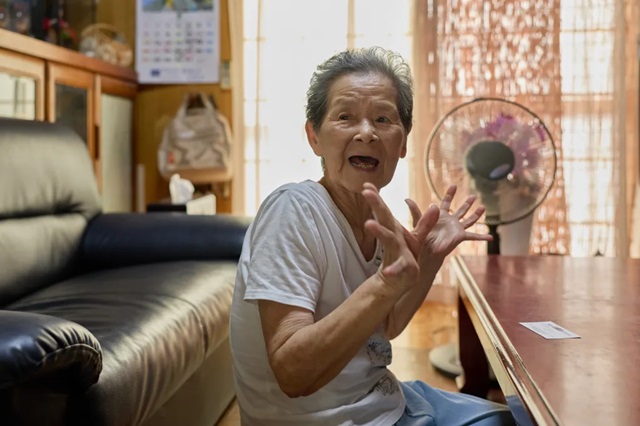
Ayano Hirashima was just eight years old when she became a living witness to one of the darkest turning points in human history—not once, but twice. On the morning of August 6, 1945, she was at school in Hiroshima, about to put on her indoor slippers, when a blinding flash ripped through the air and the atomic bomb known as “Little Boy” exploded 580 metres above the city. “Boom! Suddenly I was covered in rubble,” she recalled decades later. “I managed to crawl out, and I got home somehow. My feet were bare and they were bleeding. I saw people in the fields — they might have been dead, although I was a child so I didn’t know.” As reported by The Times UK, her family miraculously survived the blast. Believing Nagasaki to be a safer refuge, they fled Hiroshima—only to arrive in Nagasaki just a day after the second bomb, “Fat Man,” devastated the city.
Now 88, Hirashima is one of only two known living people to have survived both atomic bombings. Her story, long overshadowed by the wider tragedy, has recently re-emerged with the founding of the Double Atomic Bomb Victims’ Families Association, created to preserve the memory of these rare and tragic experiences. The new organisation was established by Toshiko Yamazaki, daughter of Tsutomu Yamaguchi—the only person officially recognised as a double survivor by the Japanese government—who died in 2010. “We have come to a time when we need to join hands and appeal for peace,” Yamazaki said.
Hirashima’s family arrived in Nagasaki 25 hours after the bomb fell, their train delayed in a twist of fate that may have saved them from immediate death but could not protect them from the invisible danger of radiation. Unaware of the peril, they walked through the heart of the ruined city. Hirashima remembers the scorched bodies of schoolgirls, fluid oozing from their burned skin, and a man so badly charred his body was entirely black. “The grown-ups were just looking at him — no one knew what to do,” she said. The family ultimately reached her mother’s home on foot and by boat, navigating a devastated landscape of dead animals, rubble, and radioactive ash.
The official term hibakusha—meaning “explosion-affected people”—includes those present at the time of the bombings, people who entered the affected areas in the days afterward, and even unborn children exposed in the womb. Hirashima meets both the Hiroshima and Nagasaki criteria. Today, fewer than 100,000 registered hibakusha remain alive, with an average age of 86. Hirashima’s survival stands not only as a testament to personal resilience but also to a generation that bore the brunt of humanity’s most horrifying scientific leap.
Her suffering did not end with the war. In her twenties, Hirashima developed colon and ovarian cancer, as well as thyroid problems that caused her throat to swell—conditions strongly believed to be linked to radiation exposure. Like many hibakusha, she faced social stigma in post-war Japan, where it was widely believed they would give birth to children with deformities. “People used to say that you mustn’t marry a woman who has been exposed to the bomb,” she said. Her husband, also a hibakusha, died of cancer in his seventies, but their three sons and five grandchildren are all healthy.
After the surrender of Japan on August 15, 1945, life for Hirashima’s family became a struggle for survival. She dropped out of school so her brothers could continue their education and helped support the family by picking flowers from the hills to sell. The psychological toll of what she had witnessed—while dulled by the imperfectness of childhood memory—has lingered. “Before the bomb, I had pneumonia and almost died,” she said. “I was on the threshold of life and death, but I recovered and then I lived through two atomic bombs. To have done that and to have lived to this age, I can say that I have happiness — or unhappiness with happiness inside it.”
Her story stands as a haunting reminder of the horrors of nuclear war and the fragile line between survival and catastrophe. As the world approaches the 80th anniversary of the bombings, voices like Hirashima’s are dwindling, but their message endures. Through her life, and those like hers, history offers a quiet but urgent plea for peace in an age that still toys with the technology of annihilation.