A combination of a surgically implanted chip and augmented-reality (AR) glasses is giving hope to people who have lost their sight — allowing many to read again after years of blindness.
According to a study published Monday (Oct. 20) in The New England Journal of Medicine, roughly 80% of participants in a small clinical trial regained the ability to read letters and words one year after receiving the treatment. The study focused on patients with advanced age-related macular degeneration (AMD), the leading cause of blindness in adults over 65.
“In the history of artificial vision, this represents a new era,” said study co-author Dr. Mahi Muqit, an ophthalmologist at University College London and Moorfields Eye Hospital. “Blind patients are actually able to have meaningful central vision restoration, which has never been done before.”
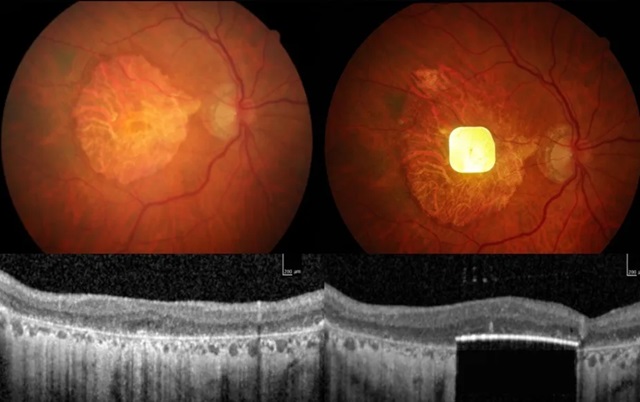
AMD damages the macula — the central part of the retina — leading to gradual vision loss and, in severe cases, complete blindness. The advanced form, known as geographic atrophy, affects about 5 million people worldwide.
In the trial, 38 patients from across Europe underwent surgery to implant a tiny electronic chip under the center of their retina, beneath cells that had died. The chip communicates wirelessly with a pair of AR glasses connected to a small computer worn on the patient’s waistband.
The device, called the photovoltaic retina implant microarray, or PRIMA system, captures visual information through a video camera in the glasses. The camera sends that information as infrared light to the implanted chip, which converts it into electrical signals the brain interprets as visual images.
For study participant Sheila Irvine, the transformation was profound. “Before receiving the implant, it was like having two black discs in my eyes, with the outside distorted,” she said. “It’s a new way of looking through your eyes, and it was dead exciting when I began seeing a letter. It’s not simple, learning to read again, but the more hours I put in, the more I pick up.”
After receiving the implants, participants spent months in training to adapt to their new vision. Some began using the system for everyday activities, such as reading fine print, doing crossword puzzles, and even navigating the Paris Metro. The device’s zoom function allowed for improved reading of small text, including prescriptions.
Experts say the technology is still in its early stages. Dr. Demetrios Vavvas, director of the retina service at Mass Eye and Ear, who was not involved in the study, noted that the current device restores only black-and-white vision and cannot yet recognize faces. Long-term durability of the implants also remains under study.
Still, researchers and clinicians are optimistic. “As the iterations of this device become better and better, it could become a real solution for a cohort of patients,” Vavvas said.