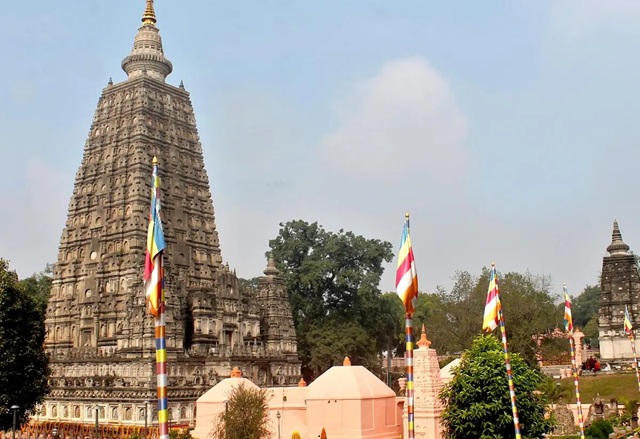
In the Union Budget for 2024-25, Finance Minister Nirmala Sitharaman announced plans to transform the Mahabodhi temple corridor in Bodh Gaya, Bihar, into a world-class pilgrimage and tourism site, modeled after the Kashi Vishwanath corridor in Varanasi. However, this ambitious vision remains unrealized as Buddhist groups, united under the All India Buddhist Forum (AIBF), have been engaged in an indefinite relay hunger strike at the Mahabodhi Mahavihara since February 12, demanding the temple’s management be entirely entrusted to Buddhists. This protest, which marks a significant escalation in the long-running dispute over the temple’s administration, has captured national attention.
The Mahabodhi Mahavihara, a UNESCO World Heritage site, is where Buddha is believed to have attained enlightenment under a peepal tree. It was originally built by Emperor Ashoka in 260 BCE and remains a crucial spiritual and historical landmark for Buddhists worldwide. Despite its religious significance, the temple has been under the control of the Bodh Gaya Math, a Shaivite monastery that has managed the temple since the 16th century, a situation that has led to frequent tensions and protests from Buddhists, demanding full control over their sacred site.
As reported by Frontline India, the current hunger strike entered its 45th day on March 25, making it the longest protest in the recent history of Bodh Gaya. The AIBF, which represents Buddhist monks, scholars, and activists, has demanded that the Mahabodhi Mahavihara be managed exclusively by Buddhists, citing their constitutional right under Articles 25 and 26 to freely manage their places of worship. They also argue that the Bodh Gaya Temple Act (Bihar Act XVII) of 1949, which established a management committee with both Hindu and Buddhist members, is outdated and incompatible with the principles of secularism and religious freedom enshrined in India’s Constitution.
Historically, the control of the Mahabodhi temple has been a matter of contention. As far back as the 19th century, the Buddhist community had petitioned the Bodh Gaya Math to hand over the temple’s management. This request was denied, leading to numerous legal battles and social unrest. In his 2017 book Buddha Gaya Temple, Its History, scholar Dipak K. Baruah highlights how the temple faced widespread destruction during the 13th century and how management of the site passed to the Mahanta of the Bodh Gaya Math in the 16th century.
The Bodh Gaya Temple Act, which governs the temple’s administration, established the Bodh Gaya Temple Management Committee (BTMC) in 1953, comprising both Buddhist and Hindu members. This arrangement has been contentious, with Buddhists arguing that it undermines their religious autonomy. Notably, the Act’s original provision requiring the District Magistrate of Gaya to be a Hindu was amended in 2013 to allow a non-Hindu chairperson, but critics argue that no significant changes have been made in the practical functioning of the committee, particularly since the Nitish Kumar-led Bihar government has failed to nominate non-Hindu members to the committee.
The current protest at Bodh Gaya is not an isolated incident but the latest chapter in the ongoing Mahabodhi Mukti Andolan (Liberation Movement). The AIBF has taken their cause to the Supreme Court, where they have filed an intervention petition, urging an expedited hearing of their long-pending writ petition. This petition, originally filed in 2012, calls for a revision of the management structure of the Mahabodhi Mahavihara to ensure that it is governed solely by Buddhists. Meanwhile, Buddhist supporters have organized protests across India, from Mumbai to Mysuru, as well as internationally, in places like the United States.
Political figures, particularly from the Dalit community, have voiced strong support for the protest. Prakash Ambedkar’s Bahujan Vanchit Aghadi party, which represents Dalit interests in Maharashtra, was one of the first to back the hunger strike. Chandrashekhar Azad, MP and leader of the Azad Samaj Party in Uttar Pradesh, raised the issue in Parliament, demanding that the Indian government address what he called the “injustice” faced by Buddhists in Bodh Gaya.
On the other side of the debate, the Hindu community, particularly members of the Bodh Gaya Math, has defended the current management structure. Swami Vivekanand Giri, head of the Bodh Gaya Math, dismissed the protests as a political maneuver by “neo-Buddhists,” claiming that the Mahabodhi temple has always been managed with the cooperation of both Hindus and Buddhists. He argued that the long-standing relationship between Hindus and Buddhists in the region, as well as the belief among Hindus that Buddha is an incarnation of Vishnu, is a source of harmony, not discord.
The issue has taken on political dimensions, with some advocating for a change in the legal framework governing the temple, similar to how the government has repealed other outdated laws. Congress MP Chandrakant Handore, speaking in the Rajya Sabha on March 21, called for the repeal of the Bodh Gaya Temple Act, questioning why the Mahabodhi temple is an exception when places of worship of other religions are managed by their respective communities. RJD MLA Satish Kumar Das, speaking in the Bihar Assembly, echoed this sentiment, framing the dispute as part of a broader question about religious rights and autonomy in India.
While the AIBF’s protests have gathered significant attention, the outcome of this struggle remains uncertain. Buddhist scholars, such as Dr. Ratan Lal, argue that the management of sacred sites like the Mahabodhi Mahavihara should be entirely under the control of their respective religious communities, as is the case with Hindu temples, Muslim mosques, and Christian churches. Dr. Lal further contended that the government’s stance on the issue has been shaped by political expediency, especially ahead of the 2024 Bihar Assembly elections.
The dispute over the Mahabodhi Mahavihara’s management is likely to remain a focal point in the months ahead, especially as Bodh Gaya plays a pivotal role in the Buddha Circuit, a key component of the government’s tourism promotion efforts. As the hunger strike continues and the demand for a revision of the Bodh Gaya Temple Act gains momentum, it remains to be seen whether political and legal reforms will emerge to resolve this decades-old conflict.
As reported by Frontline India, this protest represents not just a local issue but a broader struggle for religious freedom and the autonomy of Buddhist communities, resonating with the concerns of Dalits and other marginalized groups across India. The outcome of this movement could set a precedent for how religious sites in India are governed, potentially shaping the future of religious pluralism and secularism in the country.