by Eric
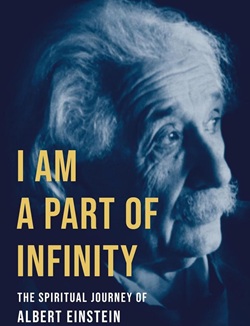
In I Am a Part of Infinity, Kieran Fox does something that borders on the sacred—he resurrects the forgotten soul of one of the most revered minds in scientific history. Albert Einstein, often remembered solely for E=mc² and the theory of relativity, is here restored as a profound spiritual thinker whose inner compass pointed not just to mathematical truth, but to metaphysical unity. With elegant prose and deeply researched insight, Fox invites readers to explore what he calls Einstein’s “cosmic religion”—a spirituality without dogma, ritual, or even a personal God, yet bursting with reverence, humility, and wonder.
From the very beginning, Fox signals that this is no ordinary biography. Einstein’s was a religion that “knows no dogma and no God conceived in man’s image; so that there can be no church whose central teachings are based on it” (p. 143). It is instead a spirituality of awe, driven by the conviction that “the most beautiful thing we can experience is the mysterious. It is the source of all true art and science” (p. 5). This spiritual instinct—a yearning to dissolve the ego into the harmony of the cosmos—is not only ancient, Fox contends, but also essential if humanity is to survive the existential dilemmas of modernity.
Fox’s argument is clear: Einstein’s worldview was fundamentally nondual. As Einstein once said, “a human being is part of a whole, called by us ‘Universe,’ a part limited in time and space” (p. 87). This wasn’t poetic metaphor—it was a guiding truth that shaped his ethics, his science, and his social commitments. In a world increasingly fractured by ideology, religion, and tribalism, Einstein believed salvation lay in the realisation that “humanity is one and undivided” (p. 134), and that we must become “a cosmic man, a man ruled by his conscience” (p. 134).
One of the most powerful threads in Fox’s book is the way he traces Einstein’s rejection of traditional religion—not out of rebellion, but out of spiritual necessity. Einstein’s God “is too universal to concern himself with the intentions of every human being” (p. 126). “What a miserable creature man would be,” he said, “if he were good not for the sake of being good, but because religion told him that he would get a reward after this life” (p. 127). For Einstein, ethics had to be intrinsic, not extrinsically imposed by divine command. “Without this primary feeling we are nothing and had better not live at all” (p. 127). It is a radical call to spiritual maturity, to be good for goodness’ sake alone.
Einstein’s ethical stance, according to Fox, emerges directly from his metaphysics. “To be just, noble, and benevolent is nothing but to translate my metaphysics into actions,” he once quoted Schopenhauer (p. 134). As Fox puts it, “Einstein’s ethics likewise emerged from his own lived experience of the intimate links between all things” (p. 134). Morality is no longer a divine decree but the inevitable conclusion of cosmic consciousness.
Of course, such a vision requires a radical reformulation of the traditional God-concept. Fox is meticulous in revealing how Einstein was not an atheist in the usual sense, but something far more subversive—a pantheist in the lineage of Spinoza, Bruno, and perhaps even the Upanishads. “This oneness of creation, to my sense, is God” (p. 125), Einstein explained, echoing Spinoza’s conviction that God is “the immanent cause of all things” (p. 60). Einstein’s reverence for this idea is unwavering: “Whether mass is transformed to atoms, electrons, or motion, it’s still a reality, a manifestation of eternal energy” (p. 125). Matter was not dead; it was alive with divinity.
Einstein’s spirituality, though often accused of being nothing more than “sexed-up atheism” by critics like Richard Dawkins (p. 65), is clearly more than just the negation of belief. As Fox clarifies, “Einstein himself asserted, ‘Mere unbelief in a personal God is no philosophy at all’” (p. 138). Instead, Einstein envisioned what he called a “cosmic religious feeling”—a nonanthropomorphic reverence that could be “the strongest and noblest motive for scientific research” (p. 144). It was, in a real sense, the engine of discovery itself: “Only one who has devoted his life to similar ends can have a vivid realization of what has inspired these men… It is cosmic religious feeling that gives a man such strength” (p. 144).
In one of the book’s most illuminating sections, Fox highlights how Einstein felt that science and spirituality were not only compatible, but necessary companions. “Science without religion is lame; religion without science is blind,” Einstein famously stated (p. 118). His cosmic religion sought to dissolve the perceived antagonism between these two realms by showing they were merely “branches of the same tree” (p. 118). Such a vision anticipates today’s “spiritual but not religious” movement, but with a philosophical rigour that most contemporary spiritualities lack.
Fox also draws powerful parallels between Einstein’s worldview and Eastern philosophies. Though Einstein “didn’t study Oriental scriptures in any detail” (p. 137), he found resonance in the Tao, in Buddhist nonduality, and in the Vedic idea of Brahman. “Man has infinite dimensions,” Einstein once said (p. 122), echoing the Hindu idea of Atman-Brahman unity. Fox notes how Einstein admired Rabindranath Tagore and how both men found common ground in the idea that “the arch-force” of the universe was the source of both science and spirit (p. 140).
But Einstein’s was not a passive or escapist mysticism. His spirituality demanded action, especially in a world ravaged by war and plagued by inequality. “We will be destroyed unless we create a cosmic conscience,” he warned (p. 134), insisting that peace, justice, and unity were not optional ideals but ethical imperatives. As Fox writes, “Einstein’s lifelong love of peace was the most obvious manifestation of this metaphysical insight” (p. 135). His call was for a planetary ethics grounded in the shared reality of cosmic interdependence.
Perhaps the most touching aspect of Fox’s work is his portrayal of Einstein not as a prophet or guru, but as a seeker—someone who belonged, in his own words, to “the society of the true searchers, which has very few living members at any one time” (p. 130). This humility permeates every dimension of Einstein’s thought. He insisted that “honesty and integrity,” not faith or ritual, were the true virtues of a spiritual life (p. 124). His religion did not require temples or texts, but only a mind “permeated by a pure mind and pure intentions” (p. 134).
Fox’s contribution is especially vital in a time when science and religion are again being pitted against one another in public discourse. I Am a Part of Infinity doesn’t just recover Einstein’s mystical side; it challenges readers to live up to the implications of his vision. It dares us to consider that perhaps the true “unified field theory” was not a physical equation, but a spiritual realisation—that everything is interconnected, that all is sacred, and that we are, each of us, not separate beings, but “a part of Infinity” (p. 135).
This is not just a book about Einstein. It is a manifesto for a new kind of spirituality—one rooted in reason, grounded in science, but soaring toward the transcendent. It’s a rare book that leaves the reader not only more informed, but somehow transformed. After finishing it, one cannot help but echo the sentiment that lies at its heart: “There comes a point where the mind takes a leap… and comes out upon a higher plane of knowledge” (p. 141). Kieran Fox has helped us take that leap. And in doing so, he has given us a glimpse—not just of Einstein’s religion, but of a future still waiting to be realised.