The quiet village of Yahidne in northern Ukraine appears, at first glance, to be rebuilding. Roads have been repaired, damaged homes restored, and daily routines are slowly returning. Yet beneath this fragile recovery lies a school basement that has become one of the most powerful symbols of the war—a place where archaeology is now uncovering the enduring human cost of a modern atrocity.
In March 2022, just days after Russia launched its full-scale invasion of Ukraine, Yahidne was occupied by Russian troops. What followed was not a conventional battle, but a prolonged confinement that left deep psychological scars on an entire community. More than 350 civilians, including 69 children and elderly residents, were forced into the basement of the local school, where they were held for 27 days under conditions so severe that several did not survive.
Now, a detailed academic study by Grzegorz Kiarszys of the Department of Archaeology at the Institute of History, Szczecin University in Poland, and Marek Lemiesz of the National Institute of Cultural Heritage of Poland in Warsaw, is shedding new light on the events. Kiarszys, who serves as the corresponding author, has led the effort to document the site using archaeological methods more commonly applied to ancient history.
Their research, soon to be published in Antiquity, an international peer-reviewed journal of world archaeology published six times a year and edited by Professor Robin Skeates, represents a significant step in understanding how material evidence can preserve the memory of very recent and deeply traumatic events.
The events in Yahidne unfolded rapidly. On March 3, 2022, Russian forces entered the village and established control, converting civilian buildings into military positions. The local school became a garrison, with soldiers occupying the upper floors while the basement was turned into a makeshift prison.
Approximately 368 civilians were crammed into a space of about 200 square meters. The youngest detainee was just one and a half months old, while the oldest was 93. Conditions inside were dire. There was little access to food, clean water, or sanitation. Poor ventilation made the air stifling, and overcrowding forced people to sit for long periods without the ability to lie down.
As the days passed, the situation deteriorated. Elderly prisoners began to die from exhaustion and lack of medical care. For a time, their bodies remained inside the basement alongside the living, intensifying the trauma. Survivors later described psychological torment, deprivation, and the constant fear imposed by their captors.
When Russian forces withdrew at the end of March following a Ukrainian counter-offensive, the survivors emerged into a devastated village. While the physical destruction was evident, the deeper emotional and psychological damage lingered, shaping the collective memory of the community.
It is this invisible legacy that Kiarszys and Lemiesz have sought to document. Their study examines not only eyewitness accounts and satellite imagery, but also the physical traces left behind in the basement—objects that tell a story of both suffering and survival.
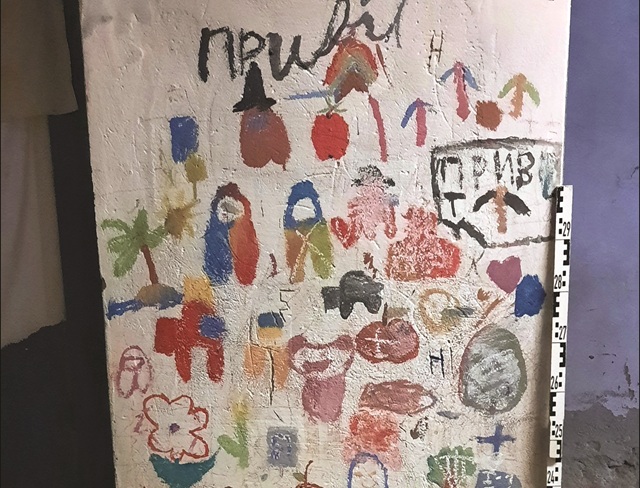
Children’s drawings cover the walls, created with crayons and charcoal during the long days of confinement. These images depict flowers, suns, animals, and characters from popular games, offering glimpses of innocence in a setting defined by fear and confinement. In some places, words accompany the drawings. “Hello” appears above one scene, while another bears the stark phrase “No Exit.”
The absence of violence in these drawings is as telling as their presence. Despite the circumstances, children did not depict the soldiers or the violence around them, suggesting a silent form of trauma that resists direct expression. This absence, the researchers argue, is itself a powerful indicator of the psychological impact of the events.
Elsewhere in the basement, adults left their own marks. Calendars were drawn on walls and doors to track the passage of time. One such calendar marks March 30, the day Russian forces withdrew, and the following day, when Ukrainian troops arrived. Nearby, lists of names record those who died during the occupation, both in the basement and elsewhere in the village.
The material evidence extends beyond these markings. Abandoned toys, schoolbooks, clothing, and remnants of food are scattered throughout the space. Military artefacts, including ration packaging and propaganda newspapers, highlight the contrast between the occupying forces and the civilians they confined.
Satellite imagery analyzed in the study provides further context. Images from mid-March 2022 show heavy military activity in Yahidne, including vehicles, fortifications, and damage from artillery strikes. Civilians are notably absent from these images, their presence hidden below ground in the basement prison.
For Kiarszys and Lemiesz, these findings demonstrate the potential of archaeology to engage with the recent past in meaningful ways. By preserving and analyzing material traces, their work not only documents what happened but also contributes to a broader understanding of how such events are remembered and commemorated.
Plans are now underway to transform the school into a museum, ensuring that the events in Yahidne are not forgotten. The archaeological research will play a crucial role in shaping the exhibition, helping to present an accurate and respectful account of what occurred.
For the residents of Yahidne, this effort is about more than historical record. It is about acknowledgment and justice. The objects left behind in the basement serve as tangible proof of their experience, countering denial and preserving their voices for future generations.
As the war in Ukraine continues, the study stands as a reminder that history is not only written in documents and reports, but also in the physical traces of human experience. In Yahidne, those traces remain vivid and unsettling, a testament to an event that is not yet past.
Through the work of Kiarszys and Lemiesz, the basement of a village school has become more than a site of suffering. It is now a place of memory, evidence, and reflection—where archaeology reveals not just what happened, but how it continues to shape the present.