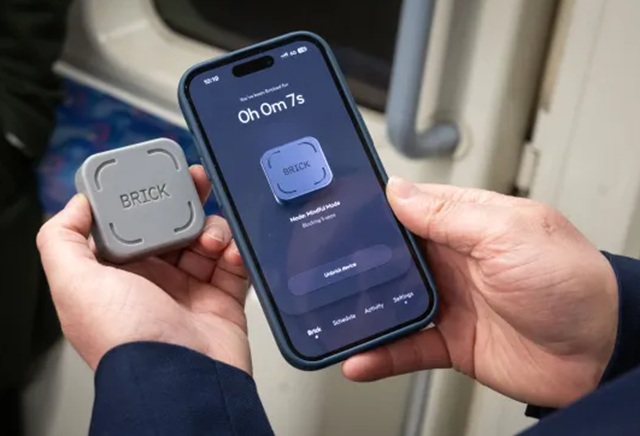
For many adults, the end of the day is defined by familiar rituals: a cup of tea, a chapter of a book, or a quiet moment of reflection. For members of Generation Z, the ritual has become an endless session of scrolling, a habit that continues the moment the phone buzzes awake in the morning. But now, growing awareness of digital overuse has spurred a wave of innovation, and tech entrepreneurs are offering a tangible solution: Brick, a two-inch by two-inch grey device that pairs with smartphones to block selected apps. Times UK joined thousands of young Britons experimenting with the device to see if it can genuinely curb their screen time.
Costing £54, Brick is already in use in more than 180 countries, with the UK becoming one of its fastest-growing markets. Once users download the companion app, they select which social media or messaging apps they want to restrict. A single tap on the Brick activates these limits, while a second tap lifts them. The simplicity is deceptive: the founders claim that it is the physical interaction—the act of tapping the grey tile—that distinguishes Brick from purely digital blockers. “Most people realise that software-only solutions aren’t effective because they are too easy to turn off,” said co-founder TJ Driver. “Our device creates the tangible friction needed to keep users accountable.”
Before testing Brick, my own weekly phone habits were typical of my generation: roughly four hours on X, one hour and 22 minutes on TikTok, and an hour and seven minutes on Instagram. Messaging apps dominated my screen time, with WhatsApp at nearly six hours and Gmail over two and a half hours. Like many peers, I reached for my phone reflexively whenever a notification pinged or during idle moments.
Initially, Brick felt no different from the software-only alternatives that promise to restrict app use. Driver acknowledges that early users of the device, launched in 2023, often left their Bricks behind when they went out, undermining its effectiveness. In practice, it is easy to carry the device and “unBrick” it, lifting the restrictions. Yet the behavioral advantage lies in creating extra thought: the friction of digging the device out of a bag or pocket forces users to pause and consider whether the distraction is worth the effort. Competitors like Forest, an app that gamifies focus, offer similar benefits for as little as £3.99, but lack this physical element.
To maximize the effect, I deliberately left the Brick in inconvenient locations, adding a small but meaningful barrier between myself and my phone. The results were notable: my time on apps such as Instagram and TikTok fell by roughly 25 percent. However, Brick includes an “Emergency unBrick” feature, usable five times, which proved tempting and exposed one of the device’s limitations.
Experts say that Brick’s design aligns with behavioral science. Simon Hammond, an associate professor at the University of East Anglia, explains that compulsive digital habits persist because software-based timers rely on executive control, which diminishes under fatigue or stress. Physical devices like Brick increase the effort required to bypass restrictions, compensating for lapses in willpower. “When the prefrontal cortex, responsible for regulating thoughts and actions, is under strain, self-control drops, and app timers become easy to ignore,” he said.
While cynics may argue that simply placing a phone in another room achieves the same result, proponents highlight that many users lack the discipline to follow this advice consistently. Psychotherapist Dr. Aaron Balick notes that Brick’s primary value is in raising the friction between the user and the apps. “You can achieve a similar effect yourself, but the device externalizes the challenge, making the habit harder to bypass,” he said.
Driver emphasizes that the conversation should shift from quantity to quality of screen time. “Gen Z grew up in the most connected environment in history,” he said, “so we are navigating attention, information, and digital presence challenges unlike any previous generation.” Brick is positioned not merely as a digital babysitter but as a tool to help users make deliberate choices about how they engage with technology.
Ultimately, Brick reflects a growing cultural recognition that screen addiction is not just about overuse but about unconscious patterns reinforced by technology. Its small size belies the impact it can have by forcing reflection and introducing friction into habitual behavior. For those willing to commit to placing the device strategically and resisting the lure of the Emergency unBrick, it may offer a practical bridge between endless scrolling and more intentional, controlled use of digital tools.
Whether it becomes a transformative habit-shaping device or a temporary novelty, Brick is emblematic of a broader generational shift: an increasing willingness among young people to take concrete steps to reclaim attention and regain control over their digital lives. For Generation Z, the struggle against screen addiction is ongoing, but for some, a small grey tile may be the first step toward meaningful change.