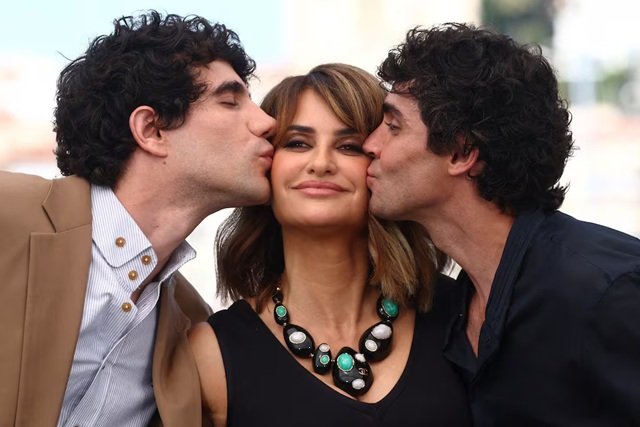
The glamour of the Cannes Film Festival took on a deeply political tone this week as acclaimed Spanish actress Penélope Cruz delivered a stark message about gender inequality and LGBTQ+ rights during the promotion of her latest film, warning that society remains far from achieving true justice or equality. Speaking with emotional intensity after the premiere of the Spanish drama La bola negra, Cruz said the continued questioning of representation in cinema proves that discrimination and exclusion still shape cultural and political life around the world.
The Oscar-winning actress appeared in Cannes visibly moved after the screening of the film, in which she portrays Nené, a cuplet singer who symbolizes freedom and artistic escape in a society constrained by repression and fear. Cruz revealed that she had broken down in tears after watching the film and again during the standing ovation that followed its premiere. The emotional response, she explained, was linked not only to the story itself but also to the film’s themes of identity, persecution, and the enduring struggle for personal freedom.
La bola negra, directed by Spanish filmmakers Javier Calvo and Javier Ambrossi — widely known as “Los Javis” — draws inspiration from the legacy of poet and playwright Federico García Lorca, whose life and death continue to symbolize Spain’s painful history of political repression and anti-LGBTQ+ violence. Lorca, one of Spain’s most celebrated literary figures, was executed during the Spanish Civil War, and his homosexuality has become central to contemporary reassessments of his work and legacy.
Cruz praised the directors for creating a film capable of reaching younger audiences without becoming overly didactic or ideological. She argued that cinema possesses a unique power to provoke reflection in ways that traditional education or political speeches often cannot. According to the actress, films such as La bola negra encourage younger generations to question history for themselves rather than simply accept inherited narratives about the past.
The actress said she immediately accepted the role despite its relatively short screen time because of the project’s emotional and political significance. She described her character as a representation of freedom in a world where most of the protagonists are unable to live authentically or openly express their identities. Nené, she explained, survives through her connection to art despite living under harsh personal circumstances. For Cruz, the character reflects the idea that creativity and performance can become forms of resistance against repression.
Her comments resonated strongly within the broader context of contemporary cultural debates unfolding across Europe and beyond, where issues surrounding LGBTQ+ rights, women’s representation, and historical memory remain highly contested. Cruz stressed that society should not assume progress is inevitable or permanent. Referring to a line in the film warning that dangers still “lurk around us,” she suggested that recent political developments in several countries demonstrate how quickly social advances can come under threat.
The actress also spoke candidly about her lifelong admiration for filmmaker Pedro Almodóvar, with whom she has collaborated on multiple films. Cruz recalled watching Almodóvar on television as a teenager and believing he would have made an excellent prime minister because of his willingness to speak openly about controversial social issues during periods of major cultural transformation in Spain. She described his public appearances as a window into a changing world during her youth, a period when Spanish society was still emerging from decades of dictatorship and conservatism.
Cruz’s appearance at Cannes also highlighted the growing international visibility of Spanish cinema. This year, three Spanish films are competing at the festival, a development many in the industry view as evidence of the country’s renewed creative influence on the global stage. The actress rejected suggestions that Spanish audiences fail to support domestic cinema, insisting that viewers in Spain have long embraced national filmmaking despite the financial and structural difficulties involved in producing films.
Reflecting on her artistic formation, Cruz revealed that she became obsessed with Lorca’s work while studying acting as a teenager under renowned acting teacher Cristina Rota. She recalled secretly lying about her age in order to gain access to advanced acting classes and described herself as drawn from an early age to emotionally turbulent material. Even as a young student, she preferred challenging theatrical works by authors such as Jean Genet and Lorca rather than lighter or more conventional performances.
The actress emphasized that Lorca’s homosexuality is impossible to separate from his writing and worldview, rejecting historical attempts to minimize or erase that aspect of his identity. According to Cruz, themes of hidden identity, danger, desire, and emotional repression permeate nearly all of Lorca’s work, even in plays without openly queer characters. She argued that ignoring this dimension of the writer’s life requires deliberately refusing to engage honestly with his art.
Her most forceful remarks came when discussing the ongoing struggles for women’s rights and LGBTQ+ equality. Cruz linked the two movements as part of a broader fight against systemic injustice and social exclusion. Asked about the progress made since the rise of the MeToo movement, in which she publicly supported initiatives such as Time’s Up, the actress warned against complacency.
She noted that journalists still routinely ask why there are multiple films centered on gay protagonists at Cannes or why women directors remain underrepresented at major festivals. For Cruz, the persistence of those questions demonstrates that equality has not yet been achieved. She argued that true progress will only arrive when diversity in cinema and society is no longer treated as unusual or exceptional.
“We are not yet living in a fair world,” she said, referring specifically to women and LGBTQ+ communities. “There is still a very long way to go, and we are moving very slowly.”
In a festival often dominated by celebrity glamour and cinematic spectacle, Cruz’s remarks transformed the Cannes spotlight into a platform for social reflection. By linking art, politics, and historical memory, the actress reinforced the enduring role of cinema not merely as entertainment, but as a battleground over identity, justice, and cultural truth.
Source: El Pais