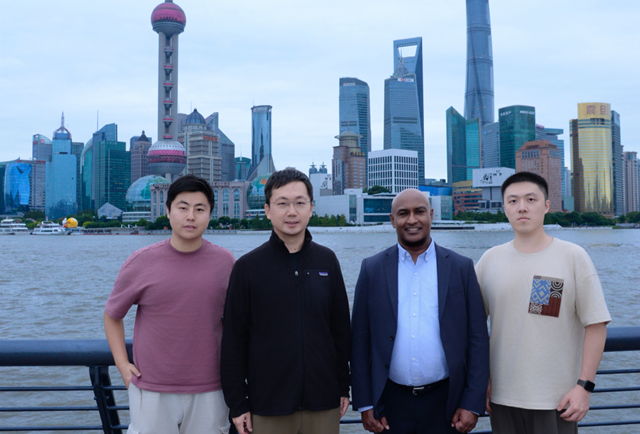
Last week, I had the opportunity to visit several Chinese universities and research centres in Shanghai, Hangzhou, and Beijing. I came back with several impressions that I think are worth sharing, particularly with colleagues who have not visited China recently.
My strongest impression is that China is building an ecosystem around robotics that connects fundamental science, hardware, manufacturing, investment and translation at a remarkable scale.
The city felt greener and cleaner. Electric cars, buses and scooters were the norm. One direct consequence was a very different experience of living in a modern city: the streets were remarkably quieter. Visibility was considerably better than I remembered, and the air felt clean.
One might argue that electric vehicles still consume energy, and that some of this electricity may ultimately come from polluting sources. But there is an important difference: electrification moves much of the pollution associated with transport away from densely populated streets. For a city of more than 20 million people, reducing local exhaust emissions can have significant benefits for urban air quality and public health. Decarbonising the electricity that powers those vehicles is then a separate challenge that can progress in parallel as renewable and other low-carbon sources expand.
What struck me in Shanghai and then in Beijing was that the first part of this transition was already tangible – not as an abstract environmental target, but in the everyday experience of a cleaner and quieter cities.
For rapidly growing cosmopolitan cities, particularly in the developing world, Shanghai and Beijing offer interesting demonstrations of what large-scale electrification of urban transport can achieve.
But my main focus was to visit some robotics labs of former PhD students and some colleagues.
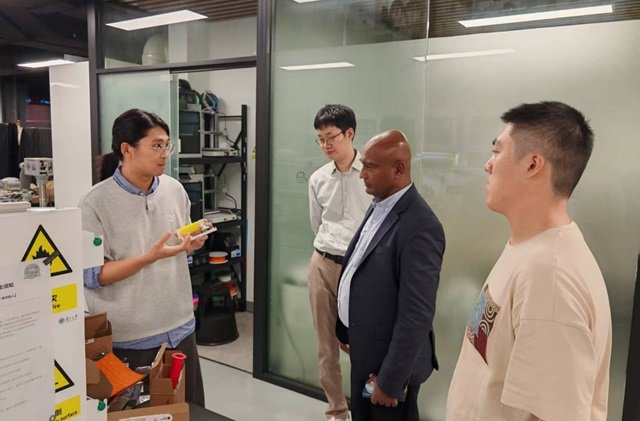
My former PhD student Xingyang Tan, now an Associate Professor at Shanghai Jiao Tong University, invited me to give a talk on my recent book, Ghost Circuits. I visited his thriving laboratory, which collaborates with leading hospitals in Shanghai.
It was wonderful to see the excitement of his PhD students as they demonstrated their robotic prototypes. Xinyang reminded me of something we used to struggle with in the UK: finding components that were sufficiently specialised for our research from a relatively limited pool of suppliers. He showed me the extraordinary range of components he can now source locally, often with very short delivery times.
More importantly, researchers are not limited to off-the-shelf components. Custom parts can be manufactured rapidly and relatively inexpensively. This matters enormously in robotics. When the cycle from idea to prototype to experiment to redesign becomes shorter, the pace of scientific discovery itself can accelerate.
The Chinese National Holiday was just beginning, but the room was full for my talk. The questions afterwards went deeply into what it actually means to design a physically intelligent robot. That distinction is important. For some, physical or embodied intelligence simply means running increasingly powerful AI algorithms inside a physical robot. I think the idea goes considerably deeper than that.
I will return to this shortly.
I saw the same ambition when visiting another former PhD student, Qiujie Lu, now a faculty member at Fudan University.
We discussed the strong role that industry plays in supporting research in China. There are advantages and disadvantages to this model. Industrial involvement creates pressure to demonstrate useful physical systems and accelerate translation. At the same time, researchers need sufficient intellectual freedom and time to explore fundamentally different approaches whose applications may not yet be obvious.
What impressed me was the attempt to do both. In the laboratory showcase I saw work published in Nature Machine Intelligence and other high-impact journals alongside technologies being developed towards practical applications. Fundamental research and translational research do not have to compete. When the ecosystem is designed well, they can cross-fertilise.
I saw another dimension of this ecosystem when visiting Peng Qi, a former PhD student I knew when I was at King’s College London. He is now a Professor at Tongji University. His group has grown to nearly 100 members, and he is involved in international collaborations, including the Sino-Italian Institute, as well as startup incubation.
His tour gave me a glimpse of the intensity of investment surrounding robotics startups in China. Funding levels at the pre-seed stage that would be considered substantial in the UK did not seem unusual.
We also discussed my plans to establish a Chinese branch of Surgim, our new venture developing advanced simulators for surgical robotics and training. I am looking forward to experiencing this ecosystem from the entrepreneurial side as well.
From Shanghai we travelled to Hangzhou for a workshop on design.
There I visited a design startup incubator. I was particularly impressed by how naturally it brought together arts, traditional crafts, design, engineering and advanced manufacturing. Rather than treating these as separate disciplines, they were being placed in the same innovation environment.
There was also a strong ambition to introduce robotics into manufacturing while preserving flexibility and quality. One particularly striking discussion concerned plans for very large-scale deployment of humanoid robots in garment and fashion manufacturing. Whether every numerical target is eventually reached is less important than the scale of the ambition.
Robotics was not being discussed as a technology waiting for future applications. It was being treated as infrastructure for the next generation of manufacturing.
We then flew to Beijing, where I visited Tsinghua University and Beijing Jiaotong University. At Tsinghua, often described as one of China’s leading science and engineering universities, I met my colleague Professor Huichan Zhao. Our discussion centred on emerging directions in physical intelligence. We share roots in the Harvard School of Engineering and Applied Sciences, and I was struck by how closely our views on future research directions aligned. We have, in fact, recently submitted a Sino-British travel grant proposal to develop these collaborations further.
So what do I mean by physical intelligence? The true opportunity is to design the physical body of a robot so that it already simplifies an interaction task before an AI algorithm begins processing the sensory information. Consider walking. Instead of asking a controller to compensate for every disturbance created when a robot’s foot collides with the ground, can we design the geometry and compliance of the foot so that the mechanics themselves stabilise part of the interaction? Consider touch. Can the geometry and material properties of a fingertip mechanically filter complex contact information so that task-relevant features become easier to extract? Or consider vision. Biological eyes do not acquire uniformly high-resolution information everywhere. High acuity is concentrated around where attention is directed, while peripheral vision sacrifices spatial resolution but remains highly sensitive to motion. The physical sensor architecture therefore reduces the computational problem before higher-level processing begins.
These are examples of a broader principle that says, do not use computation to solve a problem that physics can simplify first. This way of thinking is visible in some of China’s recent robotics successes. The Tiangong Ultra humanoid, for example, attracted international attention after completing and winning the humanoid category of the Beijing half-marathon. What interested me was not simply that a humanoid robot could run 21 km, but the combination of mechanical design, stability, lightweight construction, thermal management and control required to make that possible. That is embodied intelligence in practice.
This perhaps explains why the ideas in my book Ghost Circuits felt surprisingly natural to many of the researchers and students I met. One of the central ideas I explore is that intelligence does not necessarily reside in a single computational unit. Useful behaviour can emerge transiently when the dynamics of different physical systems – materials, bodies, environments, sensors and controllers – come together and form a functional circuit.
In robotics, this shifts the question from “How intelligent is the algorithm?” to “How intelligently does the whole physical system organise interaction?”
That requires expertise beyond AI and computer science. It requires mechanics, physics, dynamical systems, materials science, applied mathematics, biology and an understanding of how interconnected systems generate behaviour.
I saw considerable investment in precisely this combination of capabilities in China.
After my talk at Beijing Jiaotong University, we continued the discussion over dinner, including how we might strengthen collaborations between Imperial and some of the research centres I had visited.
Back in the UK, I sense increasing caution around establishing research collaborations with China. Some of this caution is clearly driven by legitimate concerns around national security, intellectual property, dual-use technologies and geopolitics.
Robotics unquestionably raises such questions. But this makes clarity and specificity in government guidance even more important. Universities need to know where the boundaries are. Clearly identified areas of national-security sensitivity should be protected. At the same time, ambiguity can lead institutions and individual researchers to become unnecessarily risk-averse, including in areas where collaboration could be scientifically valuable and mutually beneficial.
The cost of excessive disengagement may not become visible immediately. But in a field advancing as rapidly as robotics, five or ten years is a very long time.
After only one week, I would not pretend to have comprehensively understood the vast landscape of Chinese robotics. But visits to some of its leading research centres convinced me of something important.
China increasingly understands robotics not simply as AI software connected to motors, but as an integration of intelligence across computation, mechanics, materials, sensing and manufacturing. The software matters enormously. But so do physics, mechanics, dynamical systems, applied mathematics and the ability to rapidly turn an idea into a physical machine.
China also possesses another enormous advantage: the proximity of research to an extraordinarily capable manufacturing ecosystem. Add substantial investment, ambitious young researchers, growing startup capital and large domestic application markets, and the resulting trajectory is difficult to ignore.
The applications extend across medicine, surgery, agriculture, manufacturing, logistics, arts and crafts, and even fashion. Inevitably, some of these technologies are dual-use and will also have defence implications. That makes carefully designed international engagement more important, not less.
I came home thinking that the UK should consider a more ambitious and carefully structured robotics relationship with China.
We should strengthen links with selected Chinese research institutes through joint funding programmes spanning the innovation pipeline – from fundamental science and researcher exchanges to translational research, through company formation.
We should also explore mechanisms that allow British robotics researchers and startups to benefit from China’s extraordinary component-manufacturing and rapid-prototyping capabilities while maintaining clear agreements around intellectual property.
The UK has traditionally been exceptionally strong in fundamental research. Where we often struggle is maintaining momentum through the later stages of translation, particularly impact acceleration, hardware scaling and pre-seed investment.
At Imperial, I am fortunate to work in an environment that takes the complete innovation pipeline seriously. Even here, however, I experience how difficult the transition from excellent laboratory prototype to investable robotics company can be.
There is an opportunity to think differently.
Could we develop Sino-British impact-acceleration programmes in carefully selected areas of civilian robotics? Could joint incubators combine British strengths in fundamental science and invention with similar Chinese strengths and in hardware supply chains, rapid prototyping and manufacturing? Could matched pre-seed funds allow teams from both countries to build companies together?
These collaborations would need clear rules, careful due diligence and explicit boundaries around sensitive and dual-use technologies. But simply stepping away from one of the world’s fastest-moving robotics ecosystems would also be a potentially a costly one.
I returned from China convinced that physical intelligence is entering a particularly exciting period. The countries that lead it will probably not be those with the largest AI models alone. They will be those that learn how to bring AI, physics, materials, mechanics, manufacturing and human creativity together.
From what I saw last week, China understands this very well.