China’s global image has recovered from the lows recorded during the Covid-19 pandemic, with international perceptions of the country and confidence in President Xi Jinping improving as views of the United States and its global leadership have declined, according to a new survey released by the Pew Research Center on Wednesday.
The survey polled more than 45,000 people across 37 countries representing every major region of the world, including advanced economies and emerging markets such as Argentina, Australia, France, Ghana, India, Israel, Japan, Mexico, Turkey and the United States. Data was collected between February and May through telephone, face-to-face and online interviews during a period marked by increasing US involvement in the conflict with Iran and other regional crises.
According to the survey, perceptions of China have steadily improved since the pandemic, reversing a period in which the country’s global image had reached or approached historic lows in many nations. Jonathan Schulman, a research associate at the Pew Research Center, said views of China have risen while confidence in the United States has declined in many parts of the world. He also said the share of people who consider the United States to be a reliable partner for their country has fallen sharply.
One of the survey’s central findings is a reversal in the comparative standing of China and the United States. Across the 20 countries that Pew has tracked consistently over time, China now holds a higher average favorability rating than the United States. The survey found that 46 percent of respondents expressed a favorable view of China, compared with 36 percent for the United States. In 2023, the pattern was significantly different, with 54 percent of respondents expressing a more favorable view of the United States and only 19 percent holding a favorable view of China.
Zack Cooper, a senior fellow at the American Enterprise Institute, said the findings were not unexpected and reflected a broader decline in international perceptions of the United States over the past one to two years. He said China’s political stability under Xi Jinping has contributed to perceptions of consistency, while leadership changes in Western democracies often result in shifts in foreign policy.
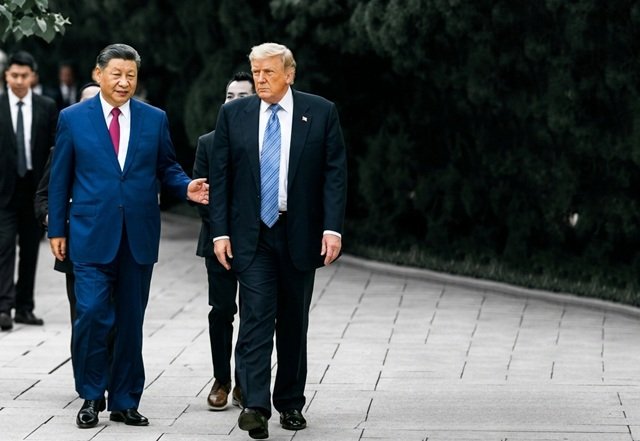
The survey also found that confidence in Xi Jinping to do the right thing regarding world affairs has increased in many countries. However, it noted that views of the Chinese leader remain more negative than positive across most of the wealthier nations included in the survey. Even within the United States, where China is increasingly viewed as a geopolitical competitor, 27 percent of respondents expressed a favorable opinion of China, an increase from the pandemic-era low.
Regional differences remained significant. Favorable views of China were strongest across much of Latin America, Africa and parts of South and Southeast Asia, while attitudes toward China continued to be less positive in Europe and advanced East Asian economies. Cooper said many developing countries place greater emphasis on China’s economic opportunities than on concerns related to political freedoms or human rights.
Despite the overall improvement in China’s international image, the survey found that many respondents continued to express concerns about the Chinese government’s respect for personal freedoms. Younger respondents were generally more likely than older adults to believe China respects individual freedoms. In the United Kingdom, for example, 30 percent of adults under the age of 35 agreed with that view, compared with 13 percent of respondents aged 50 and older.
The survey also reported a decline over the past five years in the proportion of respondents who believe the US government respects the personal freedoms of its own citizens. It found that perceptions varied significantly by country, with Israel recording one of the strongest levels of support for the United States and among the least favorable views of China, while several Southeast Asian countries viewed China substantially more favorably than the United States.
Liu Chang, a spokesperson for the Chinese embassy in Washington, said the findings reflected growing international recognition of China’s development and governance. Liu said China welcomes more Americans to visit the country to gain a broader understanding of its society and called for the United States to ease visa and border entry restrictions for Chinese citizens while increasing the number of direct flights between the two countries.
The survey also asked respondents whether they viewed China as an ally or a threat. It found that respondents in South and Southeast Asia frequently identified China as one of their country’s leading allies, while respondents in the Philippines, Japan and Australia were among those most likely to describe China as a threat. The report added that concerns over China’s territorial disputes with neighboring countries remain consistently high in several nations, particularly Japan, the Philippines and South Korea, where strong levels of concern have been recorded in surveys for more than a decade.