


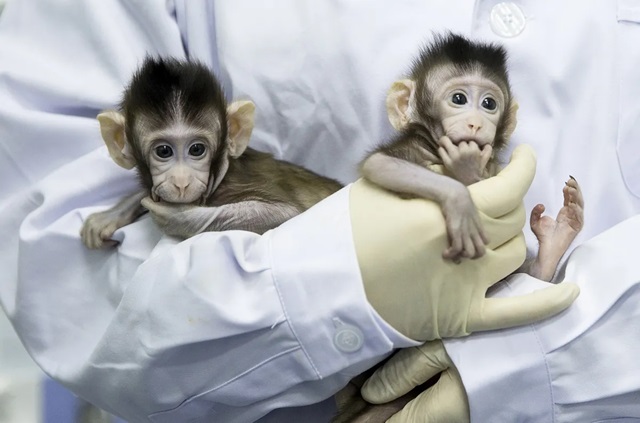
China is accelerating its quest to become a global biotechnology powerhouse, using genetically modified animals in groundbreaking experiments that would face multiple ethical hurdles in the United States or Europe, Bloomberg reports. Researchers in Beijing are creating pigs, monkeys, and dogs engineered to mimic human diseases—from amyotrophic lateral sclerosis (ALS) to autism and schizophrenia—in efforts to develop new therapies and accelerate drug discovery.
A notable example is the work of Jia Yichang, a neuroscientist at Tsinghua University. For years, Jia and his team attempted to model ALS in mice by inserting the disease into their genes. While the rodents remained healthy, a genetically engineered pig developed full-blown symptoms, including collapsing under its own weight and struggling to breathe. This breakthrough allowed the team to trace the disease mechanism more accurately, ultimately leading to the development of SNUG01, a gene therapy now approved for human testing by the U.S. Food and Drug Administration. Unlike existing treatments that only target specific mutations, Jia’s therapy is designed to protect nerve cells broadly, potentially benefiting 90% of ALS patients.
Jia sees the ethical trade-off as justified. “We should value the lives of experimental animals and their contributions to scientific research, but we should also be compassionate to our fellow humans who are suffering, helplessly,” he said.
China’s aggressive approach is bolstered by government funding, favorable regulations, and public support. Bloomberg notes that in 2023 alone, the Chinese government invested an estimated $3 billion into biotechnology. State-run breeding and research centers have been established for gene-edited animals, providing the infrastructure to conduct experiments at a scale unmatched anywhere else in the world. The government sees biotechnology and gene editing as strategic priorities, aimed at reducing dependence on foreign pharmaceutical companies and positioning China as a leader in innovative drug development.
Chinese scientists are producing an array of genetically modified animals. They have created monkeys with neurological and psychiatric disorders, cloned primates for consistent genetic research, and engineered dogs with metabolic or neurological conditions. Such large-animal models are increasingly central to drug development because mice often fail to replicate complex human diseases. Bloomberg reports that China now dominates headlines with these breakthroughs, while Western research has slowed due to stricter animal welfare regulations and ethical oversight.
The contrast between China and the West has raised ethical and geopolitical concerns. Gene-editing technology is dual-use: while it holds promise for medical therapies, it could theoretically be misused in bioweapons research. Moreover, Europe and the U.S., with their stringent ethical standards, risk falling behind in rapid innovation. Critics argue that larger animals, being intelligent and social, deserve higher moral consideration, making the ethical stakes of these experiments far greater than research on mice.
Despite these concerns, Chinese biotech firms are expanding their efforts. Companies like SineuGene, co-founded by Peng Lin, are developing dogs and primates to model complex diseases such as Parkinson’s and autism, aiming to create therapies faster than would be possible using traditional rodent models. “Our advantage is that the regulations are a bit friendlier, and people are relatively more accepting and supportive,” Peng said in an interview with Bloomberg. “I hope in the next ten to twenty years, when we hear about these diseases, we will not be horrified but have solutions for them like we have for some cancers today.”
China’s scale in breeding and genetic research is unmatched. Since 2010, the country has built multiple state-run centers housing tens of thousands of mice, rabbits, dogs, birds, and primates. In 2019, it launched two state-funded genetic research centers specifically for pigs and primates. Experts say this scale provides a major competitive edge. Erwan Bezard, founder of the Institute of Neurodegenerative Diseases at the University of Bordeaux, told Bloomberg, “China’s breeding capacity for gene-modified animals is simply overwhelming. With macaques, to get one live baby usually requires dozens of females. It’s clearly a challenge, and basically only China can do it.”
The ethical debate continues. While gene-editing offers enormous potential for treating rare and chronic diseases, critics warn that large animals are sentient and highly social, making experiments ethically fraught. Rebecca Walker, a professor of social medicine at the University of North Carolina, says, “These experiments have to be justified very carefully and have real benefits. They can’t just be curiosity-driven research.”
The arrival of CRISPR gene-editing technology has only intensified these debates. Originally demonstrated in mice in 2013, CRISPR allows precise editing of DNA, enabling researchers to model diseases in ways that were previously impossible. Yet Western institutions have slowed research on large animals due to ethical concerns, public opposition, and activist interventions, while China sees these limitations as an opportunity to accelerate innovation.
For patients with rare diseases like ALS, the stakes are profound. Thousands die quietly each year from such conditions due to limited research funding. Jia’s SNUG01 therapy represents a rare beacon of hope, born from years of painstaking work with gene-edited animals. Yet as Bloomberg notes, the ethical questions surrounding these experiments remain unresolved, and the global scientific community continues to debate where the line should be drawn between innovation and the moral costs of animal suffering.
China’s push into biotech is not just about science—it is a strategic effort with implications for global healthcare, pharmaceutical supply chains, and international competition. As the country forges ahead with large-animal gene editing, the world watches closely, balancing admiration for scientific breakthroughs with unease over ethical boundaries.









