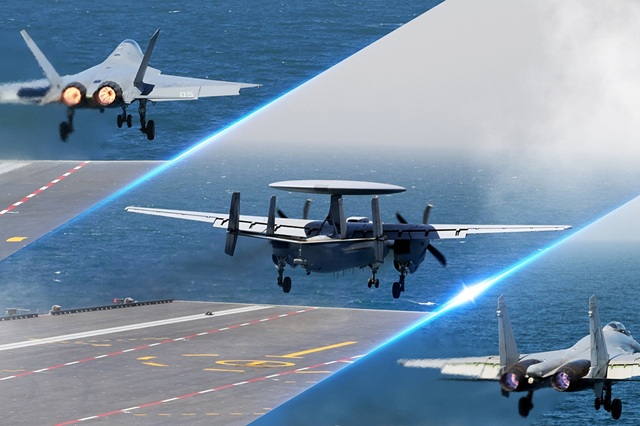
China’s first electromagnetic catapult-equipped aircraft carrier, the Fujian, has successfully completed its first catapult-assisted takeoff and arrested landing training, the Chinese People’s Liberation Army (PLA) Navy announced on Monday. The milestone involved the J-15T heavy fighter jet, J-35 stealth fighter jet, and KJ-600 early warning aircraft.
Experts told the Global Times that the achievement marks a significant step in China’s emergence as a major aircraft carrier power, demonstrating that the Fujian has reached world-class operational capabilities. The successful exercises also highlight the PLA Navy’s progress toward becoming a deep-blue water force.
“The Fujian has acquired the capability for electromagnetic catapult launch and recovery, marking another breakthrough in China’s carrier development,” the PLA Navy said.
In prior tests, pilots successfully conducted takeoffs and landings with the three aircraft types, confirming the compatibility of China’s domestically developed electromagnetic catapult and arresting systems. These operations enabled the Fujian to achieve initial full-deck operational capability, laying the foundation for integrating multiple carrier-based aircraft into its formation system.
Since its first sea trial in May 2024, the Fujian has undergone a series of maritime tests, calibrating onboard systems and verifying overall operational stability, according to an official PLA Navy statement.
“This indicates that the aircraft carrier Fujian has achieved initial operational capability, laying a solid foundation for commissioning and full combat readiness,” said Zhang Junshe, a Chinese military affairs expert.
Fifth-Generation Air Power
The J-35, China’s independently developed fifth-generation carrier-based fighter, is central to the Fujian’s air wing. Designed primarily for air superiority, it can also perform strike missions against land and sea targets. According to experts, the J-35 positions China as the second country globally, after the United States, to deploy a fifth-generation carrier-based fighter.
Combined with the J-15T heavy fighter jet’s high-payload strike capacity, the Fujian’s air wing achieves enhanced penetration and saturation strike capabilities. “The combination of the J-35 and J-15T maximizes operational potential and significantly improves far-seas combat capability,” Zhang said.
The KJ-600 early warning aircraft serves as the airborne “eyes” and “brain” of the carrier formation. Compared with helicopters and shipborne radars, it offers higher altitude, longer range, and improved detection accuracy, significantly boosting the carrier’s offensive and defensive capabilities.
Completing the Carrier “Five-Piece Suite”
With the J-15D electronic warfare aircraft and ongoing development of anti-submarine helicopters, the PLA Navy’s carrier-based “five-piece suite” — air superiority, sea control, land attack, reconnaissance and early warning, electronic warfare, and anti-submarine warfare — is now essentially complete and operational. Experts say this represents a major improvement in the Fujian’s far-seas combat capabilities compared with the earlier carriers, Shandong and Liaoning.
Strategic Significance
“The Fujian is a landmark achievement for China and the world,” said Wang Ya’nan, chief editor of Aerospace Knowledge magazine. Featuring world-class electromagnetic launch and arresting systems, it is expected to field the most effective carrier-based aviation force in the world.
The successful exercises signal that the Fujian’s commissioning is imminent. Once operational, China will have three aircraft carriers, further enhancing the PLA Navy’s ability to conduct far-seas defense operations.
“This milestone strengthens confidence in the PLA Navy’s capacity to safeguard national sovereignty and security, while serving as a powerful deterrent to potential adversaries,” Zhang said.