by Our Correspondent in Colombo
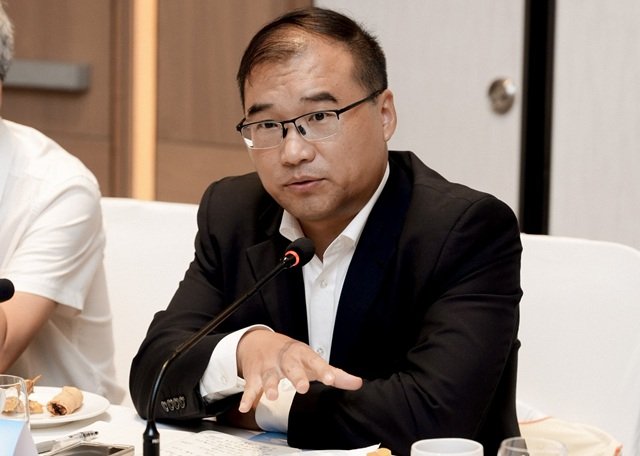
China and Sri Lanka should deepen bilateral cooperation while expanding their engagement with BRICS and the wider Global South, Professor Wang Lei, Director of the BRICS Cooperation Research Center at Beijing Normal University, said at the China–Sri Lanka Friendship Organizations Symposium in Colombo on Saturday, September 12, 2026.
Wang was speaking on “Sharing Pathways for China–Sri Lanka Cooperation in Education, Science and Technology, and Youth Exchange”, but his address ranged across the international financial system, global governance, multilateral institutions, BRICS cooperation and the role of developing countries in shaping international affairs. He placed the China–Sri Lanka relationship within a broader framework of cooperation among countries of the Global South and repeatedly linked bilateral relations to questions of global governance and international development.
Wang began by referring to the 18th BRICS Summit, which is taking place in New Delhi, and described it as an important event for Asia and the wider world. “Right now, we are talking about very important issues such as the cooperation between our two countries, relations with the South, etc. But at the same time, just in a neighboring country, in India, another important event is occurring which would bring a lot of influences upon this region in Asia as well as the world,” he said.
“That is the 18th BRICS Summit with the participation of all of those leaders of the important emerging economies.”
He said his remarks would address three areas: financial relations, global governance and BRICS cooperation. Wang connected these subjects to the circumstances facing developing economies and to the wider international environment in which China and Sri Lanka conduct their bilateral relations.
“As we know, right now, we are talking about very important issues such as the cooperation between our two countries, relations with the South, etc.,” he said, before turning to what he described as a severe global financial and economic crisis.
“We are suffering from severe actually the global financial crisis as well as the economic crisis which we did not contribute to that. We are suffering from that.”
“We are victims,” Wang said, arguing that countries that had not caused such crises nevertheless had to participate in addressing their consequences.
“How would this crisis actually is resulting from the other countries, especially for those northern countries? That now we have to take the shoulder responsibility to spare no efforts at all with them.”
He linked this position to globalisation and the interdependence of national economies.
“Because we are now living in a world of globalization, we have to take responsibility, even we are victims.”
Wang said the question of global governance was relevant to Sri Lanka despite the country’s comparatively smaller economy.
“So it’s really important, even for countries such as Sri Lanka, which is a relatively smaller economy with more economies of other important and largest economies. So we have to, even just from the profound view of national development, we have to consider the consequences of global governance.”
“I think it’s also a very important topic for those countries in Sri Lanka,” he said.
Wang then referred to China’s Global Governance Initiative and placed it within the wider framework of China’s stated approach to international cooperation.
“That’s why last year during the previous Shanghai Summit, chaired by China in Tianjin, which was one year ago, Chinese President Xi Jinping proposed the so-called global governance initiative,” he said.
“We want to contribute the Chinese inspirations to share with the other countries why did we suffer from the globalization crisis, what could we do, even we are victims.”
He said global governance was also central to BRICS cooperation.
“And I think global governance is also one of the most important issues and responsibilities for the risk cooperation.”
Wang described BRICS as having 11 official members and 10 partners and referred to Sri Lanka’s participation in the summit’s outreach process.
“As we know, just for today and tomorrow, the President of Sri Lanka will be invited to attend the certain kinds of outreach dialogues,” he said.
His remarks placed Sri Lanka’s engagement with the ongoing BRICS summit within a broader discussion of developing-country participation in international institutions. Wang said BRICS cooperation was not confined to relations among its members but involved wider questions concerning emerging economies and the Global South.
“It’s really complicated. It’s not only cooperation among the emerging economies, among the members of the risk, which would like to contribute to the integrated mutual development enjoyed by the global south.”
He also referred to what he described as external influences from industrialised countries.
“Because there are some external influences which result from the other industrialized countries, like the United States, the European Union, even Japan.”
For China and Sri Lanka, Wang said, bilateral cooperation and participation in Global South cooperation were closely connected.
“So even for both of us, I mean for China and Sri Lanka, both of us would like to promote the bilateral cooperation. Both of us would like to contribute to the global south cooperation as well as to do something to promote the global governance efficiency and the integrity.”
He said this required both countries to consider the wider international environment.
“We have to think about some other external influences.”
Wang then identified four Chinese global initiatives as significant to this approach: the Global Governance Initiative, the Global Security Initiative, the Global Development Initiative and the Global Civilizational Initiative.
“Therefore, I think it’s really, really important and significant for the Chinese president to propose the global initiatives, like the global governance initiative in addition to the global security initiative, the global development initiative, as well as the global civilizational initiative.”
Of the four, he placed particular emphasis on the Global Governance Initiative.
“And we think that those four global initiatives are significant. Of course, the most important one is the global governance initiative,” he said.
Wang identified sovereignty as a fundamental principle in the approach he was describing.
“It will emphasize the importance of the primary principle for the stability and peace of this world, that is to promote the importance of sovereign economy,” he said.
He described sovereignty as a prerequisite for China, Sri Lanka and other countries of the Global South to maintain peace and pursue development.
“And that is the most important external environment we would like to promote our modernization development.”
International law was another component of the framework.
“And the second component of the global governance initiative is to speak highly of the importance of the rule by international law,” Wang said.
He also referred to what he called a “people-centric development vision”, arguing that the benefits of global governance and globalisation should be distributed across societies and among countries.
“That means for China, for Sri Lanka, for all of those members of the global south, it’s equal for us to enjoy the fruits, the results of globalization.”
Wang also stressed the importance of multilateralism and referred to institutions including the United Nations and the World Trade Organization.
“And in addition to that, the number four component is to emphasize the importance of multilateralism, like the reform of the UN, the WTO in 2020, etc., because those multilateral regimes are really important for us, for the global south, for the developing countries.”
He then referred to the political and economic developments that he associated with Donald Trump’s return to power.
“Especially when Donald Trump came into power, we could see a certain kind of a return of internationalism, a far-right extremism, which brought in those severe consequences upon us.”
“There’s the Arab war, there’s the trade war, there’s the return of hegemony upon us,” he said.
Wang argued that multilateralism should remain central to the international system.
“So if we would like to enjoy this kind of peaceful, stable global environment, it’s really important for us, for both of us, to speak highly of the multilateralism and to speak highly of the action-oriented development regime.”
He repeatedly called for practical implementation rather than dialogue alone.
“We should not be just forum of dialogue. We should do something to facilitate the action as soon as possible, to promote the multilateral cooperation.”
Wang connected this position to the strategic cooperative partnership between China and Sri Lanka.
“Therefore, for last year, both the leaders from our countries proposed the strategic cooperative partnership between us. We have to do something to promote the collaboration between this partnership and the global governance initiative.”
He identified a range of fields in which cooperation could be developed.
“They are expanding a very vast scope for us to do something to promote the global governance initiative, like the wrap-up of the existing multilateral international regime, like to defend the importance of globalization and an open world economy, like to speak highly of the shared development, like the emerging fields, such as artificial intelligence, the marine economy, the green economy, as well as the digitalization.”
The reference to artificial intelligence, the marine economy, the green economy and digitalisation also connected Wang’s wider global-governance argument to the stated subject of the symposium: cooperation in education, science and technology and youth exchange.
Wang then returned to BRICS and its development over the past two decades.
“As we know, in the past 20 years, the BRICS cooperation has evolved into certain kinds of regime to promote the global cooperation,” he said.
“Now the BRICS cooperation has evolved into certain kinds of large and pioneering group to speak for the emerging economies, as well as developing countries.”
He argued that the scope of BRICS cooperation should extend beyond its existing members and include representatives from different regions of the developing world.
“Therefore, we could do something, not only for China and Sri Lanka, but for the whole group of those members in the developing world, for the global South.”
Against the backdrop of the ongoing 18th BRICS Summit in New Delhi, Wang called for broader participation by developing countries and identified Sri Lanka as one of the economies that could contribute to the process.
“As an expert in BRICS cooperation, I would like to encourage the BRICS cooperation to welcome the representatives from different regions of the world on behalf of the developing countries, as well as the most important contributing economies like Sri Lanka.”
He described Sri Lanka as a country that, in his assessment, had developed rapidly over the previous two years.
The summit, taking place in New Delhi on Saturday and Sunday, was therefore a continuing reference point throughout Wang’s presentation as he discussed the role of BRICS in global governance and the participation of developing countries. He said the developments taking place around the summit would have implications for the wider cooperation among emerging economies and the Global South.
“We are looking forward to the very positive consequences from the 18th Summit in New Delhi,” Wang said.
His presentation was delivered against the background of his academic and policy work on global governance, international organisations and BRICS cooperation. Wang is a professor and doctoral supervisor at the School of Government Management at Beijing Normal University and the current Director of the BRICS Cooperation Research Center at the university.
He also serves as a special researcher for the International Department of the CPC Central Committee, a council member of the China Society for Human Rights Studies and a council member of the Chinese Think Tanks Association for BRICS Cooperation.
Wang has presided over more than 10 projects, including sub-projects of major National Social Science Fund programmes, general projects and Ministry of Education-funded national and regional studies. He has authored three monographs, including BRICS Countries: A New Model of Cooperation Among Emerging Powers, and published more than 50 papers in core journals such as China Quarterly of International Strategic Studies and European Studies, as well as in central mainstream media outlets.
More than 60 of his policy consultation reports have been adopted by central government departments, with several receiving instructions from Party and state leaders. His teaching achievements earned the Second Prize of the Beijing Higher Education Teaching Achievement Award as a team member.
Wang previously worked as a visiting official at the Ministry of Commerce’s Department of International Trade and Economic Affairs, participated in diplomatic negotiations as part of Chinese delegations and served as a guest commentator more than 200 times on CCTV’s News Broadcast and other programmes.
He concluded his Colombo address by thanking his Sri Lankan hosts and returning to the language of bilateral friendship. “We really enjoyed this short but very fruitful and sincere visit,” he said.
He thanked the Sri Lankan participants for providing what he described as “sincerity, as well as integrity, in addition to friendship”. “May the friendship between us last forever,” Wang said.