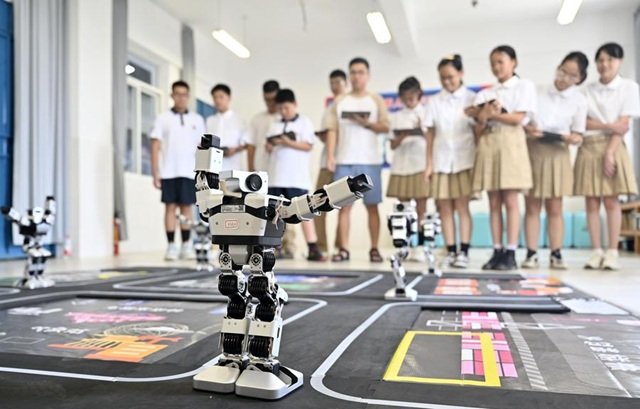
The global race for technological supremacy is increasingly being fought through artificial intelligence, robotics, and scientific innovation. But according to a growing body of analysis emerging from China’s education and research sectors, the foundations of future innovation may depend less on billion-dollar laboratories and more on what happens inside ordinary classrooms.
Recent developments in China’s technology industry have reignited debate over how nations cultivate scientific talent and sustain long-term innovation. In early 2025, the Hangzhou-based AI company DeepSeek unveiled DeepSeek-R1, a high-performance large language model reportedly developed at a fraction of the cost of comparable Western systems. The achievement drew international attention, with Silicon Valley investor Marc Andreessen describing it as “AI’s Sputnik moment,” invoking comparisons to the Soviet Union’s shock launch of the first artificial satellite during the Cold War.
Later that year, another Hangzhou-based company, Unitree, introduced its R1 humanoid robot, whose capabilities reportedly approached those of significantly more expensive Western machines. Together, the two breakthroughs intensified scrutiny of how China is producing a new generation of highly skilled engineers and researchers capable of competing at the frontiers of technology.
According to analysis published in the scientific journal Nature, one striking feature of both companies is the composition of their workforces. Many of the engineers and researchers behind DeepSeek and Unitree are young, trained largely within China, and often under the age of 30. Their emergence suggests that cutting-edge innovation no longer depends entirely on students studying abroad and later returning home with advanced expertise.
For decades, China’s scientific rise relied heavily on that model. High-performing students were selected through intense national examinations, trained at elite universities, and frequently sent overseas for advanced education or research experience before returning to strengthen domestic institutions. That approach proved highly effective during China’s effort to catch up with established scientific powers.
But geopolitical tensions, restrictions on international collaboration, and increasing global competition for talent are making that pathway less reliable. Countries can no longer assume that access to international research networks alone will sustain innovation leadership. Instead, the focus is shifting toward building stronger domestic pipelines for scientific talent from the earliest stages of education.
Nature’s analysis argues that innovation policy must now move “upstream,” beginning not at universities or advanced research institutes, but in preschool and primary education. Scientific ability, researchers say, develops progressively over time. Early childhood shapes curiosity and experimentation, secondary school builds critical thinking and conceptual understanding, and higher education refines specialization.
Systems that invest primarily at the university level may therefore be attempting to generate world-class innovation without establishing the educational foundations necessary to sustain it.
China’s recent education reforms appear designed around that realization. Initiatives launched in 2025 increasingly emphasize scientific literacy, hands-on learning, and interdisciplinary problem solving throughout primary and secondary education. One major programme, known as the Fertile Soil Plan, seeks to move schools away from rote memorization toward project-based learning tied to real-world scientific inquiry.
The broader goal is not simply to teach students scientific facts but to immerse them in how science itself operates: asking questions, conducting experiments, testing hypotheses, and collaborating across disciplines.
The reforms also aim to strengthen ties between schools and scientific institutions. Universities, national laboratories, and technology companies are being encouraged to work directly with schools, providing students access to equipment, mentors, and research environments previously unavailable in standard classrooms.
Education researchers are playing a central role in translating cutting-edge science into practical teaching material that schools can realistically implement. The strategy reflects a growing belief that exposing students to emerging technologies and real scientific practice at an earlier age can foster deeper engagement with innovation later in life.
Some programmes are going even further. China’s Standout Programme allows secondary-school students to pursue more individualized scientific pathways, including participation in authentic research projects and exposure to advanced technological fields once reserved for university students.
Yet the success of these reforms may ultimately depend on a less glamorous factor: teachers.
Nature highlights that one of the greatest obstacles facing science education globally is the shortage of qualified STEM educators. A 2021 survey involving more than 131,000 primary-school science teachers in China found that over 70% lacked formal backgrounds in science, technology, engineering, or mathematics. Many taught science only part time and had limited access to professional training.
The problem extends far beyond China. School systems across the United States, Europe, and other regions are struggling to recruit and retain science teachers while also failing to provide sufficient long-term professional development.
Researchers increasingly argue that science teachers should be viewed not merely as educational staff but as critical components of national innovation infrastructure.
China’s response has been to reorganize teacher training on a national scale. Traditionally, teachers received instruction through specialized “normal universities” focused on education and pedagogy. But recent reforms have expanded partnerships between those institutions and elite research universities such as Peking University and Tsinghua University.
Through programmes such as the National Excellence Program, top-tier universities are now directly involved in training future STEM teachers. The objective is not simply prestige, but ensuring that educators are immersed in environments where advanced science is actively being produced.
By late 2025, the programme had reportedly attracted more than 15,000 applicants across 43 leading universities, signaling strong interest in elevating the status and quality of science teaching.
China has also expanded professional development opportunities for existing teachers. National initiatives led by organizations such as the Chinese Academy of Sciences and the China Science and Technology Museum have organized intensive workshops connecting educators directly with researchers and scientific institutions.
According to Nature, one 2024 collaboration programme trained more than 2,500 educators and generated hundreds of jointly developed science curricula. Participants reported significant improvements in their understanding of scientific research and their ability to integrate contemporary science into classroom teaching.
Supporters of these reforms acknowledge that the strategy requires patience. Investments in education and teacher development often take decades to produce visible economic or technological results, particularly compared with the immediate political appeal of funding advanced laboratories or subsidizing strategic industries.
But researchers warn that many countries are already experiencing the consequences of neglecting earlier stages of talent development. The fragility of innovation systems, they argue, reflects years of underinvestment in schools, science literacy, and teacher support.
China’s Zhejiang province, home to both DeepSeek and Unitree, is increasingly cited as evidence of what long-term educational investment can achieve. Long before its technology firms attracted global attention, Zhejiang had spent years strengthening science curricula, promoting engineering and information technology education, and integrating practical technological learning into university entrance examinations.
A 2023 survey of more than 23,000 students in the province found that widespread exposure to design and manufacturing projects had strengthened engineering skills and increased student interest in technological careers.
The broader lesson extends beyond China. Open scientific collaboration, international research partnerships, and corporate innovation remain essential drivers of progress. But they cannot compensate for weak domestic educational systems or the absence of teachers capable of nurturing scientific talent over generations.
As countries compete for leadership in artificial intelligence, robotics, and advanced technologies, the struggle may ultimately depend not only on who builds the best machines, but on who builds the strongest classrooms.