


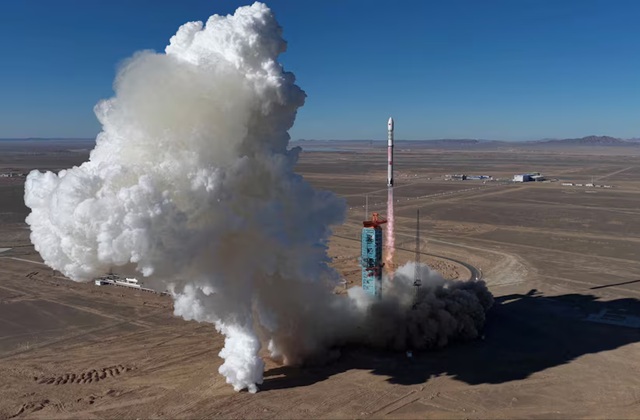
China’s rocket startup LandSpace, long inspired by Elon Musk’s SpaceX, is stepping into the spotlight after conducting the country’s first reusable rocket test earlier this month, Reuters reports. Although the maiden flight of its Zhuque-3 rocket ended in failure, the effort signals China’s growing push to develop low-cost, reusable launch vehicles and challenge state-owned aerospace dominance.
LandSpace’s engineers openly cite SpaceX as a model, emphasizing rapid iteration through testing—even when it leads to failure. Zhuque-3 chief designer Dai Zheng left China’s main state-owned rocket developer in 2016, motivated by the desire to replicate the innovation and reusability pioneered by SpaceX. Deputy chief designer Dong Kai described the rocket’s design as learning from Falcon 9 rather than imitation, highlighting its potential role in supporting China’s plan for 10,000 satellite constellations over coming decades.
The company has also embraced transparency rare in China’s space industry, opening its engine factory floor to Reuters this month. Beijing’s gradual acceptance of private investment in space since 2014, coupled with plans to ease access to capital markets, is positioning startups like LandSpace to fund ambitious projects, including potential IPOs. Dai noted that while SpaceX can absorb heavy losses during testing thanks to ample funding, Chinese startups are only now gaining similar financial support.
SpaceX founder Elon Musk commented publicly on Zhuque-3 last month, noting that the rocket combines aspects of Starship with a Falcon 9-style design, though he described Starship as “in another league.” Key innovations such as stainless steel construction and methalox-powered engines are intended to reduce launch costs, while the ability to recover and reuse first stages remains central to lowering expenses. LandSpace is preparing for another launch following the December failure, drawing on SpaceX’s experience, which saw two failed Falcon booster landings before achieving success in 2015.









