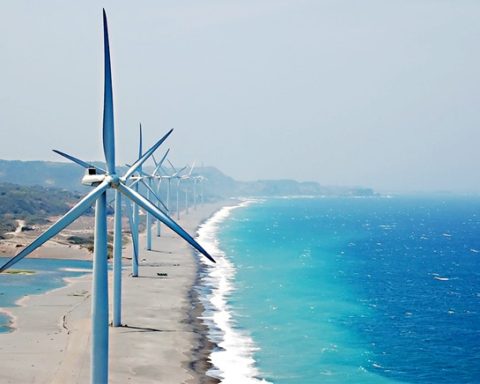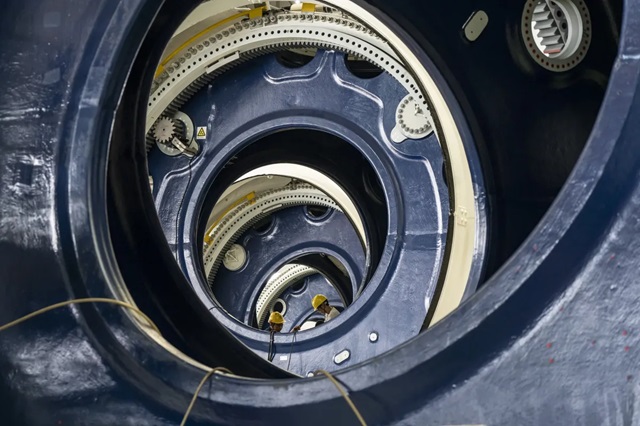
Off the coast of southern China, a colossal floating wind turbine towers above the sea, tethered to the seabed by bright-yellow moorings. Known as the OceanX design, it is the largest of its kind in operation globally — and a powerful symbol of China’s determination to dominate the clean-energy race, Bloomberg reported.
The double-headed turbine, built by Ming Yang Smart Energy Group, captures more wind power than any other floating unit in service today. Its presence reflects the strength of China’s offshore wind sector, which this year alone is expected to install nearly three-quarters of all new offshore turbines worldwide, according to BloombergNEF.
The story contrasts sharply with the situation in the United States and other advanced economies. President Donald Trump has repeatedly derided wind farms as “ugly” and environmentally harmful, halting new approvals upon taking office. His administration even blocked an almost-complete project developed by Denmark’s Orsted A/S — a global pioneer in offshore wind — shaking investor confidence and sending shares tumbling. Europe and Japan face similar setbacks, with rising costs, tighter supply chains, and fading government support causing projects to stall.
By comparison, Chinese firms benefit from an integrated supply chain, lower material costs, strong policy backing, and rapidly advancing technology. “China’s offshore wind project pipeline has remained strong because of advantages in financing, supply chain integration, policy support and technology improvements,” said Yujia Han, a researcher at Global Energy Monitor, in comments to Bloomberg.
Beijing’s industrial giants — including turbine makers Goldwind and Ming Yang — are now setting their sights on global markets. Analysts say they are well positioned to outcompete long-established rivals such as Vestas, Siemens Gamesa, and General Electric. “Chinese manufacturers are going to take most of the market share because of their fundamentally huge advantages in cost,” said Cosimo Ries of Trivium China.
China’s domestic push has been staggering. Offshore wind farms along Guangdong province, one of the country’s industrial hubs, already host some of the largest turbines ever built. The scale has helped drive down costs: BloombergNEF data shows offshore wind power in China is now less than half as expensive as in the UK, the world’s second-biggest market.
Still, challenges remain for Chinese companies expanding abroad. Unlike solar panels or batteries, supersized wind turbines are difficult to transport and assemble, requiring construction near installation sites. Moreover, concerns over national security and long-term maintenance commitments have made European governments wary. Germany recently scrapped a project involving Ming Yang, while only one European site — Taranto in Italy — currently uses Chinese turbines.
Even so, executives remain optimistic. “We have talked with a lot of Western developers now, because we have more innovative products and technology,” said Zhang Qiying, president of Ming Yang’s international business. He added that convincing European regulators and financiers of the company’s reliability is key to future growth.
For now, China’s offshore wind farms continue to expand at home, providing clean energy to coastal megacities while bolstering the nation’s energy security. As Bloomberg noted, the sector’s momentum highlights how Chinese manufacturers are positioning themselves to dominate yet another clean-energy industry — just as Western rivals falter.