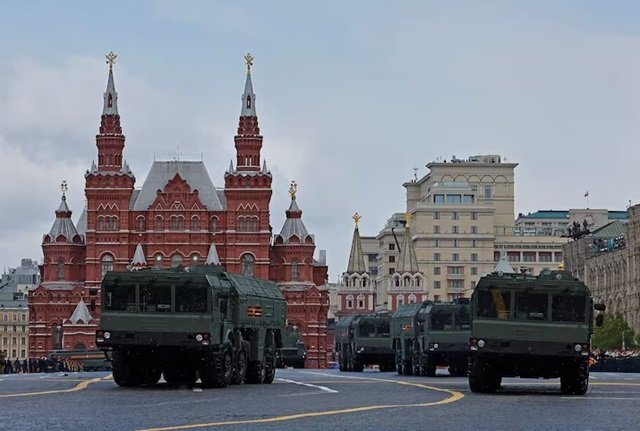
Russia is preparing for the war in Ukraine to continue for years, with the government planning record military spending and abandoning earlier efforts to restrain defence outlays as the conflict approaches its fifth year.
Projected military expenditure next year is 17.1 trillion roubles ($205 billion), an increase of more than 40 per cent from this year’s planned defence spending, although the actual totals remain classified. The figure would represent an increase of almost 380 per cent from the year before Russia began its war in Ukraine. Military expenditure is projected to ease only slightly to 16.6 trillion roubles in 2028 and 16.3 trillion roubles in 2029.
The spending trajectory marks a sharp reversal from plans outlined a year ago, when Moscow expected to moderate the growth of military expenditure as it sought to reduce the budget deficit and rebuild reserves depleted during the war. The new budget comes as US-brokered negotiations remain largely stalled, European officials increasingly warn of hybrid attacks attributed to Moscow and Russian forces continue to strike Ukrainian cities and infrastructure.
“Putin is raising the stakes,” said Kirill Rogov, head of the Vienna-based research group Re: Russia. The Russian president is signalling that Russia “will continue investing in the war, and Europe has to decide whether it’s prepared to sustain the same level of support” for Ukraine, Rogov said.
Rogov said the change was particularly striking compared with expectations a year earlier, when Moscow’s spending plans had encouraged hopes that the conflict might eventually begin to wind down.
President Vladimir Putin reinforced the changed position on Thursday by accusing European officials of escalating tensions with Russia and preparing for a possible conflict later this decade. He pointed to military exercises in the Baltic Sea and statements by Western politicians concerning Kaliningrad, Russia’s Baltic exclave.
Putin said Russia had no plans to attack Europe but warned that a direct attack on Russian territory would force Moscow to consider using the full range of weapons at its disposal.
“We understand that we would be facing an adversary twice our size in terms of population, with major economic and military potential,” Putin said. “We don’t have that many forces and means to counter this threat. But no one has the means of destruction that Russia has today.”
The earlier fiscal projections were made as US President Donald Trump’s efforts to mediate negotiations between Moscow and Kyiv were intensifying. Those efforts have continued into the second year of Trump’s presidency but have not produced a peace agreement. US envoys held another round of talks with Putin in Moscow in September before travelling to Kyiv, without a major breakthrough.
The Russian government has made clear that financing the armed forces remains central to its fiscal priorities. In announcing the new budget, the Finance Ministry said funds had been allocated for weapons and military equipment, soldiers’ pay and assistance to their families, as well as the modernisation of defence-industry companies.
Much of the additional military spending is likely to go towards weapons production, according to Janis Kluge, an analyst at the German Institute for International and Security Affairs in Berlin. Russia is producing large quantities of missiles and drones, while almost five years of fighting have depleted ammunition inventories to the point that much of what is used on the battlefield now has to be newly manufactured, he said.
The increased military commitment is also placing greater pressure on Russia’s public finances. The government has raised its estimate for the 2026 budget deficit to 3.2 per cent of gross domestic product from 1.6 per cent, while increasing borrowing and drawing further on the liquid portion of the National Wellbeing Fund.
State debt is projected to rise further in 2027 as the government again finances a larger budget gap than previously expected.
The increase in military spending comes as confrontational rhetoric between European capitals and Moscow has intensified. Russia warned on Wednesday that it regarded European countries assisting Kyiv as “directly involved” in the conflict and said its forces could strike defence manufacturers outside Ukrainian territory.
European officials have also warned of the risk of an intensifying hybrid campaign from Moscow aimed at increasing pressure on Ukraine’s allies.
Kluge said the rise in military spending alone was not evidence that Moscow was preparing for a direct war with NATO. He attributed the surge primarily to the changing nature of the conflict, arguing that Ukraine had effectively opened a new front by striking deeper into Russian territory and forcing Moscow to spend more on its own defences.
“Still, the possibility of a Russian attack on a NATO country cannot be disregarded,” Kluge said.