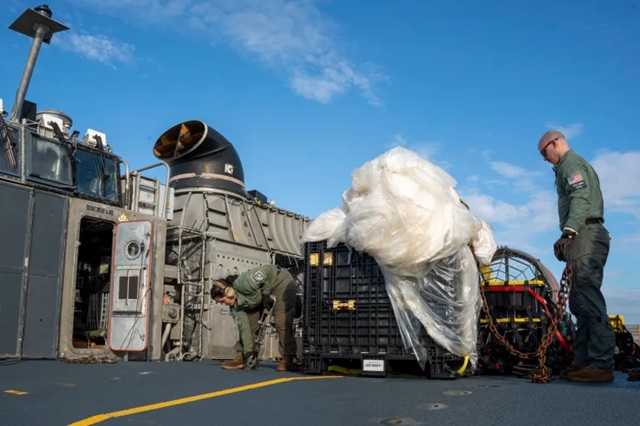
A Chinese balloon, which drifted across the United States in 2023 and was widely believed to be engaged in espionage, has been found to contain sophisticated American-made technology capable of intelligence gathering, according to a report from Newsweek, citing sources familiar with a U.S. military analysis. The examination of the balloon revealed that it was equipped with components from several American companies, underscoring potential gaps in U.S. export controls aimed at preventing the transfer of dual-use technologies to China and other nations.
The balloon, which first entered U.S. airspace over Alaska in January 2023 and later drifted across Canada and the American Midwest, was ultimately shot down by a U.S. F-22 fighter jet on February 4. The Chinese government has consistently maintained that the balloon was a civilian weather monitoring device that accidentally veered off course due to high winds, but the U.S. government and military have asserted that it was a surveillance asset.
According to Newsweek, U.S. military analysts discovered several American-made components in the balloon, including a satellite communication module, sensors, and parts from at least five U.S. companies. These technologies, including Iridium’s 9602 satellite communication module, are commonly used for global data communication and are capable of supporting surveillance operations. The technology also included components from Texas Instruments, Omega Engineering, Amphenol All Sensors Corporation, and Onsemi, as well as Swiss manufacturer STMicroelectronics.
The presence of these components raises serious concerns about the effectiveness of U.S. export controls on dual-use technologies—products that have both civilian and military applications. Iridium, which supplies satellite communication modules, acknowledged that it cannot track the ultimate end-use of its products and noted that such modules are widely available on the resale market. Iridium’s executive director, Jordan Hassim, stated that while the company does not condone the misuse of its technology, it cannot prevent its resale to unauthorized parties, such as those involved in the balloon’s surveillance mission.
The balloon, estimated to be around 200 feet tall and carrying a payload of surveillance equipment, was designed to capture images and gather intelligence data. The technology onboard allowed for high-altitude reconnaissance and might have even included small, deployable gliders intended for further surveillance. These findings were supported by a 75-page analysis conducted by the National Air and Space Intelligence Center (NASIC), which also identified components from two other similar balloons.
The incident has reignited concerns about the role of private companies in monitoring the end-use of their products. Some experts have criticized U.S. export restrictions as ineffective, given that China has successfully sourced critical technologies to further its military capabilities. James Mulvenon, Chief Intelligence Officer at Pamir Consulting, pointed out that these issues have been apparent for decades, and the Chinese military’s modernization has been in progress since the late 1990s.
In response to the revelations, companies whose technology was identified in the balloon have emphasized their compliance with export controls. However, the incident highlights the difficulty in ensuring that advanced technologies do not fall into the hands of foreign actors with military or surveillance intentions. As the U.S. government seeks to address these vulnerabilities, questions remain about how effectively it can monitor the use of its exported technologies in the global market.
As the fallout from the balloon incident continues to unfold, the U.S. government is likely to face mounting pressure to strengthen its export controls and improve transparency in the supply chain of sensitive technologies. The discovery underscores the complexities of regulating advanced technologies in an interconnected global economy, where components can easily be diverted and repurposed for unintended uses.