



by Our Special Correspondent
A controversial post published on QQ, a popular instant messaging platform in China, has generated significant attention after a Chinese blogger suggested military retaliation against Niger following the recent actions of the country’s military government. On March 15, 2025, Niger expelled three Chinese corporate executives from the country, all of whom worked for major Chinese companies, including PetroChina, the West African Pipeline Company, and the Zinder Refinery. In addition to the expulsions, the Niger government seized Chinese-owned assets worth over $3 billion, including key oil fields and refineries that had been developed over the years through China’s substantial investments.
The blogger criticized Niger’s military government for what they described as a “brazen plundering” of China’s legitimate assets, pointing to China’s role in building Niger’s oil infrastructure since 2003. The Chinese companies involved in the country’s oil sector, including CNPC, had helped Niger develop its oil industry from the ground up, including vital projects such as the Agadem Oilfield, the Bilma Oilfield, and the Niger-Benin Crude Oil Pipeline. These investments had been integral in transforming Niger into an oil-producing country, achieving self-sufficiency in refined oil, and even starting to export crude oil.
However, the writer of the post framed the Niger government’s actions as a direct violation of the cooperation agreements, explaining that the military-led government, which took power in July 2023, had implemented tough “resource sovereignty awakening” policies that were aimed at tightening its control over the country’s natural resources. The blogger referred to accusations made by the Niger government, claiming that Chinese companies had failed to meet localization requirements, had fallen behind on tax payments, and had paid excessively high salaries, among other grievances. These claims served as justification for the expulsion and asset seizure.
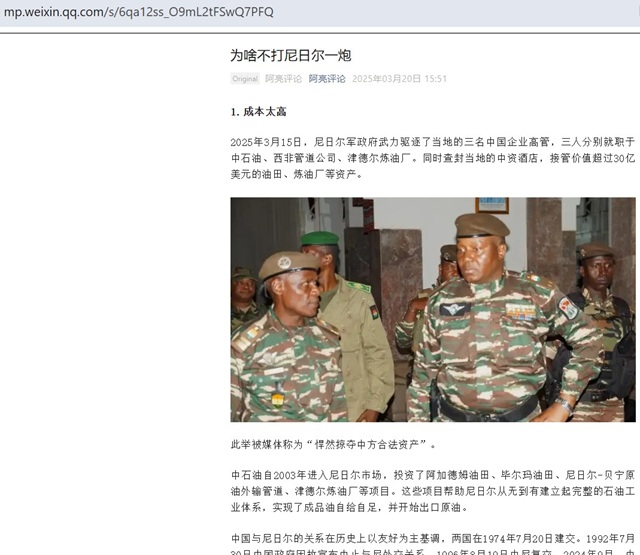
In a provocative section of the post, the blogger raised the possibility of military retaliation. Drawing on the strength of China’s military, the writer suggested that with China’s advanced missile capabilities, such as the Dongfeng-41 intercontinental missile, it would be easy to strike Niger. The post calculated the time it would take for such a missile to reach Niger, underscoring the military might at China’s disposal. However, the blogger also pointed out the significant costs associated with military action, both in terms of finances and the potential destruction that would come with it. The writer argued that war is not merely a military confrontation but a costly endeavor, with repercussions that go beyond the battlefield, including economic, human, and political costs.
Despite considering the possibility of using force to recover the seized assets, the blogger cautioned that such a move might not be worth it. The $3 billion in assets lost to the Niger government might not be sufficient justification for the financial and human toll that a military intervention would bring. The blogger pointed out that launching such a strike would not guarantee a return of the assets, and even if the Chinese government were to regain control of the oil fields and refineries, the costs of rebuilding and the further destabilization in the region could outweigh the benefits. Ultimately, the post suggested that the economic and diplomatic costs of war would make it an unwise option, highlighting the complexities of international relations and the need for more strategic responses.
The blogger also alluded to the broader geopolitical context, noting the involvement of various foreign interests in Niger. For example, French and Italian oil companies had long sought to push Chinese firms out of the region, and Russia had even attempted to seize Chinese-owned oil and gas assets through military groups. The post suggested that the situation was further complicated by Western media narratives that often portrayed Chinese investments in Africa as a “debt trap,” feeding into the perception that China’s investments were more about creating dependency than promoting mutual growth.
The writer expressed frustration with the international dynamics at play, suggesting that China, while generous in providing aid and investment to African countries, was often too benevolent and restrained in foreign policy. In the writer’s view, this tendency for restraint in the face of provocation could be seen as a form of weakness, as other nations and interests seemed to take advantage of China’s cautious approach. The post implied that China should not be so generous on the international stage, especially when its assets were being seized by rogue states like Niger.
The post, published on QQ, has drawn both support and criticism. Many readers have expressed anger over the loss of Chinese investments, while others have raised concerns about the potentially dangerous rhetoric of military retaliation. The incident has once again put the spotlight on China’s increasing involvement in Africa and the complexities of navigating resource control, sovereignty, and international relations in the 21st century. It remains to be seen how China will respond to the situation, but the blogger’s post has undoubtedly intensified the conversation surrounding China’s strategic interests in the region and how far it should go to protect them.










