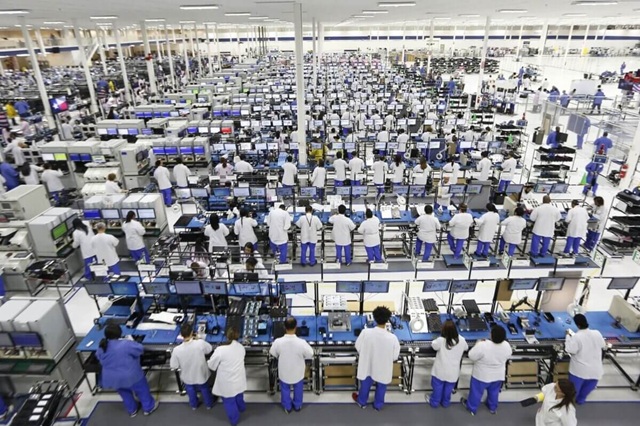
Chinese factories are suspending production and furloughing workers as a result of plummeting export orders triggered by steep U.S. tariffs, according to a detailed report by the Financial Times. The ongoing trade war, initiated under U.S. President Donald Trump, has forced businesses across China’s manufacturing sector—from plastics to electronics—to scale back operations or shut down temporarily.
With U.S. import duties now reaching at least 145% on most Chinese goods, American buyers have begun canceling or delaying orders for everything from jeans and electrical outlets to endoscopy kits and home appliances. About 15% of China’s exports last year were bound for the United States, making the impact widespread and deeply felt across several provinces.
In interviews with the Financial Times and via social media posts on platforms such as Douyin, workers shared images and video footage of eerily silent production lines and factory closure notices. “Our export orders disappeared so we’ve temporarily stopped,” said a 28-year-old worker at a plastics factory in Fujian province.
Manufacturers in the export hubs of Guangdong and Zhejiang have cut back overtime and weekend shifts. Some plants—like DeHong Electrical Products in Dongguan—have even placed workers on extended leave at minimum wage, citing “significant near-term pressure” after U.S. clients froze orders. The company told employees management was exploring new markets and cost reductions in a bid to resume normal operations.
At Hangzhou Stellarmed, a medical device manufacturer, workers were encouraged to spend the rest of April job-hunting, as the company’s U.S.-focused business dried up. “We don’t know how long this will last,” said the factory’s owner, Shi, in remarks to the Financial Times.
The broader mood is one of uncertainty. Wang Xin, head of the Shenzhen Cross-Border E-Commerce Association, said merchants had told suppliers to halt deliveries, leaving factories with no choice but to suspend production for up to two weeks. “Many are extremely anxious,” Wang said.
While electronics—particularly smartphones—have been largely exempted from the most severe tariffs, the supply chain disruptions are reverberating across cities like Shenzhen and Dongguan, which are now offering financial support measures. These include subsidies for attending foreign trade expos and expanded export insurance to cover canceled U.S. orders.
Nonetheless, the road ahead remains unclear. Han Dongfang, founder of the labor rights group China Labour Bulletin, warned that the restructuring of China’s manufacturing base will be a long-term, painful process. “Workers will be sacrificed,” he said.
Despite calls from Trump to negotiate directly with Chinese President Xi Jinping, Beijing has shown little urgency in returning to the table. China has countered Washington’s measures with tariffs of its own—adding a 125% levy on imports from the U.S.—while working to pivot towards other global markets to offset American losses.
Still, as one factory manager in Ningbo put it: “Hopefully the U.S. will change its policies.” For now, however, China’s factories are left to navigate a world where one of their largest customers is increasingly turning away.