


by Our Correspondent in Colombo
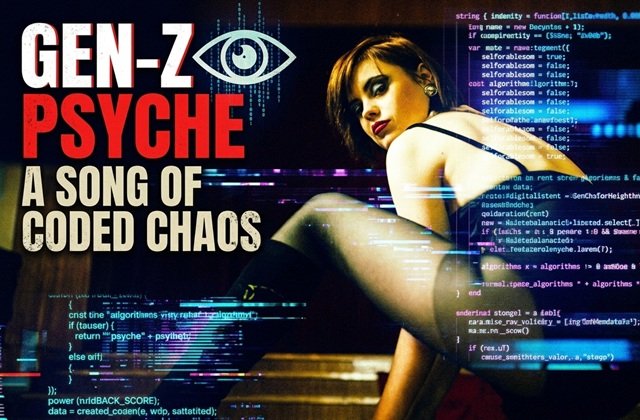
Our sister publication Lanka Courier’s social media channel has launched a new song titled Gen Z – Psyche: A Song of the Coded Chaos, a striking audio-lyrical experiment that captures the psychological atmosphere of a generation shaped by screens, algorithms, and fragmented attention. Rather than presenting a conventional narrative, the piece unfolds like an emotional system log of contemporary life, where identity is continuously constructed and deconstructed in real time. From its opening imagery of “glowing screens” and “coded scenes,” the song immediately situates listeners inside a world where childhood, learning, and even intimacy are mediated through digital interfaces. What emerges is not a stable sense of self, but a layered, shifting identity assembled from fragments of online experience, where memory behaves less like continuity and more like scattered data points stored across platforms.
At its core, the song engages deeply with psychological themes, particularly through its reinterpretation of classical thinkers such as Freud and Jung. In traditional psychoanalysis, Freud’s idea that “The interpretation of dreams is the royal road to the unconscious” positions dreams as symbolic pathways into hidden desire. In this song, however, that pathway is replaced by algorithmic interpretation, where unconscious patterns are no longer accessed through dreams but inferred through digital behavior, clicks, and consumption patterns. Similarly, Jung’s insight that “Until you make the unconscious conscious, it will direct your life and you will call it fate” gains a new resonance in a world where fate feels increasingly shaped by predictive systems, recommendation engines, and automated choice architectures. The unconscious is no longer purely internal; it is mirrored, tracked, and subtly anticipated by the systems surrounding it.
The chorus serves as the emotional and structural anchor of the composition, repeating like a looping awareness rather than a resolution. “We are Gen-Z in coming storm” positions the generation within ongoing instability rather than a defined endpoint, suggesting that turbulence is not an exception but a condition of existence. The idea of being “born inside a broken norm” reframes normality itself as something already fractured, while the lines “we break, we build, we override” reflect a vocabulary shaped by digital systems, where human agency is expressed through terms that resemble software logic. Rather than escaping the system, the voice of the song acknowledges participation within it, navigating instability through continuous adaptation.
Enjoy!









