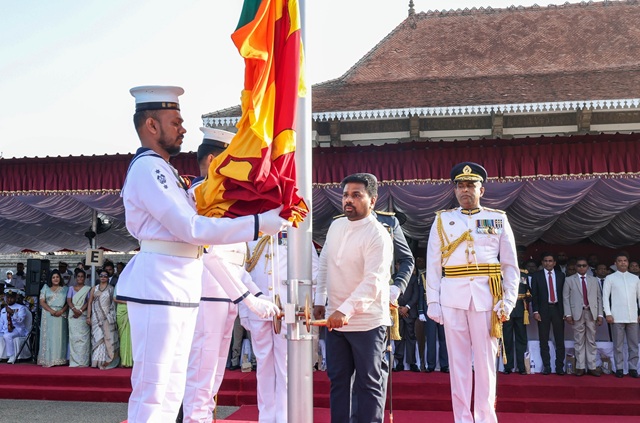
When President Anura Kumara Dissanayake stood before parliament on 20 March and confirmed that his government had turned down two military requests in a single evening — one from Washington to land missile-armed warplanes at Mattala, the other from Tehran to berth naval vessels at Colombo — he was not simply narrating a diplomatic footnote. He was describing the moment Sri Lanka’s foreign policy stopped being theoretical and became a live-fire test. As Al Jazeera reported, the US had asked, on 26 February, for two aircraft armed with anti-ship missiles to relocate from Djibouti to Mattala Rajapaksa International Airport between 4 and 8 March — two days before the US-Israeli offensive against Iran began. Iran, the same evening, asked for a goodwill port call by three warships. Dissanayake said no to both. “As a neutral nation we said no to both. That’s impartiality,” he told lawmakers, according to The Wire.
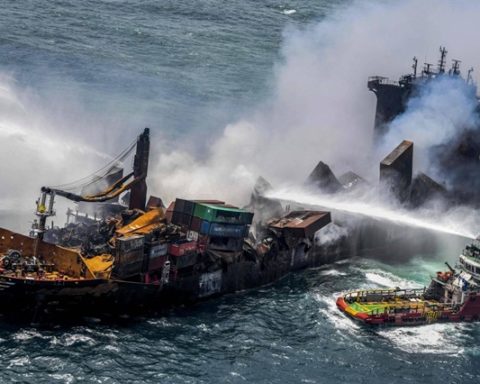
Days later, neutrality stopped being an abstraction and became a body count. On 4 March, a US submarine torpedoed the Iranian frigate IRIS Dena roughly 19 nautical miles off Galle, killing at least 84 sailors; Sri Lanka’s navy pulled 32 survivors from the water. A second Iranian vessel, IRIS Bushehr, was rerouted to Trincomalee and its crew sheltered near Colombo on what Dissanayake called humanitarian grounds, not political ones — a distinction detailed by the Defense Post. Colombo then abstained on the UN Security Council resolution condemning Iran’s attacks, calling it “a half-truth.” A war fought thousands of kilometres from Colombo had, in the space of a week, put an oil slick off Galle, a shipwreck’s worth of bodies on Sri Lankan shores, and two great powers’ patience to the test simultaneously.
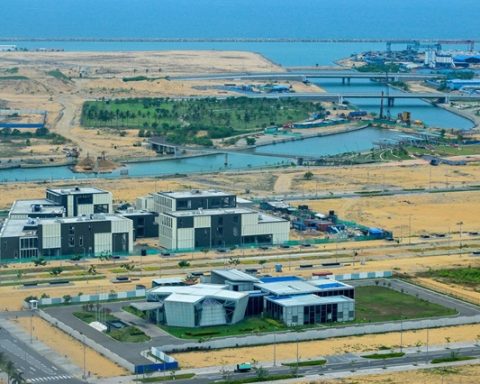
This is the paradox that defines the island’s geography: Sri Lanka sits astride the sea lanes linking the Gulf, South Asia and East Asia, which makes it indispensable to everyone and beholden to no one — in theory. In practice, as a recent analysis from Project O Five argues, Colombo’s claim to equidistance sits uneasily beside the fact that Mattala airport itself was built with Chinese EXIM Bank financing and sits beside the Chinese-leased Hambantota port — meaning the “neutral” ground the US wanted to use was, in origin, already part of the very “Chinese orbit” Washington is trying to counterbalance. Neutrality, in other words, is not a blank slate. It is a position staked out inside a landscape that decades of infrastructure diplomacy have already tilted.
That tilt is visible again, further out to sea. Roughly 650 nautical miles off Sri Lanka’s southern coast lies the Afanasy Nikitin Seamount, a cobalt-rich formation now at the centre of a legal and geopolitical deadlock between Colombo and New Delhi. Sri Lanka staked a continental-shelf claim to the area back in 2009 under a UN process, without Indian objection at the time. That changed after 2022, as India’s own net-zero ambitions sharpened its appetite for battery minerals and as Chinese research vessels — most visibly the Shi Yan 6, which docked in Colombo in 2023 — set off alarm in New Delhi about Beijing’s seabed mapping in what India regards as its strategic backyard. The result, as The Diplomat lays out, is a stalemate in which Sri Lanka’s own claim to a resource in its own extended waters is now hostage to a rivalry it did not start and cannot referee. The one-year moratorium Colombo imposed on foreign research vessels after the Shi Yan 6 episode was, as The Diplomat noted at the time, less a security policy than a stalling tactic — an attempt to buy space to write rules before the next vessel, and the next round of pressure, arrived.
None of this is new in kind, only in intensity. Sri Lanka has spent decades practising what analysts now call multi-alignment: taking Indian aid during the 2022 default, Chinese financing for ports and towers, and American market access for garments and tea, while conceding exclusive military use of its territory to no one. A recent commentary from NIICE Nepal frames this as a form of small-state agency — hedging among great powers rather than being flattened by them. The 2026 crisis suggests the model still functions, but at rising cost. Saying no to Washington and Tehran on the same night did not make Sri Lanka invisible to either capital; it made Colombo a place both capitals now watch more closely. The Morning has reported that Sri Lanka and China have discussed a memorandum on “Blue Partnership” ocean cooperation even as Delhi presses for a bilateral defence framework — two tracks running in parallel, each assuming Colombo’s attention is theirs to claim.
The lesson of this year is not that Sri Lanka should abandon neutrality but the alternative, becoming a forward base for someone else’s war, is far worse, as the oil slick off Galle and the 84 Iranian dead attest. The lesson is that neutrality has to be built, not merely declared. It requires transparent, published rules for who gets to dock, land, and survey that rules written before the crisis, not improvised during it. It requires diversifying creditors and export markets so that no single power can convert economic leverage into military access. And it requires regional partners, India chief among them, to accept that a Sri Lanka pressured into permanent alignment is a less stable neighbour than a Sri Lanka trusted to say no to everyone equally. Colombo did not ask to be a proxy chessboard for a war in the Gulf or a minerals race between Delhi and Beijing. That it has, so far, avoided becoming either is not luck. It is policy and it is worth defending, loudly, before the next request lands on a president’s desk.