Colombian prosecutors are investigating allegations that executives linked to a Chinese state-owned contractor demanded cash payments from a local subcontractor in exchange for approving invoices on Bogotá’s metro project, South America’s largest infrastructure development. The consortium leading the project has denied wrongdoing, insisting the money seen changing hands was part of a contractual retention agreement, while authorities and project overseers have launched separate investigations into the claims.
Colombian prosecutors have opened an investigation into allegations that executives associated with a Chinese state-owned contractor sought cash payments from a local subcontractor in exchange for releasing funds owed for work on Bogotá’s metro, one of the region’s most significant infrastructure projects.
The investigation follows a report published by Semana, Colombia’s leading news magazine, which detailed claims made by Union Temporal Metrobuild, a subcontractor working on the metro. According to the report, the allegations centre on a 26-minute video recorded on April 18 at the former Bogotá offices of China Harbour Engineering Company (CHEC), showing the legal representative of the Colombian firm handing over 60 million pesos (US$19,000) in cash to a commercial manager identified in the criminal complaint only as Yang.
The footage reportedly shows the Colombian contractor removing a dark bag from a suitcase and telling the Chinese executive in English that each package contained 5 million pesos (US$1,600). The executive is then seen counting the banknotes for approximately 10 minutes before writing what appears to be a receipt in a notebook.
According to the complaint cited by Semana, the payment was allegedly demanded as a condition for CHEC to approve invoices worth between 1 billion and 1.2 billion pesos (US$320,000 to US$380,000) for work completed in March. Metrobuild told prosecutors it agreed to make the payment because it faced obligations to more than 350 employees, as well as suppliers, banks and other creditors involved in financing the project.
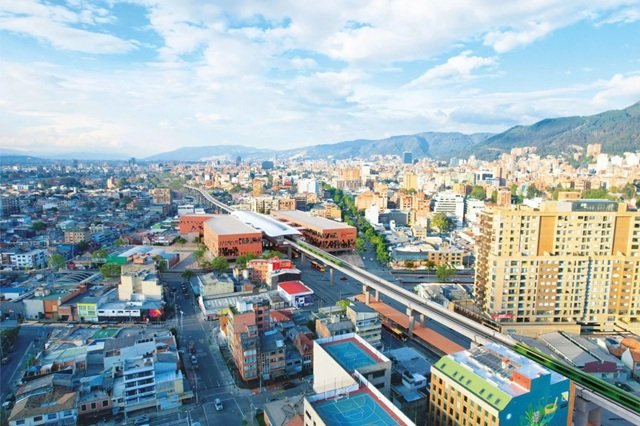
The allegations relate to the construction of Bogotá’s first metro line, a 24-kilometre elevated railway awarded in 2019 to a Chinese-led consortium headed by CHEC, with a 15 per cent stake held by Xian Rail Transportation Group. The concession was valued at approximately US$4 billion when signed and remains the largest infrastructure project currently under construction in South America. More than 15,000 people are employed on the project, which was just over 80 per cent complete at the end of June.
The system’s 30 driverless trains are being manufactured in Changchun by Chinese state-owned rolling stock producer CRRC. Fifteen trainsets have already arrived in Colombia, with testing scheduled to begin in September 2027 ahead of commercial operations planned for 2028.
Semana reported that the April 18 cash handover followed an April 8 meeting that was also recorded by the subcontractor. According to the complaint, Yang allegedly told Metrobuild that CHEC’s general manager of projects, identified as Wang Chuang, would only authorise payment for the March work after receiving 60 million pesos in cash.
Metrobuild told prosecutors it had signed at least four contracts with CHEC since 2024, valued at a combined 32 billion pesos (US$10.2 million), covering foundations, columns and other structural components of the metro viaduct. The company said payment approval delays began in March 2026 and argued that its contract contained no provision for the deductions cited by CHEC. It further stated that the Chinese contractor already retained more than 1.2 billion pesos as quality guarantees and that, despite the cash payment, more than 2.5 billion pesos (US$800,000) in invoices remained unpaid awaiting approval.
Julian Quintana, the lawyer representing Metrobuild, told Semana the alleged conduct could constitute extortion and collusion under Colombian law and urged prosecutors to seize the devices used to record the meetings to preserve the chain of custody.
CHEC is a subsidiary of China Communications Construction Company (CCCC), a major state-owned construction group involved in projects under the Belt and Road Initiative. The parent company’s corporate history has previously attracted international scrutiny. The World Bank barred CCCC and its subsidiaries from bidding on bank-financed road and bridge projects until 2017 over fraudulent practices linked to a Philippine road programme, while in 2020 the US Commerce Department placed CCCC units on its Entity List over their involvement in constructing artificial islands in the South China Sea. In Bogotá, CCCC’s ownership structure also led to the disqualification of two consortiums from the city’s second metro line tender in 2024 after authorities identified a conflict of interest.
Responding after the publication of Semana’s investigation, the Metro Línea 1 consortium rejected the allegations and stated that no illegal demand had been made. According to the consortium, the subcontractor had submitted a 960 million peso invoice disputed over the quality of its work, but CHEC agreed to process payment to avoid further delays to workers’ salaries. It said the 60 million pesos shown in the video represented a provisional retention agreed by both companies while Metrobuild corrected technical defects. The consortium added that the payment was delivered to CHEC’s finance department four days after the invoice had been settled and was supported by a signed receipt.
The consortium also said the video had been covertly recorded and argued that its publication had created confusion in public opinion. It announced the launch of a priority internal investigation under its compliance programme, reaffirmed its policy of zero tolerance towards bribery and corruption, and pledged to take action should any breach of internal procedures be identified.
The Empresa Metro de Bogotá, which oversees the project, separately announced that it had filed its own criminal complaint with the attorney general’s office, stating that it “categorically rejects any conduct that could constitute acts of corruption”. The company identified Wang as the manager responsible for the subcontractor’s girder-launching process and requested prosecutors determine whether any “criminally relevant” conduct had occurred. It emphasised that the executive had no labour, contractual or functional relationship with the public company and said the alleged events took place within private commercial dealings between CHEC, its unit and subcontractors. It also stated that concession payments had been made on schedule, meaning Metro Línea 1 remained responsible for paying its subcontractors on time.
The Chinese embassy in Bogotá did not immediately respond to a request for comment. Meanwhile, the allegations have prompted political scrutiny, with Bogotá city councillors calling for closer oversight of the project. Councilman Juan David Quintero urged city authorities and Mayor Carlos Fernando Galán to seek the immediate suspension of the executive named in the complaint, while Andrés Barrios of the opposition Centro Democrático requested a formal oversight debate to examine whether the project’s supervisory mechanisms had functioned effectively.