Eight months after the United States began its oil blockade of Cuba, the island is increasingly marked by scenes of stark economic contrast. In Havana, solar panels illuminate businesses during blackouts, electric motorcycles and imported cars move through the streets, and some residents have found ways to generate their own electricity. At the same time, large parts of the population endure prolonged power cuts, shortages of food and water, deteriorating homes and growing difficulty meeting basic needs.
The contrast is becoming one of the clearest expressions of Cuba’s deepening crisis. Those with sufficient resources can increasingly purchase alternatives to failing public infrastructure. For the majority, however, the options are far narrower.
The scale of the economic deterioration is substantial. Cuba’s economy is estimated to have contracted by more than 15% between 2020 and 2025. According to a report published this year by the Cuban Observatory of Human Rights (OCDH), 63% of households now have difficulty obtaining essential goods. The energy crisis has added another layer of pressure to an economy already struggling to provide basic necessities.
For many Cubans, working through darkness has become routine. A barber continues cutting hair during a blackout, illuminated only by the light of a mobile phone. The prolonged electricity cuts make ordinary activities increasingly difficult, but stopping work is often not an option.
The divide is particularly visible in access to electricity itself. The state-owned Unión Eléctrica de Cuba (UNE), responsible for electricity generation and distribution, has launched a programme this year to install 5,000 two-kilowatt photovoltaic systems donated by China. The systems are being distributed across all Cuban municipalities, with particular attention to isolated areas.
Yet much of the country continues to experience blackouts amid repeated collapses of the National Electroenergy System. In Havana, the sight of a bar remaining illuminated during a blackout because it has solar panels on its roof is still unusual. Many bars and restaurants, already suffering from reduced revenues because of the decline in tourism, cannot afford panels that would allow them to keep the lights on, refrigerate food or produce ice.
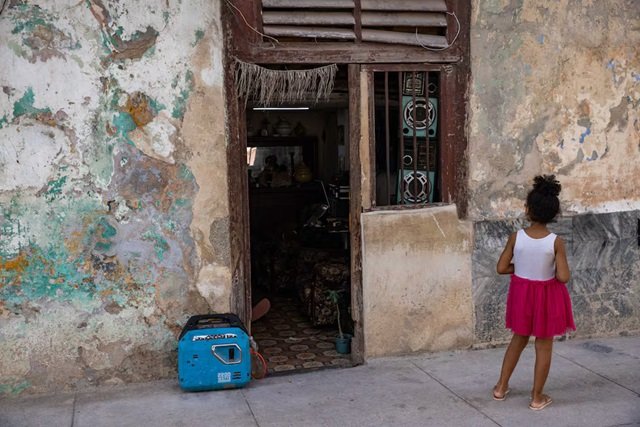
Some households have turned to generators, but that solution carries its own cost. Since January 2026, the price of petrol has risen from one dollar to five or six dollars per litre, making private electricity generation increasingly expensive.
The same contrast is visible on the streets. On the Malecón, an electric tricycle transports a solar panel. Elsewhere, electric motorcycles and scooters have become increasingly common. On 11 August, the Cuban government announced, through Decree 163, a new package of regulations replacing the 2024 rules that had already opened the door to vehicle imports.
The latest resolution is intended to facilitate imports of electric vehicles by reducing taxes. The state has also increased the number of companies authorised to sell vehicles in Cuba, from the current seven to 17.
The changes coincide with a growing influx of electric two-wheelers. Eduardo Rodríguez Dávila, the transport minister, said that private individuals imported 19,443 electric mopeds and motorcycles during the first six months of 2026.
For some Cubans, such vehicles represent a new form of mobility in a city where an electric scooter or motorcycle can now be an increasingly familiar sight. But the presence of imported electric vehicles alongside deteriorating housing and prolonged blackouts also illustrates the uneven distribution of purchasing power.
A high-end car passes a block where only the ruins of buildings remain along the Malecón. Some residents have enough money to purchase new imported cars with large engines, while others have watched their homes collapse.
The economic crisis has made it harder to maintain houses, accelerating the deterioration and collapse of numerous buildings in central Havana. According to the OCDH, 47% of homes require repairs, 25% require urgent intervention and 7% are at risk of collapse. Only 18% are considered to be in good condition.
The contrast between mobility and housing is mirrored by the crisis in food. In Centro Habana, dozens of people queue at a bakery, a scene that has become increasingly common. Some customers buy bread in large quantities and resell it door to door at a higher price to obtain an income, leaving bakeries frequently without supplies for the rest of the day.
Even securing the ingredients needed to produce bread has become more difficult. In June, Alberto López Díaz, the minister of the Food Industry (MINAL), said the US blockade had prevented five of the six vessels contracted to bring flour to Cuba from arriving, affecting production.
For those without the means to navigate shortages through private purchases, the consequences are becoming increasingly severe. Eight out of ten people now skip at least one meal a day, according to the OCDH, compared with seven out of ten the previous year.
In Havana, growing piles of rubbish have also become places where people search for recyclable materials or even food. On the streets of Old Havana, older people and children increasingly ask passers-by for assistance.
A World Food Programme (WFP) study published in April 2026 said the tightening of the economic, commercial and financial embargo imposed by the United States had intensified Cuba’s economic and financial exclusion and deepened the crisis. Shortages in state markets are forcing people towards private markets, where prices are increasingly high. The burden falls particularly heavily on low-income Cubans, including many women and older people who survive solely on their pensions.
Tourism, another important source of economic activity, is also in decline. Between January and July, 419,863 international tourists visited Cuba, 37.2% fewer than during the same period in 2025, according to the National Office of Statistics and Information (ONEI). Several airlines have reduced frequencies or suspended routes to the island.
The decline has affected many businesses in Havana. Yet it has not eliminated all pockets of consumption. Elite bars and restaurants continue to attract customers with greater purchasing power. In one Havana Vieja jazz club, a couple eats sushi while elsewhere in the city people queue for bread and search through rubbish.
The energy crisis reaches beyond electricity itself. During prolonged blackouts, water pumping systems cannot operate normally, making it difficult to fill tanks in buildings. A man accompanied by children carries water containers home on a non-motorised tricycle, turning access to a basic necessity into a physical task.
Across Havana, the images form a pattern of increasingly divergent experiences. Solar panels offer independence to those able to obtain them. Electric motorcycles provide mobility to those able to import them. Generators offer some households an escape from darkness, provided they can afford the fuel. Imported cars and luxury restaurants remain visible even as buildings deteriorate and food becomes harder to secure.
An electric motorcycle chained to an old car that has been parked for months on a Centro Habana street captures the contradiction particularly clearly. One represents a new form of transport entering the island; the other belongs to a past whose infrastructure is increasingly difficult to maintain.
Cuba’s crisis is therefore being expressed not only through shortages and blackouts, but through the unequal ability to escape them. For those with resources, private technology can provide alternatives to failing systems. For the majority, the same crisis is experienced through darkness, queues, deteriorating homes, scarce food and water carried home by hand.
The result is an increasingly visible divide: a Cuba where modern electric technology is becoming more common at precisely the moment when many of its citizens are struggling to secure the most basic necessities.