


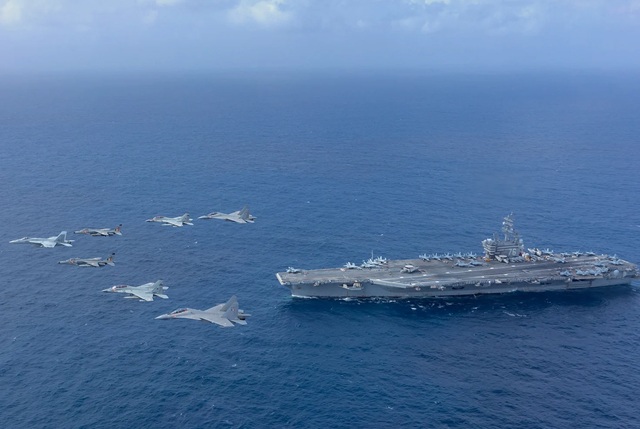
What does it mean when a defence strategy announces itself as a triumph before it has even articulated a problem? What kind of naval order is being imagined when a state declares, without qualification, that its armed forces are now “the world’s absolute best—its most formidable fighting force”? And what follows, precisely, when maritime access is no longer described as something to be preserved, but something to be “guaranteed” and, if necessary, “enforced with speed, power, and precision”?
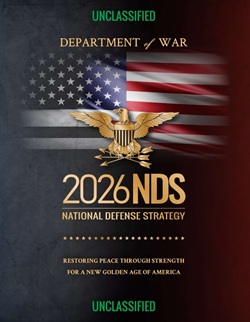
The 2026 National Defense Strategy answers these questions obliquely, but relentlessly. It is a document that speaks in absolutes, that treats uncertainty as weakness, and that elevates naval power from a tool of policy into a civilisational imperative. Its language is not cautious, nor even conventionally strategic. It is accusatory. It insists that America’s predicament was the result of having “squandered” its post–Cold War advantages, of having “ceded influence in our hemisphere”, and of having allowed access to “key terrain” to drift into doubt. The sea, in this telling, is not a medium of exchange or interaction. It is a space that must be repossessed.
The Strategy repeatedly frames maritime geography as something that has been lost and must now be reclaimed. It vows to “secure America’s borders and maritime approaches”, to “guarantee U.S. military and commercial access to key terrain”, and to ensure that the United States will “no longer cede access to or influence over key terrain in the Western Hemisphere”. This is presented as prudence. Yet the insistence on guarantees, rather than resilience or cooperation, betrays a deeper impulse: naval power is being recast as an instrument of entitlement. When access to the Panama Canal, Greenland, or the Gulf of America is framed as non-negotiable, the implication is not stability but compulsion.
This compulsion is explicitly historicised. The document invokes the Monroe Doctrine and declares a “Trump Corollary” to it, promising that America’s military “stands ready to enforce it”. Such phrasing is not incidental. It situates naval forces as the executors of a revived hemispheric hierarchy, one in which the presence of rivals is automatically construed as illegitimate. The seas of the Western Hemisphere are no longer imagined as spaces of shared navigation, but as zones of exclusion, policed by a power that claims the authority to decide who belongs and who intrudes.
The same logic is exported to the Indo-Pacific, albeit wrapped in the language of moderation. The Strategy insists that it does not seek to “dominate, humiliate, or strangle” China, and that its goal is merely to prevent “anyone, including China, from being able to dominate us or our allies”. Yet this professed restraint is immediately contradicted by the commitment to “erect a strong denial defense along the First Island Chain”. Denial, by definition, is not passive. It requires naval forces configured for interdiction, surveillance, and rapid strike, permanently forward and permanently alert. A fleet designed for denial is a fleet designed to compress decision time and to live at the edge of escalation.
The document repeatedly reassures the reader that this posture serves “a decent peace”. But the peace it imagines is conditional and asymmetrical. It is a peace that exists only so long as others accept a balance of power defined elsewhere, enforced by a force that promises it will be “strong but not unnecessarily confrontational”. The qualifier does considerable work. It acknowledges, perhaps inadvertently, that confrontation is not an aberration in this architecture, but a calibrated option, always present, always rehearsed.
Naval security, under this vision, becomes inseparable from industrial mobilisation. The Strategy demands that the United States “return to being the world’s premier arsenal”, capable of producing weapons “at scale, rapidly, and at the highest levels of quality”. This is not merely about readiness; it is about endurance across theatres. The document dwells on the prospect of “simultaneous aggression” and insists that allies must contribute so that potential adversaries can be deterred “even in the face of concurrent” crises. The sea, once again, is assumed to be a theatre of permanent contest, requiring fleets, shipyards, and supply chains structured for sustained confrontation rather than episodic defence.
Allies are woven into this maritime order, but on strictly defined terms. They are admonished for having allowed the United States to “subsidize their defense” while they invested elsewhere. They are now expected to spend more, to field more forces, and to take “primary responsibility” in their regions. Yet the Strategy makes clear that access, posture, and escalation control remain centralised. Allies are necessary to extend reach and share burden, but not to shape the rules of the naval system being imposed. Partnership, in this formulation, is conditional on compliance.
Perhaps most revealing is the Strategy’s moral language. It repeatedly contrasts “utopian idealism” with “hardnosed realism”, declaring that the former has been discarded. Yet what replaces it is not restraint, but a moralised realism in which American interests are treated as self-evident and enforcement as virtuous. Operations that restore access are celebrated as proof of resolve; adversaries are warned that the United States will be “ready to take focused, decisive action” wherever its interests are challenged. Naval power is thus endowed with an ethical charge: it is not merely force, but correction.
The document insists that “peace is the highest good”, but immediately qualifies that peace must never come at the expense of “security, freedoms, and prosperity” as defined by one actor alone. It offers rivals a choice: accept a “reasonably conceived” order or face a military that promises it will “stand ready to fight and win the nation’s wars”. There is no ambiguity here, only conditional tolerance. The olive branch is offered, but the sword is already unsheathed.
This Strategy does not imagine the sea as a shared domain governed by restraint and reciprocity. It imagines it as a proving ground, a space where resolve is demonstrated, hierarchies enforced, and industrial capacity translated directly into influence. It asks the reader to accept that such an order will be stable because it is strong. What it does not ask—what it does not permit—is whether a naval system built on permanent denial, guaranteed access, and enforced hierarchy can ever escape the gravity of its own assumptions.










