
Analysis of World Bank bilateral lending data is leading some observers to conclude that China is no longer a net provider of bilateral credit to the Global South. Repayments and debt servicing costs are now outstripping new loan commitments. This was the finding of a recent study by the Lowy Institute which concluded that “soaring debt repayments and a sharp reduction in lending have transformed China’s role in developing country finances from capital provider to debt collector.”
The Lowy paper, however, has limited its analysis to disclosed, official, bilateral public and public guaranteed debt (PPG). As the Lowy paper rightly points out, comprehensive analysis of China’s overseas lending practices is made impossible by the opacity of the data. There are definitional issues with regards to what constitutes state lending from China. In addition, there is the issue of disclosure around public guarantees, particularly when applied to state-owned enterprises (SOEs) in recipient countries.
There are two key points to consider here. Firstly, from both a developmental point of view, and from the perspective of potential geopolitical leverage, there are many alternatives to official bilateral PPG debt. It makes little difference which Chinese institution has conducted the lending, since China’s capital controls ensure that, in most cases, any such financing is in line with Party-state objectives. Equally, other forms of financing such as direct equity investment and portfolio flows have their role to play in furthering economic development and garnering political influence.
Secondly, new flows are likely being dramatically understated because of a lack of disclosure or because they fall outside the definitions applied by the World Bank or other institutions and therefore are not being included in particular datasets. AidData, for example, tracked up to US$1.3 trillion of Chinese lending to emerging economies. By way of comparison, the World Bank external debt numbers include just US$123 billion of PPG debt owed to China.
As a starting point for assessing the size of Chinese capital flows to emerging economies, it is worth beginning with a macroeconomic analysis of China’s total capital exports. China runs a current account surplus that in 2024 amounted to US$423 billion according to the data provided by the State Administration of Foreign Exchange (SAFE). As we have argued elsewhere this number probably understates the true size of China’s current account surplus, but it is the best data we have.
The current account surplus is, by definition, equal to the amount of China’s net capital exports. To this number we must add foreign capital inflows into China to arrive at China’s gross capital exports. In 2024, foreigners actually withdrew US$12 billion from China, so China’s gross capital exports totalled US$411 billion.
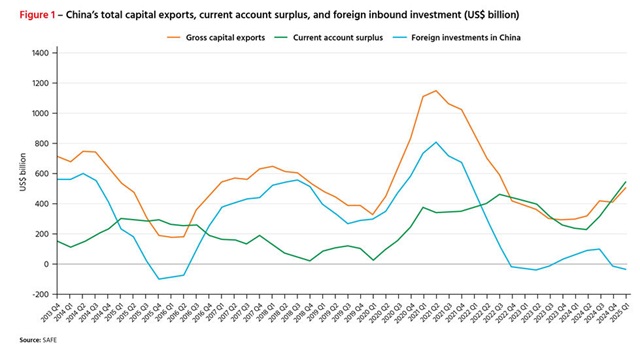
The chart below shows the 12-month rolling sum of China’s gross capital exports and the breakdown between the two sources: the current account surplus and foreign purchases of Chinese financial assets and investment.
The chart shows that China’s total capital exports troughed at about US$200 billion in 2016 and peaked at nearly US$1.2 trillion in 2021 and are now running at about US$540 billion. The volatility is largely down to the variation in foreign appetite for Chinese assets. The crackdown on China’s tech companies; the property bust; disappointing long-run returns and a lower growth trajectory combined with US economic statecraft have, unsurprisingly, dampened foreign enthusiasm. Nevertheless, cumulatively since 2013, China’s gross capital exports have totalled an incredible US$6.8 trillion. Furthermore, the average annual outbound flow of capital between 2013 and 2016, when it has been suggested bilateral PPG lending peaked, was US$500 billion, whereas the average flow post-2016 has increased to US$577 billion.
So where is all this capital flowing to and in what form? The answer appears to be that no one knows for sure and much of it is unaccounted for – even by the Chinese authorities themselves.
Of the US$ 6.8 trillion of total capital exports China made after 2012, an astonishing US$1.5 trillion (22%) are unaccounted for and have been put into the “errors and emissions” line of the balance of payments. These flows must have taken place for the balance of payments to be balanced, but they are not included in China’s overseas assets for calculating its net international investment position, which is consequently very understated.
An exceedingly small proportion, just over 1%, went into reserve assets. Foreign direct investment (FDI) accounted for 30% of the cumulative flows, about US$2 trillion, while portfolio flows accounted for 19% or US$1.3 trillion. The “others” category, which includes the accumulation of foreign currency and deposits, trade finance, and loans and payables accounted for another 30% of flows or about US$2 trillion.
Geographically it is hard to be sure how much of these overseas investments have and continue to head towards developing economies. Ministry of Commerce (MOFCOM) data confirms the relatively small scale of Chinese FDI investment in the US, putting the North American share at just 3.7% of China’s total FDI stock. Europe is only slightly larger at 5%, meaning that the two largest economic blocs account for less than 10% of China’s overseas direct investment stock. In contrast, MOFCOM data shows that the stock of Chinese FDI in Belt and Road Initiative (BRI) countries jumped by US$120 billion between 2021 and 2023 to stand at about US$334 billion. Asia dominates China’s global investment footprint, but Latin America has received twice as much FDI as the US and Europe combined, while Africa has received about half of the North American total, which is an outsized proportion relative to Africa’s GDP.
As geoeconomic competition intensifies and the global economy fragments into blocs for trade and investment, we can expect an ever-increasing proportion of China’s overseas capital to be directed toward the developing world. These flows will no doubt have a sharper strategic focus but will still provide a source of growth financing to the developing world. Equally, we are unlikely to see greater transparency in Chinese data to enable more granular analysis. An overreliance on incomplete data sources to formulate policy could lead to significant policy errors but the highest-level macroeconomic data leaves little doubt that China is and will remain a major source of new capital for the Global South.