



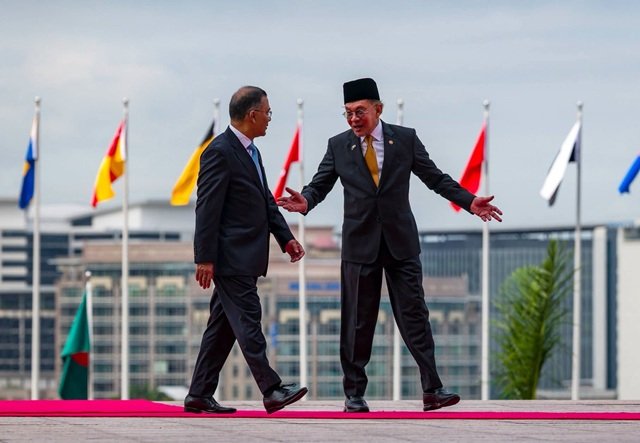
Bangladesh Prime Minister Tarique Rahman’s first overseas tour since assuming office in February 2026 was as much about signalling intent as it was about securing tangible outcomes. By choosing Kuala Lumpur and Beijing as his first destinations thereby departing from the longstanding convention of an initial visit to New Delhi—Rahman set a deliberate tone for his administration’s foreign policy. The tour, conducted between 21 and 26 June, underscored a strategic shift toward diversification of partnerships, economic pragmatism, and enhanced diplomatic flexibility. Through a combination of political outreach, economic negotiations, and symbolic gestures, the visits collectively indicated Dhaka’s intent to broaden its external engagement while recalibrating regional priorities.
The Malaysia leg of the visit, though relatively brief, was rooted in urgent economic considerations. Labour migration formed the central pillar of bilateral discussions, reflecting the vital role overseas employment plays in sustaining Bangladesh’s economy through remittance inflows. Malaysia remains a key destination for Bangladeshi migrant workers, and Rahman’s engagement with Malaysian Prime Minister Anwar Ibrahim focused on reopening and expanding the labour market. Equally important was the emphasis on reforming recruitment systems to enhance transparency and reduce exploitative practices that have historically affected migrant workers.
Discussions also addressed the status of undocumented Bangladeshi workers in Malaysia, with both sides exploring pathways for regularisation and legal protection. These concerns extended beyond immediate labour access to questions of worker welfare, governance, and long-term sustainability of migration flows. In this sense, the Malaysia visit reflected a pragmatic approach to safeguarding a critical economic lifeline.
Beyond labour migration, the talks expanded into broader domains of economic cooperation. Trade, investment, energy, agriculture, education, and the digital economy featured prominently on the bilateral agenda. The two countries signalled mutual interest in deepening economic ties, particularly in areas aligned with Bangladesh’s development priorities. While the outcomes in Malaysia were modest in scale, they carried both symbolic and functional significance. A Memorandum of Understanding on cultural cooperation was signed, alongside exchanges of notes on counterterrorism research collaboration and investment promotion. In addition, ongoing discussions on a potential free trade agreement suggested a forward-looking approach aimed at institutionalising economic integration over the long term.
If Malaysia addressed immediate economic concerns, the China leg of the tour represented its strategic core. Rahman’s engagements in China combined high-level bilateral meetings in Beijing with participation in the World Economic Forum’s Summer Davos in Dalian, positioning Bangladesh within broader global economic discourse. This dual-track engagement underscored Dhaka’s intent to align its national development agenda with wider global economic trends.
The scale and scope of agreements concluded with China were significantly larger than those in Malaysia. Bangladesh and China signed 13 memoranda of understanding and two formal agreements, forming part of a broader package of cooperation instruments negotiated during the visit. These instruments spanned a wide array of sectors, including infrastructure, trade, investment, education, technology, and human resource development.
A key emphasis was placed on investment and industrial cooperation. Chinese commitments to expand investment in Bangladesh’s economic zones—particularly in Anwara and Mongla reflected a broader strategy to enhance industrial capacity, boost exports, and generate employment. Notably, a dedicated memorandum of understanding on cooperation related to the development and utilisation of Mongla Port added a critical maritime dimension to bilateral ties; significantly, the project—originally envisaged as an India-supported initiative has since been reassigned to China, a shift that is likely to be viewed as a matter of concern in New Delhi. The agreement signalled efforts to strengthen Bangladesh’s logistical infrastructure, improve port efficiency, and integrate the facility more effectively into regional trade networks. In doing so, it positioned Mongla as a strategic asset within broader connectivity frameworks linking South and Southeast Asia.
Development cooperation also featured prominently under China’s Global Development Initiative. Projects and programmes targeting health, education, and human resource development highlighted the socio-economic dimension of the partnership. These initiatives suggested an attempt to move beyond purely infrastructure-driven cooperation toward a more comprehensive development model.
Trade remained another major area of focus. Bangladesh sought to enhance its export capacity and secure improved access to Chinese markets, including for agricultural products. Such measures are particularly significant in the context of Bangladesh’s efforts to diversify its export base beyond traditional sectors. Meanwhile, infrastructure cooperation continued to occupy a central role, with discussions on river management and the long-pending Teesta project drawing attention. China’s willingness to support flood control, water resource management, and related infrastructure added a strategic layer to the partnership, extending beyond conventional economic cooperation.
The visit also hinted at a gradual expansion of bilateral relations into strategic and security domains. While economic cooperation was foregrounded, joint statements and discussions referred to broader collaboration across connectivity and strategic sectors. Reports of potential defence cooperation, including discussions around Chinese military hardware, suggested a cautious but discernible widening of the relationship into the security sphere.
Taken together, the China leg of the tour reflected an effort to consolidate and deepen an already significant partnership. By securing commitments in infrastructure, technology, and financing, Bangladesh aims to strengthen its domestic growth trajectory while embedding itself within evolving regional and global economic networks. This approach aligns with Dhaka’s broader strategy of leveraging external partnerships to support internal development objectives.
The broader significance of Rahman’s foreign tour lies in the coherence of its underlying approach. The emphasis on diversification reduces reliance on any single partner, while economic pragmatism ensures that engagements are closely tied to national development priorities. Malaysia represents the importance of labour markets and remittance flows, while China embodies access to capital, infrastructure, and large-scale development support. Together, these engagements illustrate a calibrated effort to balance immediate economic needs with long-term strategic considerations.
For India, the implications are both symbolic and substantive. The decision to bypass New Delhi as the first destination marks a notable departure from established diplomatic practice, signalling a shift in emphasis rather than a complete reorientation. At the same time, the scale and depth of engagement with China particularly in infrastructure and port development introduce new dynamics into regional geopolitics. Bangladesh’s efforts to diversify trade partnerships may also gradually reshape existing economic patterns, including its dependence on Indian markets. However, structural realities such as geography, economic interdependence, and cultural ties ensure that India remains an indispensable element of Bangladesh’s strategic landscape.
Rahman’s first overseas tour, therefore, extends beyond routine diplomacy. It offers a clear indication of the direction in which Bangladesh’s foreign policy is evolving—toward a more flexible, multipolar framework that prioritises economic growth and strategic autonomy. The agreements signed in Kuala Lumpur and Beijing reflect a government focused on employment generation, infrastructure development, and enhanced connectivity, while the sequencing of the visits signals a willingness to engage the wider region on its own terms.
In a geopolitical environment characterised by shifting alignments and competing influences, Bangladesh’s evolving strategy reflects an adaptive and forward-looking posture. The trajectory from Kuala Lumpur to Beijing thus serves not only as an introduction to a new leadership’s foreign policy but also as a broader statement of intent: to navigate complexity through diversification, balance, and strategic engagement.










A Masterful Exploration of Bangladesh’s Emerging Diplomatic Landscape.
Dhaka’s New Diplomatic Map is an intellectually compelling and remarkably insightful analysis of the evolving contours of Bangladesh’s foreign policy.
With exceptional clarity and strategic depth, revered Batabyal bhai, you have skillfully unpacked the intricate dynamics shaping Dhaka’s engagement with an increasingly complex geopolitical environment.
The article rises above conventional political commentary by offering a balanced and nuanced examination of diplomacy as both an instrument of national interest and a reflection of global realignments.
Its lucid prose, persuasive arguments, and thoughtful interpretation transform a complex subject into an engaging and accessible narrative.
What makes this work particularly commendable is its ability to place Bangladesh within the broader architecture of regional and global diplomacy without sacrificing historical context or strategic perspective.
Every paragraph reflects meticulous research, intellectual integrity, and a profound understanding of international relations.
This is more than an article—it is a valuable contribution to contemporary geopolitical discourse.
It deserves the attention of diplomats, policymakers, scholars, journalists, and every reader seeking to understand the changing diplomatic landscape of South Asia.
It stands as a testament to thoughtful journalism and strategic analysis of the highest order.
Thank you so much, respected Batabyal bhai. Joy Bangla. Joy Bangabandhu. Jai Hind.
—- Anwar A. Khan, a direct witness of the brutal birth of Bangladesh from the direful Pakistani military regime from very close proximity in 1971 and a frontline Freedom Fighter of the 1971 war field to establish Bangladesh.