


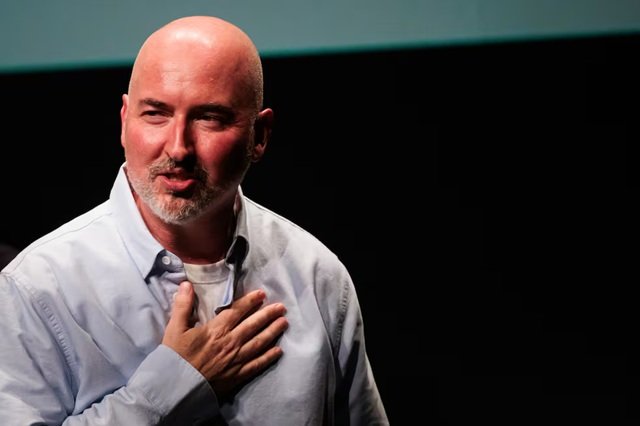
In an interview with El País, Scottish writer Douglas Stuart speaks about the subjects that have defined both his life and his fiction: poverty, fractured families, homosexuality, class and the enduring difficulty of belonging. But a conversation intended to avoid Donald Trump eventually turns towards the US president — and Stuart’s fears about what America may become after Trump leaves office.
Stuart, 50, was born in Glasgow and is preparing to publish John hijo de John in Spanish, following the international success of Shuggie Bain, which won the Booker Prize in 2020, and Young Mungo. His novels return repeatedly to families trapped by economic hardship, relationships marked by emotional pain and homosexuality experienced in societies where being openly gay could carry profound consequences. Their setting is largely the Scotland of the 1980s and 1990s, a period Stuart also experienced personally.
His own childhood was marked by poverty and family breakdown. His father left when he was four and died soon afterwards, while his mother, an alcoholic with whom he had a close relationship, died when he was 16. Those experiences have left him viewing family less as a simple source of comfort than as something complicated and unresolved.
“Family for me is a puzzle that I am still trying to decipher,” Stuart tells El País.
Yet he also recognises the literary power of such difficult relationships. The suffocating atmosphere of John hijo de John, he suggests, comes partly from the reality that loving families can still cause profound pain. “It would be very boring to write only about people who love each other and behave correctly,” he says.
For Stuart, this complexity is particularly relevant to gay and lesbian people, who may grow up constructing versions of themselves because they cannot safely reveal who they are. Love from parents does not necessarily eliminate that isolation.
“Just because your parents love you does not mean they do not cause you pain,” he says, arguing that families are more complicated than the conventional language of love and acceptance suggests. Even when relatives are proud of him, he says, there are parts of his life they cannot fully share with him.
That sense of isolation extends into Stuart’s understanding of gay history. He believes the remarkable advances in LGBT rights over recent decades have also encouraged younger generations to look away from the painful past.
His new novel returns to a period when gay people could feel profoundly isolated, particularly before the arrival of the internet. Stuart says his generation has not fully confronted the emotional cost of that history.
“I feel we lose something by not talking about how hard the recent past was,” he says. “I am only 50; all of this happened during my lifetime.” For him, that painful history is part of queer history, but gay communities, he believes, are still not ready to confront their collective pain.
The contrast with contemporary gay life is stark. Stuart remembers a period when relationships could develop through months of letters between strangers, conversations about families, schools, hopes and ordinary life. When he began working on John hijo de John, he returned to some of those letters and was struck by how desperately isolated he and others had been.
Today, he argues, technology has made sexual connection easier but has not necessarily eliminated loneliness. People can find someone who matches their preferences almost instantly, yet the speed and explicitness of modern dating can come at the expense of deeper intimacy.
“It is practical, but it corrupts the soul a little,” he says.
Stuart himself has been in a relationship with his husband for 30 years. They met when Stuart was 20, at a time when marriage between two men was not legally recognised, but he says they effectively decided to marry within a month of meeting.
When he began writing John hijo de John in 2018, Stuart wondered whether returning to these themes was still necessary. The US Supreme Court had recognised same-sex marriage only three years earlier, and it seemed to him that a major battle had been won. Since then, however, he has watched the political climate change.
The treatment of transgender people under the Trump administration has reinforced his decision to return to questions of queer identity and vulnerability. Seeing politicians and writers attack trans people, he says, made the themes of his novel increasingly relevant.
Class is another central concern. Stuart is determined that discussions of sexuality should not erase economic background. He grew up seeing gay characters in films associated with affluent worlds, joking that it sometimes seemed as though “to be gay you had to play cricket”.
His own journey across class boundaries was dramatic. He was the first in his family to complete secondary education and began what he describes as leaving his social class in 1994, when he entered Glasgow’s textile college. Scotland’s scholarship system made that transformation possible, he says, although he believes such opportunities no longer exist in the same form.
After completing a master’s degree in fashion, Stuart was recruited by Calvin Klein. He moved to New York in 2000 and later worked for Ralph Lauren, entering the world of luxury fashion that was far removed from the poverty of his childhood.
But the experience was deeply uncomfortable. He found himself surrounded by people who had never needed to worry about money, while decisions were sometimes made on the basis of making products deliberately inaccessible through price.
At Ralph Lauren, he says, highly educated young designers from middle- and working-class backgrounds worked alongside people who had gained influence through social connections and privileged family backgrounds.
“It was a microcosm of social classes, like a miniature Dickens novel,” he says.
Eventually, the contradiction became unbearable and he left the industry.
Stuart may have escaped poverty, but he insists that poverty never leaves the person who experienced it. His childhood continues to shape how he spends money, how he thinks about fairness and even whether he feels entitled to buy something as ordinary as the olive-oil cake sitting in front of him during the interview.
“You never leave the social class you grew up in,” he says. “If you have ever known poverty, you never forget it.”
That experience also shapes his disappointment with the United States, the country where he has spent more than half his life and of which he is now a citizen.
The conversation eventually returns to Trump. Stuart says he and his husband have begun considering leaving America. He does not believe the country will necessarily become better when Trump leaves office in 2028.
“He has planted the seed of hatred, and it will remain,” Stuart says.
More than Trump himself, however, he fears the people who support him.
Stuart arrived in America believing that the promise of the American dream could become a reality. Coming from Glasgow, he says, the idea that people could be accepted and build better lives through hard work appeared genuine.
He no longer believes that promise is secure.
America, he says, has become so intolerant that it can feel dangerous, making it difficult to maintain hope in the face of hostility. Trump, in his view, is not the sole cause but a symptom of something deeper.
“Every country is an experiment,” Stuart says. “And the United States is very young, barely 250 years old. It is still discovering how to build itself.”
But he believes hatred has increasingly become part of the country’s political currency, directed at immigrants, queer people, transgender people, women and Black Americans.
He has little sympathy for Trump, whom he describes as “a lunatic, a narcissist and a conman”. Yet his greater concern remains the millions of Americans who support him.
“They carry much of that hatred in their hearts,” Stuart says. For someone who built his life in America believing it could be a place of acceptance, confronting that reality has become deeply traumatic.
For Stuart, poverty, sexuality, family and politics ultimately converge around the same question: what does it mean to belong? His novels explore people struggling to find an answer, while his own life has taken him from a poor childhood in Glasgow to the world of American fashion and finally to international literary success.
But the past remains present. Poverty still shapes his decisions. His family remains a puzzle. The history of gay isolation still informs his fiction. And the country he once chose as home now leaves him questioning whether he can remain there.
His fiction may be rooted in the Scotland of decades ago, but Stuart’s fears are unmistakably contemporary. The battles over class, identity, belonging and acceptance that shaped his childhood have not disappeared. They have simply taken new forms.
And, as Stuart warns, changing political leaders may not be enough to erase what has already taken root.










