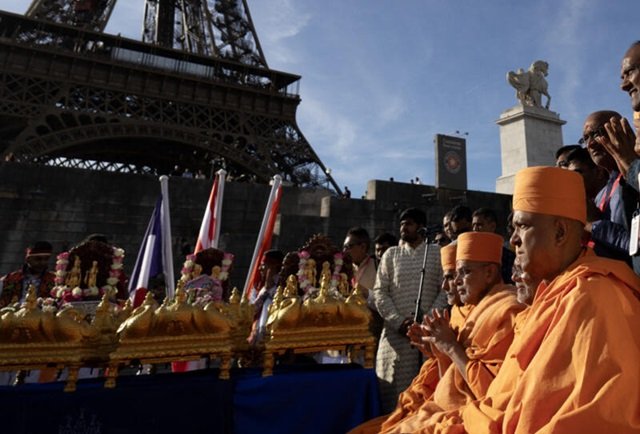
The Eiffel Tower was closed on Monday following a strike by staff over the removal of female employees during a visit by a Hindu religious delegation, workers and management said, turning a dispute over workplace instructions into a wider confrontation over France’s commitment to gender equality.
The delegation’s visit took place on the same day as a cultural boat procession on the Seine organised by the Bochasanwasi Akshar Purushottam Swaminarayan Sanstha, or BAPS, spiritual movement.
In a statement, Eiffel Tower staff condemned what they described as “professional instructions that led to female employees being sidelined, replaced and made invisible because of their sex” during the delegation’s visit.
“Instructions were given to female employees of the Eiffel Tower and to female employees of contractors to make themselves invisible in order to welcome this delegation,” the staff said, adding that they were shocked to have been placed in such a situation.
According to the employees, some women were instructed to leave their posts and withdraw to other areas, while in some positions they were replaced by men. Female employees were also told not to go through or cross certain areas while the delegation was present.
The operating company responsible for the Paris landmark, SETE, acknowledged that the Hindu delegation had requested that the visit be organised to limit “interactions with women”. The company said such conditions “should not have been accepted”.
SETE said the arrangements were “not in line with SETE’s values, nor with the principles of equality between men and women”, and promised to accept the “consequences”.
Ariel Weil, president of SETE and a socialist elected official in Paris, described the arrangements as unacceptable and reaffirmed the landmark’s commitment to France’s republican principles.
“It is clearly not an acceptable practice,” Weil said. “I restate the Eiffel Tower’s commitment to republican values and to the equality of men and women.”
The dispute quickly moved into the political arena. Paris’s socialist mayor, Emmanuel Gregoire, said on X that it was “unacceptable” that Eiffel Tower management had agreed to the delegation’s conditions and announced that an investigation would be launched.
The Eiffel Tower, which receives nearly 7 million visitors a year according to its website, remained closed throughout Monday. A staff representative said it would reopen as normal on Tuesday.
The incident also triggered criticism from senior French politicians across the political spectrum. Equality Minister Aurore Berge reacted angrily on X, declaring: “In France, we do not ask women to erase themselves. No dogma, no religion is above the laws of the Republic.”
The controversy comes shortly after BAPS consecrated its first major temple in France on Sunday, near Paris. The organisation is close to Indian Prime Minister Narendra Modi’s ruling conservative Hindu nationalist party.
Far-right presidential candidate Marine Le Pen also criticised the incident, saying France would “never accept that women’s presence be ’limited.’”
Gabriel Attal, a centrist rival to become president, similarly rejected any suggestion that cultural or religious considerations could determine the role of women in French public life.
“In France, no culture, no belief, no religion, nothing and no one can come and dictate to women what their place should be,” Attal said.
The closure of one of France’s most recognisable landmarks has therefore become the focal point of a broader dispute over the limits of religious accommodation and the application of equality principles. For Eiffel Tower staff and French political figures who have condemned the arrangements, the central issue is whether religious requests can justify treating female employees differently from their male colleagues.