European countries are increasingly confronting the history and continuing consequences of the transatlantic slave trade, yet formal apologies and meaningful reparations remain rare as governments draw a legal line between acknowledging the past and accepting responsibility for its costs.
When the United Nations General Assembly voted in March to recognise the transatlantic trafficking of enslaved Africans as the greatest crime against humanity and called for reparations for affected countries, every member of the European Union abstained.
European delegations described slavery as a tragedy “without parallel”. They said its memory must be preserved and pointed to monuments, foundations and public policies designed to ensure that the history is not forgotten. But they drew a firm distinction when the question moved from remembrance to legal responsibility.
The European position was that a crime committed during the colonial era could not automatically create a legal obligation today to provide reparations.
The resolution, sponsored by Ghana and the African Union, nevertheless passed, placing before the international community demands from a continent from which an estimated 12.5 million people were transported to the Americas and subjected to enslavement. Those demands include formal apologies, the return of looted property, compensation for those affected and legal and political reforms aimed at preventing racism and discrimination from reproducing the damage of the past.
Europe, however, is not starting from nothing.
Over recent years, a growing number of European countries have acknowledged the brutality of the slave trade and its continuing consequences, while taking cautious steps towards restorative justice. Yet only the Netherlands, in 2022, and the Catholic Church, in 2026, have issued formal apologies.
Restitution of looted cultural objects has also accelerated, alongside monuments, memorials, educational initiatives and other symbolic gestures. More ambitious measures, particularly those involving financial compensation, have proved considerably harder to achieve.
As historian José Antonio Piqueras, author of Negreros and professor at Jaume I University, explains, the transportation of Africans to the Americas represented a profound transformation because it “racialised slavery” from the 16th century onwards.
Melissa Hendrickse, legal adviser on racial justice and international criminal law at Amnesty International, says European states have realised they “cannot stand idly by”. But, she argues, governments are trying to contain the consequences. “They do the bare minimum or try to dictate the conditions under which they offer reparation,” she says. “But it is problematic because it reproduces the kind of colonial dynamic between European states and their former dominions.”
One of the clearest dividing lines is between recognising wrongdoing and formally apologising for it.
Repentance and an apology are not necessarily the same thing, particularly in legal terms. An apology is addressed to victims and acknowledges that a wrong or crime was committed. Ana Lucia Araújo, a historian at Howard University, says the distinction matters when discussing reparations.
“Repentance does not imply recognition of an error,” she says.
Belgium confronted precisely this problem in 2022, when a parliamentary committee examining Belgian colonial rule in Congo failed to agree on whether the state should say it “regrets” its past or “apologises” for it. Some lawmakers feared that an official apology could become the first step towards financial claims for reparations. No declaration was ultimately adopted.
“The apology is a first step, which may lead to nothing, but for there to be reparation it is a necessary step, and that is why it has always been avoided,” Araújo says.
The Netherlands has gone further than any other European state. In 2022, then-prime minister Mark Rutte formally apologised for the country’s role in slavery. A year later, King Willem-Alexander issued his own apology during the annual ceremony marking its abolition.
This year, Pope Leo XIV also apologised on behalf of the Catholic Church and explicitly acknowledged its historical responsibility, including its delayed condemnation of slavery and its role in legitimising the institution.
Elsewhere, political acknowledgement has often stopped short of formal responsibility.
Former Portuguese president Marcelo Rebelo de Sousa said two years ago that Portugal had committed “crimes during colonisation” and should “pay the costs”. But the statement was made to journalists rather than victims and was not followed by concrete measures.
The financial implications of reparations help explain the reluctance.
Khanya B. Motshabi, a professor of law at the University of the Free State in South Africa, says European states are “very cautious” about issuing apologies because of fears that they could open the door to legal claims for compensation.
Estimates of the potential cost have reached extraordinary levels. In 1999, one calculation put the figure at $777 trillion. Thomas Craemer, an expert on slavery reparations, later estimated that the cost to the United States alone could range from $5.9 trillion to $14.2 trillion. In 2023, the Brattle Group estimated a global figure of between $100 trillion and $130 trillion.
“These are enormous figures,” Motshabi says. “The colonising powers would have to pay more than global GDP.”
He rejects the European argument that the passage of time prevents reparations. The consequences of slavery, he argues, remain visible in systemic racial discrimination — a phenomenon prohibited under contemporary international law.
“Prescription is a European concept,” he says. “But according to African conceptions of law, a debt does not expire.”
At the end of August, the UN Committee on the Elimination of Racial Discrimination, an independent body of 18 experts, also determined that states are legally obliged to provide reparations for slavery.
European governments have, in some cases, paid compensation for specific colonial abuses. In 2013, Britain paid £19.9 million to 5,228 Kenyans who suffered torture and abuses during the Mau Mau uprising in the 1950s. Germany, meanwhile, lost a legal battle in 2021 concerning the genocide of the Herero and Nama in Namibia. Although victims sought individual reparations, Berlin rejected that approach and instead agreed to provide €1.1 billion through a development programme.
Amnesty International questions whether such payments should be presented as development assistance.
“This is not a matter of charity,” Hendrickse says.
Yet litigation remains extremely difficult. Cases can be expensive and take years, while states possess the financial and institutional resources to delay and contest claims for prolonged periods.
Reparations, however, need not always mean direct financial payments.
Memorials, museums, monuments, changes to public place names and commemorative ceremonies can serve as forms of symbolic repair, Araújo says. They make visible a history that was for generations suppressed or ignored.
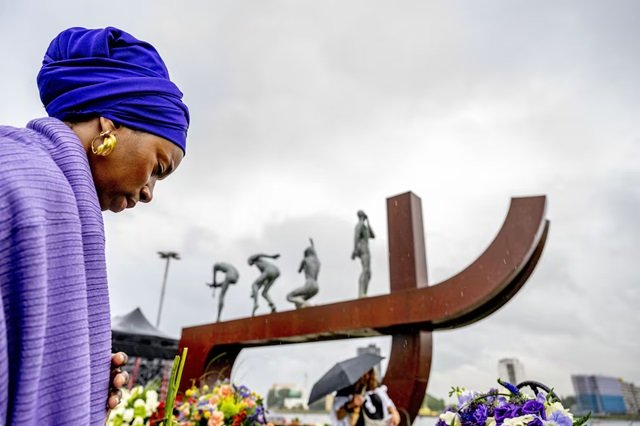
Amsterdam has commemorated the abolition of slavery with a monument since 2002 and has celebrated Keti Koti, marking the memory of slavery and its abolition, since 2009. The Dutch government also dedicated an entire year, between 2023 and 2024, to slavery remembrance, financing about 200 educational, cultural and community initiatives. A National Slavery Museum is now being developed in Amsterdam.
France has also built an increasingly visible public memory. Nantes has a memorial to abolition, while 10 May has been observed since 2006 as the national day of remembrance of slavery and its abolition. A new memorial to victims of colonial slavery is planned in Paris for 2027, in a 4,000-square-metre garden near the Trocadéro, close to the Eiffel Tower, with the names of around 215,000 enslaved people.
Portugal demonstrates how fragile such efforts can be. A winning design from a 2017 public competition for a monument in Lisbon commemorating victims of the slave trade has still not been inaugurated after years of bureaucratic and political obstacles.
Spain, too, continues to confront reminders of its slave-trading past in public spaces. In 2018, Barcelona removed a statue of the slave trader Antonio López, Marquis of Comillas.
The return of cultural objects stolen during colonial rule represents another increasingly important form of restitution.
The African Union has identified restitution as one of its demands. Twenty years ago, Beninese heritage specialist Alan Godonou estimated that 90% of Africa’s cultural heritage was held outside the continent, particularly in major museums.
There is still no comprehensive count of the objects, archives and human remains returned by European institutions. But restitution gained momentum after a study commissioned by French President Emmanuel Macron was published in 2018.
Since then, France, Britain, Germany, the Netherlands and Belgium have transferred ownership of objects from European museums to African institutions. Some have instead used long-term loans or temporary transfers. Others have published inventories documenting thousands of objects taken during the colonial period.
Yet every restitution can become a battle.
Germany, for example, has still not returned the Cameroonian statue of the goddess Ngonnso, taken in 1903, despite agreeing to do so in 2022. The object remains in Berlin’s Ethnological Museum.
For researchers working on restitution, the problem is not simply returning an object. It is recovering the history and meaning attached to it.
“From a European perspective, return is seen as taking an object that is in Europe and putting it back in Africa,” says Karen Ijumba, a senior researcher at Open Restitution Africa. “But for us, there are additional processes needed to repair what that extraction meant in terms of knowledge, culture and spirituality.”
The gap between European countries is particularly stark in Spain and Portugal.
Piqueras argues that Spain and Portugal have denied their slave-trading past despite the fact that two out of every three enslaved Africans ended up in territories controlled by those countries in the Americas.
Spain was involved not only in the slave trade but also as a destination for enslaved Africans, according to historian Martín Rodrigo Alharilla of Pompeu Fabra University. He argues that slavery was widespread and generated fortunes whose effects remain visible today.
In Portugal, anthropologist Raquel Machaqueiro says slavery permeated society and a wide range of businesses. It was, she argues, treated as a commercial activity alongside tobacco, salt, soap and whale oil.
The difficulty, according to researchers, is that public memory has not caught up with historical evidence.
Portugal’s national identity has long been built around the narrative of exploration and discovery, Machaqueiro says, leaving slavery to be understood as a “collateral damage” of a supposedly greater mission.
“How can there be reparation without recognition?” Piqueras asks.
France and the Netherlands have travelled further. France became the first country to recognise the transatlantic slave trade as a crime against humanity through the Taubira Law in 2001. Its empire had enslaved close to four million people. In May, Macron became the first French president to speak about reparations for slavery, although he announced no concrete measures.
France has also changed school curricula, introduced legislation intended to facilitate the return of looted objects and abolished the Code Noir, the 17th-century royal decree regulating the lives of enslaved people.
But major questions remain, including the compensation Haiti was forced to pay France after independence in 1804, persistent inequalities in overseas territories and racism against Black people.
“Reparation never means repairing the past; it means correcting problems in the present that come from that history,” says Pierre-Yves Bocquet of the Foundation for the Memory of Slavery.
The Netherlands faces a similar question about what follows an apology.
A recent study estimated that more than five million people were subjected to Dutch enslavement. The country’s 2022 apology followed decades of pressure from Afro-descendant communities, political support and greater institutional openness to minority demands, according to research from Cambridge University.
“The apology marked an important starting point,” says Bianca Groen Gallant, director of the National Institute for the Study of Dutch Slavery and its Legacy. “The challenge now is how to use that momentum to move towards genuine restorative justice.”
Since the apology, the Netherlands has created a National Slavery Memorial Committee and established a €200 million fund for initiatives concerning remembrance and the fight against racism. Applications opened in 2025 and will continue until 2028.
But Groen Gallant argues that even this is insufficient.
The European debate over slavery has therefore moved beyond whether the past should be remembered. The harder question is what recognition requires when the consequences of that past are still visible in the present.
Monuments can preserve memory. Museums can return objects. Governments can issue apologies. Funds can support education and anti-racism initiatives.
But reparations raise a more difficult question: whether acknowledging an historical crime also creates an obligation to address the inequalities and institutional consequences that survived it.
For much of Europe, that is where the boundary remains.
The history can be admitted. The memory can be preserved. Even an apology can be offered.
But when the question becomes what Europe owes for the wealth, power and inequalities produced by slavery, the resistance begins.