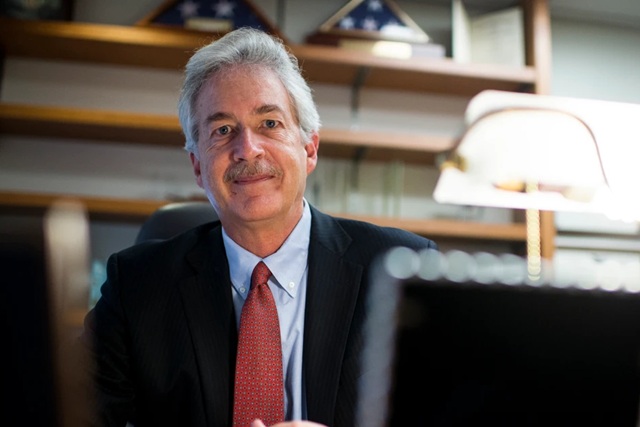
Editor’s Note: The following article is based on an interview conducted by Aaron David Miller with William J. Burns, former Director of the CIA and former President of the Carnegie Endowment for International Peace. In their conversation, Burns reflects on a career spanning four decades in diplomacy and intelligence, sharing insights on leadership, national security challenges, and the role of American public service in an increasingly complex world.
William J. Burns began by reflecting on the foundations of his life in public service, emphasizing both personal and familial influences. “I grew up in an Army family. My dad was a career Army officer and really was inspired by him to enter public service later on,” he said. That early environment, he explained, instilled in him a sense of discipline and a belief in the value of service above self-interest. Burns recalled a note from his father during his graduate school years, a message that continues to guide him: “Nothing can make you prouder than to serve your country with honour.” This principle, Burns noted, became the compass for a career that would traverse the complex intersections of diplomacy, intelligence, and global crisis management. He entered the Foreign Service in 1982, and from the outset, he acknowledged that his path would be shaped as much by circumstance as by design. “People always ask, especially eager young professionals, how do you get ahead? I hate to burst their balloons, but serendipity always plays an important role,” he said. He stressed, however, that luck alone is insufficient; preparation, expertise, and the willingness to seize opportunity are indispensable.
Reflecting on his formative years in diplomacy, Burns highlighted the significance of mentorship and institutional culture. He spoke of his time serving under Secretary James Baker during pivotal moments in American foreign policy, noting the emphasis on preparation and methodical problem-solving. “Prior preparation prevents poor performance,” Burns recalled, referencing Baker’s well-known maxim. He also shared a more candid version he once heard: “Preparation plus perspiration prevents piss-poor performance,” underscoring both the rigor and humour necessary in high-pressure roles. Burns described these early experiences as foundational in shaping his understanding of strategic patience, meticulous planning, and the importance of cultivating trust—both within American institutions and in foreign capitals.
Turning to Afghanistan, Burns conveyed the profound professional and emotional stakes involved in the U.S. withdrawal in 2021. “The withdrawal of the U.S. from Afghanistan…was an incredibly painful experience on a number of different levels,” he said, highlighting the dual challenge of managing a complex operational exit while maintaining responsibility to local partners. He praised the intelligence officers and diplomats who navigated the retrograde with exceptional professionalism, particularly in circumstances of heightened risk. Meeting Taliban leadership outside Kabul International Airport, Burns recalled the extraordinary tension of the encounter: “I had like two dozen security people with me, two dozen of his Taliban security people…all had their fingers on the triggers. But it went okay.” Despite the theatre of tension and the ever-present risk of miscalculation, Burns emphasised that the operation’s human dimension was paramount. “We had a profound obligation to Afghan partners…we worked really hard to ensure that they were safely taken out of Afghanistan. That meant a lot to me personally and to our workforce too.” He reflected on the burden of responsibility, not only for operational success but for the moral and ethical obligations owed to those who had served alongside the United States over decades.
Burns’ narrative shifted seamlessly to the Russia-Ukraine crisis, illustrating the weight of intelligence in anticipating and responding to global aggression. “We provided credible, accurate early warning of what was coming…coupled with the sense of some wonderful analysts at CIA and my own sense over the years…that he [Putin] was dead serious this time,” Burns said. He described how intelligence assessments, paired with years of personal experience in Moscow, informed both U.S. policy and allied responses. The stakes were particularly high given widespread scepticism among some allies regarding Putin’s intentions. “The credibility of our intelligence…helped the president and policymakers to build a strong coalition. It certainly helped us to support the Ukrainians,” he said, underscoring the vital role of trust and accuracy in global affairs.
Burns also conveyed the intensity and personal dimension of his engagement in Ukraine. He made fourteen trips to the country during his tenure as CIA Director, noting that the frequency of his visits was a testament not just to his personal commitment but to that of the agency itself. He highlighted the relationship with President Zelensky, noting, “Zelensky…never lost his sense of humour despite all the burdens of his job. On my 10th trip…he gave me a certificate entitling me to a free upgrade on the train from the Polish frontier to Kiev.” Beyond anecdote, these visits reflected the careful cultivation of trust—a prerequisite for effective collaboration in wartime conditions. Burns further emphasised the continuity of engagement: “You have to go back to 2014 after Putin’s illegal annexation of Crimea, when we first…started working closely with our Ukrainian partners. That paid off in significant ways when the Russians invaded.”
Discussing the broader intelligence context, Burns reflected on the nature of Putin’s decision-making and the concentration of power within his inner circle. “Those were fundamentally flawed assumptions…that circle of people who were actually privy to the planning for the war was tiny, and it was made up of people who either shared Putin’s hard-nosed views or had learned…not to challenge his judgments,” Burns said. He observed how the lack of dissent and overconfidence in Moscow exacerbated miscalculations, and he underscored the importance of accurate, independent intelligence in countering false narratives. He noted that declassifying certain information at critical junctures helped prevent Putin from exploiting disinformation, reflecting the careful balance between secrecy and transparency that intelligence professionals must navigate.
Burns’ reflections on the Middle East, particularly Gaza, revealed the human and political complexity of conflict resolution. “This was a very human issue…hostages, the horrific plight of Gazan civilians caught in a terrible crossfire,” he said. He described how the divergent endgames of Hamas and the Israeli government complicated diplomatic efforts, noting that both sides often avoided confronting the fundamental political questions about Gaza’s future. “One of the key ingredients…is who governs Gaza after the end of the conflict,” he explained. Burns stressed that establishing credible Palestinian leadership, even if it required technocratic figures with loose ties to the West Bank, was essential for economic recovery and regional stability: “Without that, it’s very hard to imagine how you get Gulf Arabs to contribute to economic recovery…let alone provide security. But I don’t think it’s impossible.” His reflections highlighted the persistent tension between strategic necessity and human reality, a theme that runs throughout Burns’ career.
Transitioning from diplomacy to intelligence, Burns offered a candid comparison of institutional culture and operational expectations. “State…can sometimes be a kind of passive-aggressive place…if you ask for something, people will think, ‘If he’s really serious, he’ll ask again.’ At the CIA…by the end of the day I’d get a 14-page single-spaced action plan for all I knew.” He described how the CIA’s culture of agility and mission-focus enabled rapid, decisive action, but also required careful communication with both leadership and workforce. “On all those plane rides home…after writing a letter to the President, I would write a letter to our workforce…explaining, these were classified, but…what I saw, what we were trying to do.” Burns also highlighted the importance of personal engagement with analysts and officers: “I wandered down to their offices…to hear directly from analysts for whom I had great admiration…not just waiting for their carefully coordinated memos.”
Burns addressed the contemporary challenges facing the intelligence community, particularly the dangers of politicisation. “I worry deeply about what’s happening to honorable career public servants who are apolitical…creating fear…about should I speak truth to power…should I convey very directly views that may be contrary to what policymakers want to hear,” he said. He warned that the erosion of institutional norms could have long-term consequences, chilling the willingness of officers to provide candid assessments. “If you continue to take some of the steps which really are about retribution and sowing fear, you can have a very chilling effect on people over time,” Burns cautioned. For him, maintaining integrity and independence in intelligence work is not merely procedural—it is a moral obligation and a foundation for effective policymaking.
Throughout the discussion, Burns repeatedly returned to the ethical and human dimensions of public service. “We have a profound obligation to Afghan partners…human in the sense of the horrific plight of hostages…and human also in the sense that ultimately this was about decisions that leaders on both sides could make,” he said. Whether in managing intelligence operations, negotiating in conflict zones, or advising policymakers, Burns emphasised that the human stakes are inseparable from strategic calculations. His reflections consistently highlighted service, responsibility, and the courage to act with integrity, even under extreme pressure.
Finally, Burns offered a hopeful perspective on the next generation of public servants, drawing from an article he authored in The Atlantic. “There’s still a chance that the next generation…will serve in a world where we curb the worst of our current excesses…stop betraying the ideals of public service…stop blowing up institutions that matter to our future. There is still a chance that the next generation could be present at the creation of a new era for America in the world in which we’re mindful of our many strengths, but more careful about our overreach.” His reflections underscore the resilience of the United States, not merely as a geopolitical power, but as a society sustained by the dedication, courage, and integrity of those who choose to serve.
Across Afghanistan, Ukraine, Gaza, and the broader landscape of global politics, Burns’ experiences reveal a consistent theme: leadership in a complex, fast-moving world requires preparation, principled judgement, and a profound respect for the human consequences of policy. From his earliest days in the Foreign Service to his tenure as CIA Director, he has repeatedly emphasised that strategic insight and ethical responsibility are inseparable. “Good and effective policy…is finding the balance between the way the world is on one hand and the way any administration wants it to be on the other,” he said. For Burns, the enduring lesson of his career is that service—thoughtful, principled, and courageous service—is the true measure of national strength and leadership.