


by Our Correspondent in Colombo
An Iranian Navy warship has reportedly sunk in waters south of Sri Lanka following what sources described as a possible underwater attack, potentially involving a submarine, triggering an urgent maritime rescue operation and leaving dozens of sailors missing at sea.
The vessel, identified as the IRIS Dena, was carrying approximately 180 personnel when it transmitted a distress call early this morning while navigating about 40 nautical miles off the coast of Galle. Sri Lankan officials stated that the incident occurred outside the country’s territorial waters.
According to unconfirmed security sources familiar with the situation, the warship may have been struck below the waterline, raising suspicions of a torpedo or other form of underwater strike possibly launched from a submarine. However, neither Iranian nor Sri Lankan authorities have officially confirmed the cause of the sinking, and investigations are ongoing.
The Sri Lanka Navy launched an immediate rescue mission after receiving reports that the ship was taking on water and in danger of sinking. Between 30 and 35 individuals have so far been rescued from the southern seas and transported to the Karapitiya Teaching Hospital in Galle for medical treatment. The Ministry of Defence confirmed that emergency protocols were swiftly activated, while the Sri Lanka Air Force deployed aircraft to support continuing search and rescue operations.

Addressing Parliament, Minister of Foreign Affairs Vijitha Herath said the distress signal indicated the vessel was in critical condition, prompting rapid humanitarian intervention by Sri Lankan forces. He emphasized that although the warship was not within Sri Lankan waters, assistance was provided without delay.
The incident unfolds amid heightened tensions linked to the 2026 Iran conflict, intensifying concerns over maritime security in the Indian Ocean region. If confirmed as an underwater strike, the attack would mark a significant escalation with potentially far-reaching geopolitical consequences.
The IRIS Dena, a Moudge-class frigate in the Southern Fleet of the Islamic Republic of Iran Navy, had recently participated in the International Fleet Review 2026 in Visakhapatnam, India. The large-scale naval gathering, hosted by the Indian Navy, brought together dozens of international fleets in a display of maritime cooperation.
After taking part in the Fleet Review and Exercise MILAN 2026, the Iranian warship docked in India before departing on its return voyage. Named after Mount Dena, the frigate was equipped with advanced radar systems, surface-to-air and anti-ship missiles, torpedoes, and domestically manufactured engines, and had previously completed long-range deployments, including a global 360-degree mission.
As search operations continue off Sri Lanka’s southern coastline, authorities have yet to confirm the full number of casualties or determine the precise cause of the disaster. The loss of a frontline Iranian naval vessel under suspected hostile circumstances is expected to draw intense international scrutiny and could carry significant diplomatic and security repercussions.
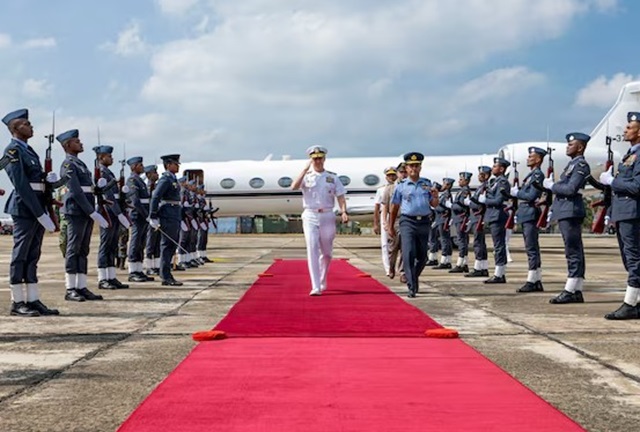
It is noteworthy that Admiral Steve Koehler, Commander of the U.S. Pacific Fleet, made a recent visit to Colombo, Sri Lanka, highlighting Washington’s ongoing focus on maritime security in the Indian Ocean region. During his visit, he met with senior Sri Lankan naval officials and toured key port facilities to discuss strengthening regional partnerships and operational coordination.
Speaking in Colombo, Admiral Koehler emphasized the importance of secure, open sea lanes and freedom of navigation, stating that these measures are essential for protecting international commerce as well as American strategic interests. He reaffirmed that the United States is committed to working with regional partners to deter threats and enhance maritime domain awareness.










