by Our Correspondent in Colombo
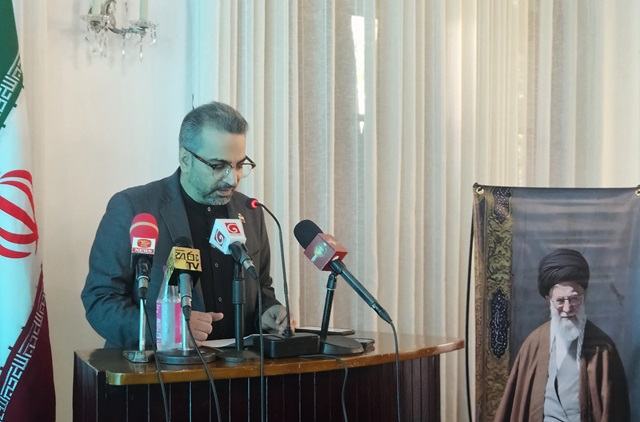
The Sri Lankan government has officially invited three Iranian ships — IRIS Dena, IRIS Booshehr, and IRIS Lavan — for a goodwill visit, Iranian Ambassador to Sri Lanka Dr. Alireza Delkhosh announced during a press briefing this morning.
However, according to the ambassador, delays in the host country’s procedures led to the IRIS Dena being attacked by a U.S. submarine off the southern coast of Sri Lanka, resulting in the deaths of more than 104 unarmed sailors.
Meanwhile, the second Iranian naval vessel IRIS Booshehr remained near Colombo, as the process of transferring the ship to the Trincomalee Naval Base had not begun as planned, the Ambassador added. The Sri Lanka Navy had taken the vessel into custody and evacuated all personnel on board before bringing them to Colombo Port. A total of 208 individuals were on the ship, including 53 officers, 84 cadets, 48 senior sailors, and 23 regular sailors. The Navy is currently providing them with accommodation and necessary facilities at the Welisara Naval Base.
During the press briefing, Ambassador Delkhosh also provided details on the ongoing situation and addressed the state of Sri Lanka–Iran relations.
For the first time at a diplomatic level, he disclosed the origins of the invitation, which contradicted previous statements by Sri Lankan authorities, including President Anura Kumara Dissanayake.
Addressing Parliament last week, the President had stated that the Iranian government had made requests for port calls, while the U.S. had separately requested airspace access and landing at Mattala Rajapaksa International Airport for its fighter jets. According to the President, the Sri Lankan government had refused both requests to maintain neutrality in its foreign policy.
***
Key Excerpts from the Iranian Ambassador’s Press Briefing are as follows:
The Islamic Republic of Iran has been actively engaged in negotiations to resolve disputes with the United States. Ambassador Dr. AliReza Delkhosh stated that attacks by the United States and the Zionist regime on civilian sites, including hospitals, schools, mosques, churches, and public infrastructure in various cities, have resulted in the deaths of hundreds of civilians and continue to this day. He noted that these actions constitute a blatant violation of international law, including Article 2, Paragraph 4 of the United Nations Charter, which prohibits the use of force against other countries. According to Dr. Delkhosh, most international organizations, including the United Nations Security Council, have remained inactive, merely observing these crimes.
In response to these aggressions, he explained, the Islamic Republic of Iran exercised its inherent right to self-defense as outlined in Article 51 of the United Nations Charter. He said, “Iran’s self-defense, including attacks on United States and Zionist regime military bases, was a crushing response to the crimes of these two regimes. As we have repeatedly stated, in the event of attacks on Iran from United States military bases in neighboring countries, the Islamic Republic of Iran would target those bases. Observing the use of such bases by the United States in some neighboring countries, Iran carried out targeted attacks accordingly.”
Dr. Delkhosh emphasized that these actions “do not constitute violations of the sovereignty of neighboring countries. They were solely acts of self-defense and direct responses to United States attacks. Neighboring countries could not be immune before our enemies.” He further addressed neighboring states directly, stating, “Please do not be complicit in the crimes of the United States and Israeli regimes. The United States disregards the principles of international law and, together with the Zionist regime, repeatedly violates international law and humanitarian principles.”
“In response to attacks on its civilians and military, Iran asserts its inherent right to self-defense under international law, targeting hostile bases without violating the sovereignty of neighboring states.”
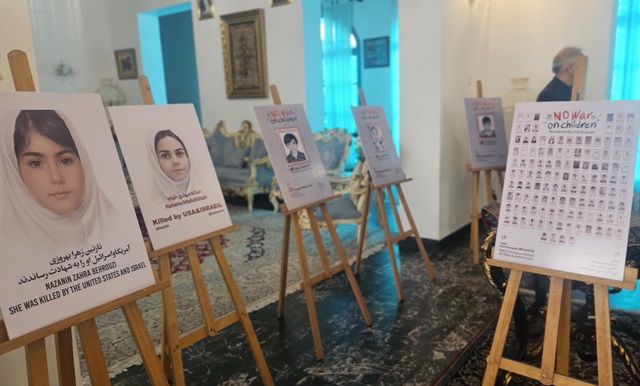
Regarding the IRIS Dena incident near Sri Lanka, the Ambassador said, “In violation of humanitarian law, on March 2026, the IRIS Dena, a vessel of the Islamic Republic of Iran Army, returning from the multinational naval exercise MIDAM-2026 in India, was targeted near Sri Lankan waters by United States submarines. The United States President considered the targeting of this ship as entertainment, and as a result, 104 unarmed sailors aboard were killed. According to humanitarian law, attacks on a hostile party are permitted only on the battlefield. The IRIS Dena was thousands of nautical miles from the battlefield and had no weapons or defensive capabilities. This attack, together with other actions such as the Minar schoolgirls incident, constitutes a violation of the Geneva Conventions.”
Dr. Delkhosh reiterated Iran’s stance on war, saying, “Iran neither seeks war nor welcomes it. The Iranian nation is a peace-loving nation, as history bears witness. At the same time, we respond decisively to any aggressors to defend our land. Countries that support aggressors are, under international law, considered accomplices in acts of aggression. I repeat my message: do not be complicit in the crimes of the United States and Israeli regimes.”
He explained that the Strait of Hormuz, within Iranian territorial waters, has been declared a war zone. “This does not mean it is closed by Iran. It is only closed to the ships of hostile countries,” he added.
Regarding bilateral relations with Sri Lanka, Dr. Delkhosh confirmed, “The Sri Lankan Navy officially invited three Iranian ships — [IRIS Dena, IRIS Booshehr, and IRIS Lavan] — for a goodwill visit. This invitation was issued during the naval exercise in India when the Indian side extended the invitation for friendly visits. The Sri Lankan Navy issued official clearance for these ships to dock in Sri Lankan waters.”
The Ambassador highlighted Iran’s readiness to assist Sri Lanka in the event of an oil shortage, stating, “If Sri Lanka faces difficulties in procuring necessary oil due to regional developments, Iran will provide all necessary supplies. The Strait of Hormuz is not closed to friendly countries, and we are always ready to supply necessities to Sri Lanka. The nation of Sri Lanka is highly esteemed and respected by Iran.”
Addressing a recent event hosted by the President of Sri Lanka, Dr. Delkhosh clarified, “There was no special reason for my absence at the event. I was engaging with our sailors and cadets who were present here, and I was with them in accordance with common law responsibilities. That was the reason I could not participate. There was no boycott or political reason involved.”
Regarding the safety of Sri Lankan professionals and university students currently in Iran, he stated, “The Iranian government has established comprehensive infrastructure to ensure the safety and care of all foreign nationals. We have not received reports of any problems. If they wish to return to their countries, Iran can facilitate their travel through neighboring countries such as Turkey and Armenia.”
Regarding the IRIS Dena incident near Sri Lanka, Ambassador Dr. Delkhosh addressed concerns raised about delays in clearance. He said, “According to international humanitarian law, all countries, including neutral countries, have some responsibility to provide facilities and assistance to other ships, including warships, in urgent situations. Our information indicates that the IRIS Dena was in an urgent position and requested permission to enter Sri Lankan waters. However, I do not have documented confirmation of whether an urgent request was officially made. If so, all countries, neutral or not, have responsibilities to provide help, even from a humanitarian perspective.”
He responded to questions regarding possible prior warnings from the United States: “According to our information, Dena was not ready for war. It was participating in a peaceful exercise in India. During its presence there, the three Iranian vessels were invited by the Sri Lankan Navy to come for friendly visits. Upon arrival, they received no alerts or warnings from the United States before being attacked. The sailors who were killed were unarmed; some were members of a music band with instruments such as saxophones and violas. More than 104 people were killed without any warning.”
On the Sri Lankan government’s response after the incident, he said, “The sailors were taken here and provided care. We are thankful to the Sri Lankan government for their hospitality toward the personnel of Dena and the other vessels. Most of those aboard were cadets. The government has been very hospitable, and we have no issues. We hope to return them to their families as soon as possible.”
Regarding reports that Dena victims had drowned, he clarified, “I do not confirm that. I cannot verify that information.”
Dr. Delkhosh outlined the invitation timeline, saying, “During the exercise in India, the Sri Lankan Navy Commander invited the Iranian Navy Commander to send the vessels to Sri Lankan waters for friendly visits. Three ships were involved: one went to India, and two came here. The IRIS Dena was attacked, and IRIS Booshehr remains here, with the process of transferring it to the Trincomalee Naval Base still underway.”
On the condition of the wounded and their repatriation, he stated, “The wounded are in good condition; only two or three have serious issues. Most are well and are happy, though they wish to be reunited with their families. We are coordinating with the Sri Lankan government to ensure their safe return. Additionally, India has repatriated more than 100 Iranian sailors from the region, who are now back in Iran.”
Over 104 unarmed Iranian sailors were killed when the IRIS Dena, returning from a peaceful exercise, was attacked near Sri Lankan waters—an act condemned as a blatant violation of humanitarian law.
Regarding Iran’s attacks on regional infrastructure, including oil facilities, Dr. Delkhosh explained, “Even friendly countries like Sri Lanka are affected. We informed all neighboring countries prior to our attacks that if any country provides assistance to our enemy, including food, electricity, or bases from which attacks are launched, Iran reserves the right to respond in self-defense. This is the rule of law. Countermeasures are a standard defensive response to aggression.”
On claims that Iran’s military capabilities have been destroyed by the United States, he said, “Do not take such statements seriously. The United States recently claimed that 100% of Iran’s capabilities were demolished. Yet daily, we continue to defend ourselves and attack hostile bases. Reports of destruction are exaggerated. Similarly, Israel’s claims to target 2,500 Iranian military leaders are statements without substance.”
Concerning the Strait of Hormuz, Dr. Delkhosh stated, “Iran provides security facilities for all foreign vessels passing through the strait at no cost. Rumors that Iran demands payment are false. The United States, if withdrawn, would remove instability in the Strait. Currently, the area is considered a war zone, and we cannot guarantee security for vessels unless they request permission from us. Reports of attacks falsely attributed to Iran, including a recent incident in Bahrain, were confirmed to be from the United States, not Iran.”
He addressed questions regarding regime change and nuclear issues: “Iran does not seek regime change. The Iranian regime is based on the nation itself. The people continue to support their leadership despite attacks. Claims regarding the demolition of Iran’s nuclear capabilities are exaggerated and not credible.”
On international participation in the war, he said, “Countries, including Spain, Japan, and others, are aware that this war is illegal and that the starting of this war breached international law. No country will legally participate in acts of aggression alongside the United States and Israel.”
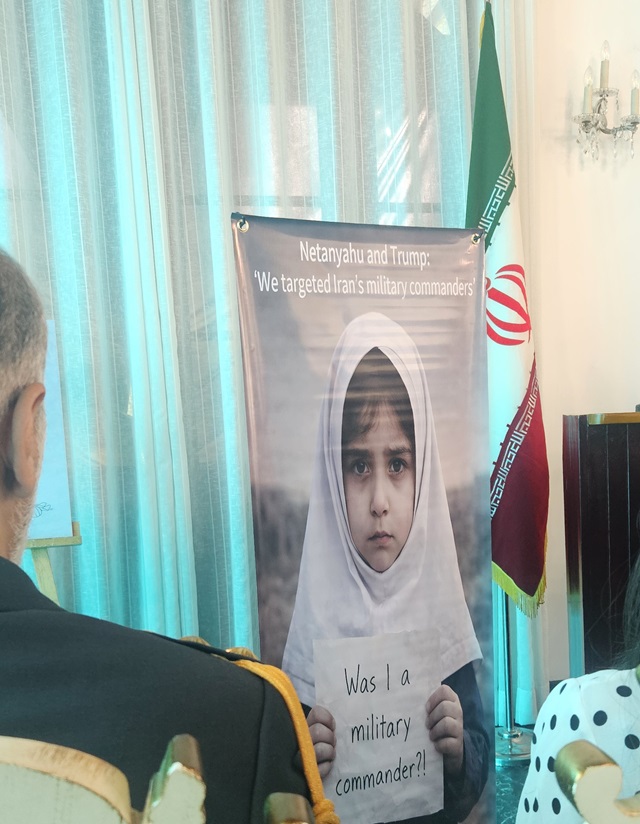
Regarding peace negotiations, Dr. Delkhosh emphasized, “Iran does not welcome war, but we also do not seek a ceasefire as it is temporary and allows aggressors to rebuild their capabilities. We are open to peace talks only if preconditions are met: aggressors must withdraw from our region without preconditions, compensate for attacks, and fulfill other conditions set by our foreign ministers. If these are met, we are willing to negotiate for peace, not just a ceasefire.”
On regional diplomacy, he added, “There have been discussions between the Syrian President and leaders of Qatar and UAE, but no direct communication with Iran yet. We are willing to facilitate dialogue if they seek it.”
Regarding Iran’s Supreme Leader, Mojtaba Ali Khamenei, he stated, “The Supreme Leader has issued messages through media and continues his work. For security reasons, public appearances are restricted due to threats to his life.”
Iran rejects temporary ceasefires that allow aggressors to regroup, insisting on negotiations only under preconditions that guarantee withdrawal of hostile forces and full compensation for attacks.
On the status of Sri Lanka-Iran barter trade, including tea, he said, “The barter system continues, and we will resume normal trade once conditions allow. Currently, no vessels from other countries can reach Iran, but we hope to resume soon.”
Regarding the IRIS Booshehr vessel, Dr. Delkhosh explained, “It is being prepared to move to Trincomalee. A contract has been signed with a company to tow the vessel, and the process is currently underway.” He added that the exact number of casualties since the start of the conflict has yet to be confirmed.
Commenting on recent alleged missile attacks on US and UK military bases, the Ambassador stated, “We do not have official confirmation that Iran was involved. We do not provide information on unverified incidents, including claims related to Diego Garcia.”
On accusations from Israel regarding cluster munitions, he said, “These are false claims. We have not used forbidden weapons against civilians. We are victims of attacks on civilians ourselves. Iran strictly forbids attacking civilian infrastructure, and all actions target military objectives only.”
Finally, regarding current diplomatic discussions in Qatar, Dr. Delkhosh stated, “Iran welcomes peace negotiations, not temporary ceasefires. Ceasefires allow aggressors to rebuild and attack again. Peace talks are only possible if our preconditions are fulfilled. Iran is a peace-loving country, but it will not compromise on the security and sovereignty of its nation.