

Ambassador Reuven Azar is a seasoned Israeli diplomat with a distinguished career spanning several decades in public service. Born in Argentina and moving to Israel at the age of thirteen, he grew up in a deeply Jewish and Zionist household, which shaped his lifelong commitment to serving his country. Following his military service in the Israel Defense Forces, where he served on multiple fronts including Lebanon, he entered the Israeli Foreign Ministry, taking on key postings in Egypt, Jordan, and working closely with the Palestinian Authority after the Oslo Accords. Over the years, he has held senior positions including Deputy National Security Advisor, contributing to Israel’s strategic planning and security policy, and has served in various roles within the Ministry of Foreign Affairs, where he oversaw critical aspects of international relations and defence cooperation. Today, he is the Israeli Ambassador to India, while also serving as a non-resident ambassador to Sri Lanka and Bhutan, managing a complex portfolio of diplomatic, economic, and security interests across the region.
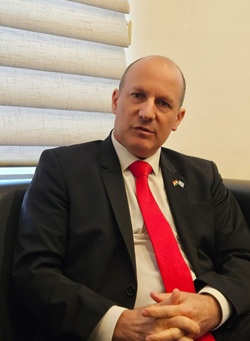
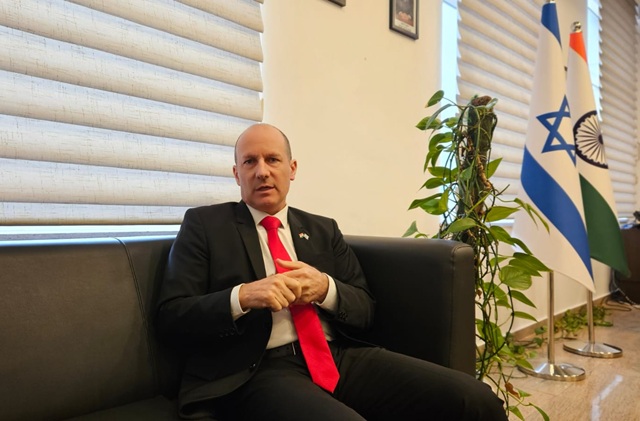
On 31 December 2025, the final day of the year, I sat down with him at his well-secured office in New Delhi. He offered a warm welcome, and our discussion covered his experiences, Israel’s foreign policy, and the evolving partnerships spanning South Asia, Africa, and beyond.
Ambassador Reuven Azar, born in Argentina and relocated to Israel at the age of thirteen, recounted his early life, highlighting the deep influence of his Jewish and Zionist upbringing. He stated, “I grew up in a very Jewish and Zionist home. I received Jewish education since my early childhood, kindergarten. I knew Hebrew even before we came to Israel.” Azar described his family roots in Jerusalem, explaining that “our family actually came from Jerusalem. My grandfather was born in Jerusalem and his family came from Aleppo to Jerusalem. And we had to go to Argentina for economic reasons. And we came back.” Upon returning, he grew up in Jerusalem, completing the mandatory three years of military service in Israel, where he “was positioned in different fronts, including Lebanon.” Following his service, he chose to pursue a career in diplomacy, motivated by a desire “to study international relations and try to expand the scope of relations of Israel in the international arena and seek peace with our neighbours.” His first foreign ministry postings were in neighbouring countries, serving in Egypt, working with the Palestinian Authority after the Oslo Accords, and also serving in Jordan.
From Iran’s missile programs to stabilizing trade routes in the Horn of Africa, Israel’s foreign policy balances diplomacy, defense, and strategic foresight.
Azar discussed his linguistic abilities, noting the interplay between his upbringing and career. “Spanish I had because, you know, I was born in Argentina. So it was my native tongue. And as I said, I learned Hebrew from early stage. And in high school, I took Arabic as major because I was very curious to speak with our neighbours. You know, Jerusalem is a city that has a lot of Arab population. So when I entered the foreign ministry, I already knew three languages, basically.” His language skills, spanning Hebrew, Arabic, Spanish, and later Romanian and Hindi, facilitated his diplomatic engagements across multiple regions.
When asked about the India-Israel strategic partnership, Azar emphasised a transformative period in bilateral relations. He explained, “We are in a turning point in our relationship because we’ve been leaning mainly on two verticals in the last 30 years. One was the defence vertical that is now evolving very fast. You know, we started with supplying solutions on defence issues. Then we moved to joint production in the context of Make in India. Now we are doing a lot of partnerships in the private sector and also starting R&D together, developing things together.” He highlighted recent developments, noting, “Recently, in the last two months, about two months ago, we signed an MOU to increase the government-to-government cooperation. And soon we’re going to sign another agreement, an updated security agreement, that would allow an expansion of our industrial defence cooperation.” He linked these developments to regional security challenges, explaining, “The reason it’s happening is because we are having mounting challenges, as we saw in the last few years. We were attacked by seven fronts. India is subject to a lot of terrorism threats. So this is a trajectory that is going very fast forward.”
Azar detailed another foundational vertical of bilateral engagement, agriculture. He observed, “We really made together an impact on the small farmer in India because we opened so far 34 centres of excellence in the Indo-Israeli centres of excellence, by which we introduced the modern methods of irrigation. And many Indian small farmers have actually switched, have adopted some of these technologies. And that causes increase of crops. It’s a very good thing that serves food security in India.” He explained that water management was becoming increasingly critical due to rising stress on natural resources, stating, “One of the results of development is the fact that there is a lot of stress on the natural water resources, a lot of contamination, and more needs as the economic level of life rises. There is more need for water. So we are working with our Indian friends to create partnerships to make the water management more efficient, to purify water, and to desalinate water.”
Expanding beyond agriculture and water, Azar described infrastructure as an emerging vertical of cooperation. “Israel is going to invest about $200 billion in infrastructure in the next 10 years. One of the flagship projects is going to be the metro of the greater Tel Aviv area. There is a project that is going to cost something between $40 billion to $50 billion. And we urgently need foreign expertise of the kind that India has. India has been developing a huge quantity of metro networks in India. And also has been building about 14 airports every year, hundreds of kilometres of rail and roads. And these are the kind of companies we want, Indian companies, that we want to apply for tenders in Israel.” He clarified that the aim was to leverage Indian expertise rather than merely importing labour, stating, “It’s not just a matter of bringing Indian or Sri Lankan workers. We want companies that have the expertise to execute infrastructure projects.”
Azar also outlined high technology cooperation between India and Israel, explaining the multi-layered approach. “We are cooperating on high tech on different levels. One level is via the joint R&D programme that we have. It’s called I4F. We spent already $25 million investing in partnerships, in academia or applied research on companies that promote solutions that serve the economies of both sides.” He linked investment security to these initiatives, stating, “We have signed this year a bilateral investment treaty with India. This is promoting mutual investments, both Israeli investments in India and Indian investments in Israel. This is very important because many investments that we have are in technology. In the last few months, for example, a major Indian conglomerate called Amber purchased, invested in Israel about $50 million in taking over an electronics company that serves the purpose of upgrading the products and also bringing them markets in the West.” Azar further discussed the free trade agreement negotiations, noting, “During the visit of Minister Piyush Goyal to Israel, we signed the TOR. That means that in the coming months, we are going to negotiate on a very fast track to get, first of all, to the first phase of the FTA, which will be the easy part of agreeing on the low-hanging fruit issues, and then a more articulate negotiation to try and finish the FTA by the end of the year. End of the year? 2026, yes. So we are, as I already mentioned, two agreements on the security side, two agreements on the economic side.”
A fast-track Free Trade Agreement is on the horizon—signaling deeper economic ties, joint investments, and technology collaborations between Israel and India by the end of 2026.
Addressing logistical and transport links, Azar stated, “We want to create a government-to-government framework that will make it much easier for the private sector to work. I call it moving from a dirt road to a highway. And of course, we need also direct flights. Fortunately, Air India is renewing now their direct flights. There were some companies both in Israel and the Indian side that are showing interest because it’s not enough to have a flight to Delhi. We want to have also flights to other cities like Mumbai, Bangalore, and also to Colombo.” He placed these initiatives within the broader economic and strategic context, explaining, “India has now, I think it was officially announced yesterday, that India has surpassed Japan in size of economy. It’s become the fourth economy in the world. There’s a prospect for India becoming the third economy in the world in the coming years. And there is another important development, this decision of many Indian companies to go global, not to work only on the local market, which was the orientation in the past, but also to compete for global markets. That means that much more production will be done here in India and will be exported to different parts of the world, to West Asia and, of course, to the markets in the West, Europe and the United States.”
Azar addressed the Horn of Africa and Israel-Somaliland relations, stating, “There’s no doubt that there is common interest among many countries, not just Israel and India, but also many countries in Europe, the United States, and also countries in the Middle East, in West Asia, to keep the trade routes open and secure. Now, our recognition of Somaliland was very natural because Somaliland represents an example of a government that is decent, that is stable, that enjoys a high degree of security. You know, Somaliland has been performing as a successful country for more than 30 years now. And they meet all the parameters of the Montevideo Convention. They have an effective government, they have defined borders, and they have the ability to conduct foreign relations.” He explained the legal and historical context, adding, “First, that Somaliland actually declared its independence in the 60s. When it did, 35 countries recognised it. Then they decided to join Somalia, but that experiment proved to be very unsuccessful. And at the end of the day, not only that they decided to depart from all the chaos that is happening in the rest of Somalia with Islamic extremism there, with organisations like Shabab taking over. They don’t want to be associated with that. They are a country that wants to be stable, that wants to be prosperous, and they have the right to do that.”
“Israel recognizes Somaliland as a beacon of security and governance in a turbulent region, underscoring shared interests in stable trade and maritime routes.”
Regarding Sri Lanka, Azar highlighted multiple areas for cooperation. “First of all, the most immediate one is tourism. We’ve seen thousands of Israelis coming to Sri Lanka every year. Now, I think that from next summer we’re going to see a direct line, a renewal of a direct line to Sri Lanka. This can create a lot of income for Sri Lanka and give opportunities for Israelis to have a good time.” He also discussed labour agreements and agriculture, noting, “The workforce sector is also a very powerful one. We’ve signed several agreements for employment of Sri Lankans. Israel gives very good conditions compared to other places around the world. Because in our system, foreign workers must get at least a minimum wage in Israel, which is something like $2,000, plus social benefits. They’re really happy, actually. Under the Israeli law, foreign workers cannot be abused. They have to be paid a fair salary by Israeli standards. In addition, we have some potential in agriculture. There are some private sector companies that already started working in Sri Lanka. I think that there is a huge gap between the work that we’ve been doing in other places and what we can do in Sri Lanka.”
Discussing regional security, Azar reflected on China and India-Sri Lanka-Israel cooperation: “I dealt mainly with the Israeli policy issues when it comes to China. We consider China a country that we have interest in developing relations with. But there are also concerns. So we had to balance our act when it comes to the things we want to promote with China and the things that we are more reserved. At the end of the day, we are not very concerned on a day-to-day basis, following Chinese activity around the world, but it’s not something that is our main concern. Of course, when it comes to creating capabilities, we are working with different governments in the region to cooperate on things that have to do with increasing their defence capabilities, their capabilities to maintain their sovereignty and then control over their borders, and this is something that we’ve been working on with India, but also with Sri Lanka.”
Azar reflected on Israel’s strategic challenges, particularly Iran, Hezbollah, and other regional threats. “What we’ve been facing in the last few years was mainly the aspirations of Iran to eliminate our state and the development of weapons of mass destruction, like nuclear weapons, ballistic missiles, and also the proliferation of advanced technologies of missile production that were proliferated to Hezbollah, to the Shiite militias in Iraq and Syria, to the Houthis. This was creating a ring that was going to choke the State of Israel, and we had to deal with that.” He referenced the 7th of October attacks, noting, “Following the attack, that was followed by an attack by Hezbollah, at the end of the day gave us an opportunity to counterattack. Thankfully, we’ve been able to debilitate quite significantly the Iran axis. That is giving a lot of opportunity for Israel, but also for the region, because there were additional countries, Arab countries, that were very concerned from the rise of Iran as a radical Islamic military power. They felt very threatened by that.”
He elaborated on Israel’s domestic political stability and economy, saying, “We have a pretty vibrant democracy, and I think that I’m very confident. I’m a great believer in Israeli democracy. I think that democracy is enshrined not only in our values, in our laws, but also in our hearts. The Jewish people have developed throughout millennia the culture of criticism. So even the most extreme parts, including the religious parts of our politics, are very democratic in nature. Israel, despite the war, is having amazing success in the economy. We have already surpassed $600 billion. We were defined by the Economist as the third most dynamic economy within the 36 richest economies in the world. And we have a very successful, as you know, innovation sector that has attracted a huge amount of investment in the last year, mainly in the cyber field. Our defence industry is doing very well, with a backlog of about $50 billion in orders for the next five years. And also in the energy sector, Israel is doing very well. We just signed a $35 billion contract with Egypt to export gas.”
Regarding the peace process with Hamas and the Palestinian question, Azar was clear and detailed. “Phase one is not completed. We are still waiting for the return of our last deceased hostage. His name is Ron Gvili. Prime Minister Netanyahu came to Washington with his family. We want to make sure that the terrorist organisations meet the commitment of bringing him back. Now, the second stage is also pretty challenging, because we’ve seen declarations from Hamas and other terrorist organisations that they are not going to dismantle, despite the commitment they gave when we signed the deal a couple of months ago in Sharm el-Sheikh. So we want all the 20 points of Trump’s plan to be implemented. Fortunately, President Trump was very clear when it comes to the need of Hamas to disarm. So we have a challenge there, because we want to give a chance to diplomacy to succeed. And we believe that much more diplomatic pressure is needed in order for Hamas to agree willingfully to disarm. If they don’t, then we will have to do it. We prefer not to engage in that because of the price in human life that may charge.”
From boosting tourism to equitable labor agreements and modern farming techniques, Israel and Sri Lanka are cultivating a partnership that benefits people and economy alike.
On the broader question of Palestinian statehood, Azar explained, “During the 90s, when there was a stable Arab state system, we had a peace process that was intended to create successful self-rule for Palestinians. We didn’t discard the option that the Palestinians would have a state. We even offered that in peace negotiations. Unfortunately, the Palestinian leadership decided not to cooperate with our offers and to launch a war against that. That was the Second Intifada. Since then, the Palestinian population has been not only radicalised, but we have seen the collapse of the Arab state system in 2011, and we have seen strife and civil war within the Palestinian society. And this exploded in our faces on the 7th of October. You had a terrorist organisation controlling Gaza for more than 20 years, almost 20 years since Israel withdrew.” He added, “Many Israelis are thinking in terms of creating maybe small emirates within the Palestinian constituency, because it’s very unlikely that different groups within the Palestinian constituency will decide to actually cooperate with each other. So we’ve seen the Israeli parliament overwhelmingly supporting a resolution against the Palestinian state that was, I think, passed with a majority of 88 votes out of 120. So I think we have to be much more responsible when it comes to taking risks vis-à-vis the Palestinians. And you can’t romanticise serious questions like that. Yeah, you cannot romanticise it. I think you have to be more vigilant. We have to make sure that the overall security control remains under Israel, whether it be the IDF or security services, so we can maintain stability.”