by Our Correspondent in New Delhi
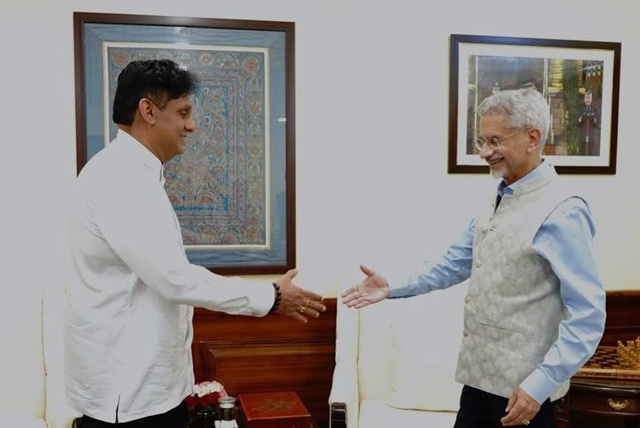
During his ongoing visit to India, Sri Lanka’s Opposition Leader Sajith Premadasa delivered a detailed address at the Indian Council of World Affairs, reaffirming his commitment to the full implementation of the 13th Amendment and stressing the importance of strategic bilateral cooperation between India and Sri Lanka amid the island nation’s ongoing economic and political challenges.
Speaking before an audience of diplomats, journalists, and policy experts, Premadasa highlighted the need for long-term, pragmatic thinking in Sri Lanka-India relations. “At a time when Sri Lanka is facing these enormous challenges, the Indo-Sri Lanka relationship should be devoid of parochial thinking. We need to think anew, and we need to think far. Our relationship should be results-based, evidence-based,” he said.
Premadasa outlined a comprehensive vision for collaboration between the two countries across multiple sectors. “We need to work together in technology, in investment, championing South-South cooperation, promoting green energy, and implementing integrated poverty alleviation programs—an issue that affects both our nation states. Micro, small, and medium enterprises must be rejuvenated so they become engines of economic growth,” he emphasized.
He also spoke on the role of Sri Lanka in supporting regional security. “I would like to assert that Sri Lanka at all times will work towards ensuring the national security interests of India. India, as a global power and a superpower, deserves its rightful place in the United Nations Security Council as a permanent member,” he noted.
Addressing Sri Lanka’s economic situation, Premadasa stressed the challenges ahead. “We have a single-minded approach to come out of our present levels of bankruptcy. It’s not an easy task. Even though certain macroeconomic indicators show positive tendencies, we face a pivotal challenge in 2028 when repayment of our foreign loans and debt commences,” he said. He called for high economic growth, expansion of exports, increased foreign reserves, improved remittances, and incentivizing foreign direct investment. “I would like to take this opportunity to encourage businesses and investors in India. Your infusion of capital will help the people of Sri Lanka return to normality—a normality predicated upon present and future progress,” Premadasa added.
The address was followed by an interactive question-and-answer session, where Premadasa elaborated on his party’s position regarding the 13th Amendment. “We fervently believe in the full implementation of the 13th Amendment. Provincial council elections need to be held. It is incumbent upon the present administration to ensure this. These elections are an integral part of a functioning democracy. They empower communities that have long been disempowered,” he said.
On governance challenges, he remarked, “One of the major deficiencies in Sri Lanka has been in the policy process—policy initiation, formulation, implementation, monitoring, and evaluation. Too often, decisions have been ad hoc, knee-jerk, and not based on evidence or science. Unless we fix the fundamentals of governance, we will remain trapped in a vicious cycle that pushes Sri Lanka down to the precipice.”
Premadasa addressed youth unrest, particularly the recent Aragal protests, attributing it to economic grievances and a sense of political disempowerment. “There have been occasions where youth were promised active participation in parliamentary decision-making, but these reforms were rolled back. This generates suspicion and instability. We must fulfill promises to the youth, not renege on them,” he said.
On bilateral issues, Premadasa stressed the need for inclusive economic connectivity. “The Indo-Sri Lanka relationship should not be confined to one sector. Connectivity in trade, commerce, ports, and human capital must be strengthened. But growth alone is inadequate—it must be equitable and inclusive. Prosperity must be shared across all segments of society,” he said.

He also touched on sensitive issues such as the longstanding fisherman disputes, advocating for international law and cooperative frameworks. “We need a permanent, workable mechanism based on law, rules, and regulations. Livelihoods are important, but income-generation methods must stand the test of legality,” Premadasa added.
Addressing international cooperation and strategic partnerships, he said, “We see India as an opportunity, not a challenge. The 1.4 billion-strong Indian market allows Sri Lanka to promote its goods and services. Free trade agreements must benefit both countries; it cannot be a one-way street.”
Concluding his address, Premadasa emphasized pragmatism, inclusivity, and long-term planning: “We have to ensure that all in society are winners. Our policies must be meticulous, not ad hoc. By working together, India and Sri Lanka can foster peace, harmony, growth, and shared prosperity for the people of both nations.”