


by Our Foreign Affairs Editor
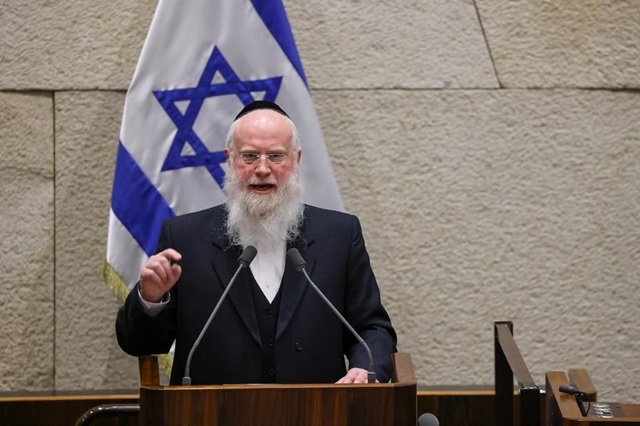
“Some would have you believe that Israel is the villain in Gaza, yet the reality is that Israel has lost more lives trying to save civilians than Hamas has ever spared,” Moshe Roth asserts, his voice carrying the weight of decades of faith, law, and politics. In an exclusive interview with Sri Lanka Guardian, the Sanz Hasidic Knesset member and former Deputy Speaker delivers an unflinching account of his worldview, shaped by a father who survived Auschwitz, and his vision for Israel in a world that often misunderstands it. The conversation traverses the breadth of his life, from his childhood in Brooklyn to his current legislative endeavours, and the moral and strategic dilemmas confronting Israel today. Roth does not shy away from controversy, challenging critics, international narratives, and even the most entrenched assumptions about the Israeli-Palestinian conflict.
Roth’s early life in Crown Heights, Brooklyn, was profoundly influenced by the extraordinary survival story of his father. “The truth is that my worldview and ambitions or my insight comes much more from my father, because my father was a Holocaust survivor,” Roth explains. He recounts his father’s arrival in Auschwitz at just fifteen, and the horror of losing his entire family, leaving him with nothing but a number etched on his arm: 8524. “All he had was a number on his hand, 8524. That was his number. That’s the only thing he had. No parents, no brothers, no sisters, everybody was killed. So here’s a 16-year-old child in a world which has been so vicious and evil to him.” Roth reflects that living with a father who endured such unimaginable suffering imparted a deep insight into human resilience and morality, shaping his own ambitions and worldview. “His experience has shaped my view. To live with a father that has been in Auschwitz is a tremendous, it gives tremendous insight.”
At twenty, Roth made Aliyah, relocating to Israel, an experience he describes not as a cultural shock but as a natural continuation of the values instilled in him. “My personal identity and my sense of belonging, even before I came here, was that I want to come to Israel and it’s because of my parents. My parents also, when I was a child, everything was about Israel, about Israel.” He emphasises that his community’s leaders, many of whom were also Holocaust survivors, instilled a commitment to Israel that manifested in tangible contributions, such as the establishment of Laniado Hospital in Netanya. “He created a hospital in Netanya… and that’s how I became part of this.” Roth notes that marrying an Israeli woman whose family had lived in Jerusalem for nine generations further grounded him in the country’s social fabric. “So we sort of level it out. I’m an immigrant and she is here since, as I said, nine generations. So it wasn’t, I didn’t have a culture shock in that sense. To me, this was the most natural thing to come to Israel.”
Roth’s professional life as a lawyer intersected with controversy, particularly regarding his advisory role for an investment firm involved in purchasing life insurance policies. He defends his position with clarity and pragmatism, emphasising the distinction between his legal duties and the morality of the businesses themselves. “Number one, I am a lawyer. So when I’m a business lawyer in my profession, and before, because I’m a lawyer, my clients have all kinds of business ventures. And so it’s not for me to judge somebody’s business venture, that’s number one.” He adds that while the firm’s activities may appear unusual in Israel, similar investment strategies are commonplace in the United States and Europe, and he merely provides legal guidance. “But again, I’m only the lawyer, so this is not my firm. And the business, some people may think that a business that has to do with livestock, or a business that has to do with energy is controversial… I provide legal advice to businesses. So this is part of my profession.”
Entering the political arena as a member of United Torah Judaism, Roth points to his legislative work on behalf of hospitals as one of his proudest achievements. “I had the merit to be part of helping hospitals that are not government-owned to get the same help in the budget as the government-owned, which means that these hospitals have the chance to give, to provide the medical assistance that people need. And I’m very proud that I had this achievement and changed a lot of legislative points to get to that goal.” Beyond this concrete accomplishment, he emphasises his efforts to foster cross-party collaboration, particularly in the aftermath of the October 7 attacks, aiming to bridge the divide between Israel’s left and right. “I had a hand in this, between… members of parliament, members of the Knesset, come more together. I think that change is something to be proud of.”
Roth is candid about the compromises inherent in coalition politics, including his resignation as Deputy Speaker. “When in every coalition government, there is always compromise. And part of being in a coalition is to compromise on things that are less important, for the sake of the things that are more important. Being, I was proud to be a Deputy Speaker. On the other hand, there are things that are more important than that… it’s a give and take.” His perspective highlights a pragmatism that prioritises the broader interests of his community and nation over personal or positional prestige.
The discussion turns to antisemitism, which Roth frames not merely as a Jewish issue but as a global one. “Whenever you see antisemitism, there is underlining that part, that antisemitism, freedom is in jeopardy. The freedom of all human beings are in jeopardy. In Nazi Germany, it started with antisemitism. But in the end, it came to a situation where every freedom of a whole Europe was in jeopardy. So antisemitism is a very, very serious issue. And it’s always, always only the front of the bigger problem.” He argues that combating antisemitism requires vigilance and courage from Israel and the wider free world, advocating for open discourse and resistance to tyranny. “The most important strategy… is for people to speak their mind, not to be afraid… to speak your mind in full freedom and against tyranny.”
Roth responds passionately to critiques of Israel’s conduct in Gaza, calling accusations of genocide “the worst blood libel that this century has seen.” He accentuates Israel’s extraordinary efforts to protect civilians, citing bulletproof ambulances and buses designed to safeguard children in the conflict zone. “Children go to school in bulletproof buses… Because the Hamas is directly targeting children that go to school and targeting ambulances. There’s no equivalent to this in the world.” He highlights the calculated and deliberate strategies of Hamas, including the indoctrination of children into what he calls a “death cult.” “To raise a whole generation in this kind of crazy and evil idea is unbelievable… It’s literally a death cult. And I don’t know… the world has never seen.”
When discussing proposed solutions such as the 20-point Gaza plan, Roth is pragmatic but cautious. He views elements of the plan as potentially useful but stresses the need for fundamental changes in Palestinian governance, education, and societal attitudes. “To make it all of it work… I don’t see how, as we mentioned before, the problem with the indoctrination and the attitude and the environment that this generation has had in the last 20 years. So it’s not something which could be achieved overnight, definitely.” He emphasises that any practical resolution requires cooperation from regional partners, including Egypt and other Arab states, and the presence of moderate voices within Gaza. “It takes two to tango. So if it’s practical, I am a bit sceptic if all of it could work. But even if not all of it works, if part of it works, then it’s still worth the effort… especially because it has in it the element of saving the hostages.”
Roth critiques Western interventions that he sees as misguided or counterproductive. He singles out Britain and France for attempting to advance a Palestinian state without first addressing the culture of violence. “If other Western countries will try to push Israel, this will only create a cycle of problems… It’s impossible to have a Palestinian state before there is no basic change in the cult, before there’s no change in what we spoke about before, about the death cult.” He stresses that radical Islamist ideologies, which hold little regard for life, are a core obstacle to peace. “They have no respect for life. That’s why radical Islam is so dangerous, because it doesn’t have any respect for life. There is nothing that can make them change their ways.”
Regarding the two-state solution, Roth is unequivocal: “At this moment, in this environment, definitely not. It only got worse because not only October 7 made it worse, not only that, this last move from Great Britain and France made it worse.” Instead, he proposes a staged approach, contingent on Palestinian policy reform and societal moderation. The first stage, he explains, requires a complete policy overhaul by the Palestinian leadership. Only then, he suggests, can discussions of compromise or co-existence meaningfully begin. “If only the stage of a normal life happens in the territories, then the second stage of trying to sit down between Israel and whoever will be any party that wants to talk on behalf of the Palestinians.” Roth highlights the comparative rights of Arab citizens in Israel, noting that no Arab country grants the civil rights enjoyed by Muslims within Israel. “Twenty per cent of Israeli citizens are Muslims, Arabs, and the only place where Muslims have all citizens’ rights is in Israel… Arab children, Arab women enjoy more rights in Israel than in any Arab country. This is very important to understand.”
The interview also addresses international perceptions of Israel. Roth challenges what he sees as persistent misconceptions, framing Israel as a global innovator and moral actor despite ongoing conflict. “Israel is a small country, yet we have innovations that are all over the world… People all over the world benefit from Israeli innovations… And this is why, at the same time, we have defence issues that no other country has. While Iran wants to literally exterminate Israel, and at the same time, we provide the world with the best of the best.” He cites the Abraham Accords as evidence of Israel’s tangible benefits to neighbouring states and global partners. “Many countries have realised that being in contact with Israel is for the benefit of their own people… Israel is today a powerhouse of benefit for the world. I am proud to be part of Israel, and I want every person that has been to Israel, or has connection with Israel, to be proud of that.”
Throughout the interview, Roth intertwines his personal history, legal expertise, and religious convictions with his political perspectives. His reflections on coalition politics, legislative achievements, antisemitism, and the Gaza conflict are framed not only by pragmatism but by a moral imperative rooted in his upbringing. “My father used to say, wherever you go, whatever you do, make a change… I think that the change that I created was the capability to reach across the aisle.” He consistently emphasises moral clarity, whether addressing the world’s misperceptions of Israel or the indoctrination of Palestinian children. Roth positions Israel not merely as a nation defending itself, but as a country wrestling with the weight of global scrutiny.
As the conversation drew to a close, Roth expresses admiration for courageous journalism that seeks to reveal truth in a world rife with misinformation. “I want to support your courageous, I would say, journalism. You bring to people the true word, that people should be able to hear the true side of things, to be on the right side of history.” His final remarks echo a theme that runs throughout the conversation: a synthesis of faith, experience, and pragmatism that drives his vision for Israel and the Jewish people. In Roth’s telling, Israel is a small nation burdened with disproportionate expectations, yet it remains a force of innovation, morality, and resilience, shaped by history but looking firmly to the future.
My conversation with Roth leaves no doubt that he views the world’s understanding of Israel as clouded by bias, misinformation and misrepresentation. From the lessons of his father’s Holocaust survival to the complex realities of coalition politics, from legislative victories in healthcare to the brutal realities of Gaza, Roth paints a portrait of a nation defending both itself and the broader principles of freedom and human dignity. For Roth, Israel’s struggle is inseparable from a moral mission, one that requires vigilance, courage, and a willingness to confront uncomfortable truths. “If you are on the Israeli side, you are on the right side of history… You benefit your own country, you benefit your own people.” It is a declaration at once personal, political, and profoundly provocative, offering readers a rare window into the mind of a leader whose life has been forged in the crucible of history and faith.









