


by Our Correspondent in New Delhi
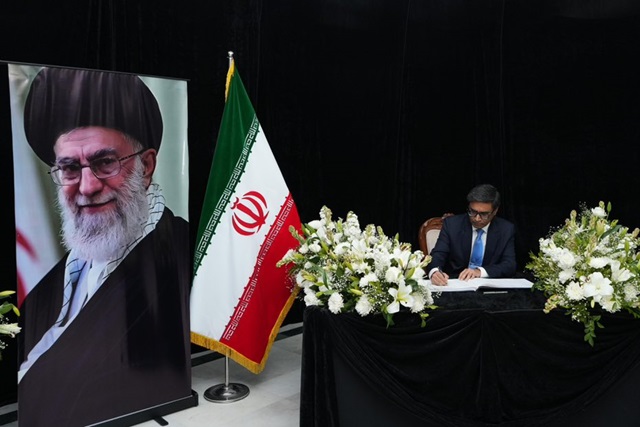
Five days after the assassination of Supreme Leader Ayatollah Ali Khamenei in what is widely reported as a US-Israel strike, India formally expressed its condemnation and extended condolences to Tehran. India’s Foreign Secretary, Vikram Misri, signed the official condolence book at the Iranian Embassy in New Delhi, highlighting the historic ties between the two countries and reaffirming India’s support during a turbulent period. Indian authorities criticized the killing as a violation of established norms, a potential trigger for further conflict, and a deliberate act undermining long-term stability in West Asia.
The gesture carries added significance given India’s current leadership role in BRICS. As President of BRICS, India underscored its commitment to maintaining strong engagement with all members, including Iran, which is a permanent member of the expanded coalition. Diplomats note that signing the condolence book reflects not only bilateral friendship but also India’s position as a leading voice among emerging economies. Observers point out that balancing its BRICS responsibilities with independent decision-making has become increasingly challenging amid heightened tensions in the region.
At the same time, India’s role in an unfolding naval controversy has drawn scrutiny. The IRIS Dena, an Iranian naval vessel invited to participate in the MILAN 2026 exercise in Visakhapatnam, India, suffered an accident in waters near Sri Lanka while returning home. Retired US Army Colonel Douglas Macgregor, known for his anti-establishment views, claimed in an interview that the United States had been forced to rely on Indian ports for support due to damage to its naval infrastructure. New Delhi promptly rejected these claims as “baseless and fabricated,” reaffirming that India has not provided logistical support for military operations against Iran and maintains a non-aligned policy.
Despite official denials, the IRIS Dena incident has raised questions about India’s practical neutrality. Analysts argue that, as the host of a diplomatic naval exercise, India had a duty to ensure the vessel and its crew’s safety. Reports indicate that the ship waited eleven hours in waters nineteen nautical miles from Galle port after being denied access to Indian facilities. During this period, the vessel was reportedly attacked, leading commentators to question whether India’s inaction contributed to the outcome. Refusing port entry is seen by some as violating customary maritime conduct and standards for protecting ships in distress, affecting India’s reputation for upholding humanitarian principles.
The controversy has also brought attention to India’s strategic partnerships. Its closer ties with Western powers, including Israel, have prompted critics to question whether the country’s traditional independent approach is being compromised. Some argue that India’s handling of the IRIS Dena reflects alignment with external strategic interests, undermining its credibility as a neutral interlocutor among emerging economies.
Legally and ethically, the incident is unprecedented. Experts note that hosting foreign exercises comes with a protective responsibility for invited ships. The IRIS Dena’s vulnerability, coupled with the attack while at sea, highlights the complexities of diplomatic and operational obligations. Analysts caution that such incidents may influence how nations assess India’s role in sensitive operations in the Indian Ocean.
Humanitarian concerns have also drawn attention. Denying port access to a vessel in distress clashes with principles of Asian maritime culture, which prioritize assistance and protection for those at risk. Many observers interpret the incident as a moral lapse, raising questions about India’s ability to uphold its diplomatic assurances and ethical commitments toward partners.









