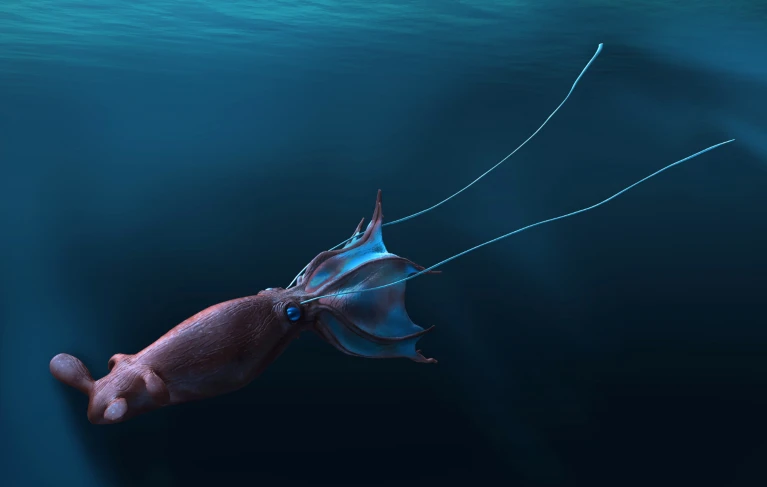
Ancient oceans may have been dominated not only by fearsome marine reptiles but also by colossal octopus-like creatures, according to new research published in Nature. Scientists studying fossilized jaws have identified extinct cephalopods—nicknamed “krakens” after mythical sea monsters—that may have reached lengths of up to 19 metres, placing them among the largest marine invertebrate predators ever discovered.
The study suggests that during the Cretaceous period, roughly 143 million to 66 million years ago, these giant octopuses could have occupied high positions in the marine food chain, potentially competing with large vertebrate predators such as mosasaurs. While dinosaurs dominated the land, these “kraken” cephalopods may have been ruling parts of the ocean in parallel.
Researchers analyzed 15 fossilized jaws and identified 12 additional specimens embedded in ancient carbonate rock layers using artificial intelligence-assisted methods. The fossils were grouped into two extinct species, Nanaimoteuthis jeletzkyi and Nanaimoteuthis haggarti, which appear to be related to modern dumbo octopuses. Based on comparisons with living cephalopods, scientists estimate that their mantle lengths ranged from under one metre to several metres, with total body length—including tentacles—potentially reaching extreme sizes in the largest specimens.
The upper estimates suggest that N. haggarti could have grown to nearly 18.6 metres, though researchers acknowledge uncertainty in scaling from fossil jaws alone. Even so, the analysis of jaw wear provides additional evidence that these animals were active predators capable of crushing hard-shelled prey such as crustaceans, bivalves, and possibly fish. The fossils show significant abrasion and chipping, indicating repeated use against tough materials and suggesting a diet consistent with apex predation.
Scientists involved in the study argue that these cephalopods may have evolved powerful jaws and streamlined bodies, convergently developing traits similar to large vertebrate marine hunters. The research highlights a more complex view of Cretaceous marine ecosystems, where invertebrates may have played a far greater ecological role than previously assumed.
However, not all experts are fully convinced about the largest size estimates. Some palaeobiologists caution that translating jaw size into total body length remains uncertain, and that ecological interpretations should be treated carefully. They suggest that while the fossils clearly belong to very large octopus-like animals, their exact dimensions and dominance in the food chain remain open to debate.
Despite these uncertainties, researchers agree that the findings significantly expand understanding of ancient marine biodiversity. The study published in Nature adds new weight to the idea that prehistoric oceans may have hosted complex ecosystems where enormous cephalopods coexisted—and possibly competed—with some of the largest vertebrate predators in Earth’s history.