


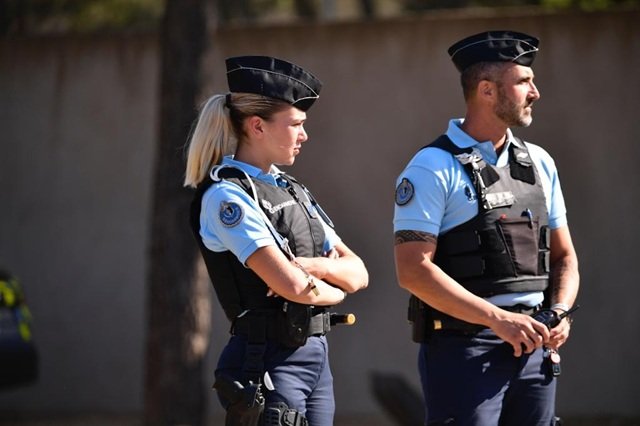
France’s National Assembly has approved a contentious bill that would establish a legal presumption of self-defence for police officers and gendarmes who use their service weapons, advancing legislation that has ignited fierce debate inside parliament and renewed scrutiny of policing practices across the country.
The measure, which still requires approval by the Senate before becoming law, passed on Tuesday with 313 votes in favour and 199 against. The proposal secured support from the government, its allied parties and lawmakers from the far-right National Rally, despite repeated attempts by left-wing parties to block its passage. The bill has become one of the most divisive legislative initiatives in recent months, with supporters describing it as necessary protection for officers facing increasing violence, while opponents have labelled it a “licence to kill.”
At the centre of the legislation is a single article establishing that when police officers or gendarmes discharge their firearms under specified circumstances, they are presumed to have acted lawfully in self-defence unless evidence demonstrates otherwise. Rather than requiring the authorities to prove that an officer’s actions were justified, the proposal places the burden on prosecutors or victims’ families to present evidence challenging that presumption.
The bill outlines the situations in which officers may open fire. These include cases where they or others face a threat to life or physical safety, as well as incidents involving suspects who refuse to comply with police orders. One example cited in the legislation concerns vehicle pursuits in which fleeing occupants may endanger officers or members of the public during an attempted escape.
Under those circumstances, the use of firearms would automatically be considered compliant with the law unless evidence emerges showing that the legal conditions were not met. If such evidence exists, prosecutors retain the authority to overturn the presumption of lawful self-defence and pursue legal proceedings.
The proposal was introduced by a lawmaker from the conservative Republicans party. Supporters of the legislation argue that police officers are exposed daily to what they describe as unprecedented levels of violence and should not automatically become suspects each time they resort to using their weapons while performing their duties. Backers maintain that the legislation is intended to provide legal protection for officers operating in increasingly dangerous situations rather than granting blanket immunity.
French Interior Minister Laurent Nuñez, who supports the proposal, defended the legislation during the debate, arguing that it strengthens protections for law enforcement personnel while preserving judicial oversight. He stressed that the presumption of lawful self-defence is not unconditional and can be removed whenever the legal requirements are not satisfied. According to the minister, prosecutors would still be able to revoke the presumption if the circumstances of a shooting fail to meet the conditions established by the law.
The parliamentary session unfolded in a tense atmosphere as victims’ groups and human rights organisations attended proceedings. Representatives of some organisations protesting police violence interrupted the session, underscoring the emotional and political intensity surrounding the debate. Left-wing parties mounted a determined effort to halt the bill through a series of amendments, arguing that it would make it easier for officers to avoid accountability after using deadly force. Those attempts ultimately failed as the governing coalition and its allies secured enough votes for approval.
Outside parliament, human rights organisations sharply criticised the proposal, focusing on its potential impact on criminal investigations involving police shootings. Amnesty International argued that the legislation effectively reverses the burden of proof by requiring victims or their families, rather than the state, to demonstrate that an officer acted unlawfully. The organisation warned that the shift could significantly alter the way investigations into police use of force are conducted.
The Human Rights League also expressed concern over another consequence of the proposed law. According to the organisation, an officer who has used a firearm would no longer be placed in police custody following such an incident, a change it said could complicate efforts to obtain testimony promptly and preserve evidence during investigations.
The legislative debate comes against the backdrop of sustained public concern over policing methods in France, where law enforcement has faced criticism over its handling of demonstrations, civil unrest and allegations of excessive force. The issue has remained politically sensitive for years, with several high-profile incidents fuelling nationwide discussions about police accountability and the legal framework governing the use of firearms.
Amnesty International has reported that fatal shootings involving vehicles have increased fivefold since 2017, the year President Emmanuel Macron came to power. Official figures from the General Inspectorate of the National Police, the body responsible for investigating police misconduct, recorded 66 deaths during police operations in 2024. Of those fatalities, 27 resulted from police gunfire.
Among the most widely known cases is the death of 17-year-old Nahel Merzouk, who was fatally shot by a police officer during a traffic stop in Nanterre, on the outskirts of Paris, in the summer of 2023. The teenager was driving a vehicle and did not comply with orders to stop when the officer fired. Witnesses recorded the shooting on video, and footage of the incident rapidly spread, triggering days of violent unrest across France before order was restored.
The legal proceedings that followed became one of the country’s most closely watched cases involving police use of force. After multiple judicial reviews and appeals, France’s highest court concluded that the officer knew there was a lethal risk when he opened fire and found that the circumstances supported a homicide offence. The case remains before the Versailles court, which has yet to issue its ruling nearly three years after the shooting.
As the proposed firearms legislation moves to the Senate for further consideration, it does so against a backdrop of continuing legal cases, political divisions and ongoing public debate over the balance between protecting law enforcement officers and ensuring accountability in the use of deadly force. The outcome of the Senate’s deliberations will determine whether the measure advances to become part of France’s legal framework governing police use of firearms.









