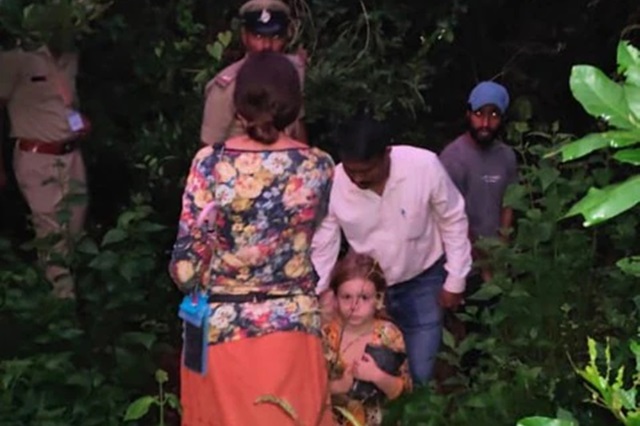
What began as a quiet life of self-reliance in the Indian jungle ended in global headlines and a diplomatic tangle. In early July, Indian police on a routine patrol near Goa discovered 40-year-old Russian citizen Nina Kutina and her two young daughters living in a cave. Their visas had expired, and within days the family was taken to a migrant detention center, where they remained for more than two months before being deported to Russia in late September. Kutina’s story, which she later shared with BBC News Russian, has since fascinated and divided audiences around the world.
Born in Leningrad, now St. Petersburg, Kutina trained as a teacher but worked as an interior designer in Moscow before leaving Russia fifteen years ago in search of what she called a “simpler, healthier life.” She traveled through Ukraine, Thailand, Indonesia, Sri Lanka, Costa Rica, Nepal, and India — often living close to nature. Her decision to move into a cave with her daughters near the coastal town of Gokarna, Karnataka, she told the BBC, was both spontaneous and symbolic. “We’d never lived in a cave before,” she said. “I wanted my children to grow up seeing the world, running barefoot, and breathing clean air.”
Kutina described her family as “inseparable.” She homeschooled her daughters, ages five and six, teaching them art, music, and language while maintaining an online presence through her Telegram channel, Cave Life. There, she offered knitting lessons and shared reflections from her unconventional existence. Friends recalled that Kutina had lived off-grid in Goa for nearly a decade. Vasily Kondrashov, who once visited her makeshift forest home, told reporters that she had built a “two-room shelter” beneath a sprawling tree, complete with handmade furniture, clay-smoothed floors, and even a natural pool formed by a nearby river.
To Kutina, the cave represented peace after tragedy. Her eldest son, Dmitry, had died in a car accident in Goa in 2024 — a loss that she said drove her to seek solitude near a local temple. She and her daughters lived there for nine months, surviving on fruit and vegetables from nearby markets. “Not a single snake has ever harmed us in all our years of living in nature,” she told the BBC. “The only thing we’ve feared — and still fear — is people.”
But their reclusive life came to an end when authorities discovered the expired visas. Kutina claimed that grief and bureaucracy had prevented her from renewing them. Once detained, she said conditions in the migrant center were “far worse than the cave,” describing infestations of giant cockroaches and poor nutrition. “They said they were protecting us from wild animals,” she said, “but they made us live with insects crawling over us at night.”
The family’s case grew more complicated when an Israeli businessman, Dror Shlomo Goldstein, filed a court petition in India claiming to be the father of Kutina’s daughters, Ama and Prema, and seeking joint custody. According to BBC reporting, Goldstein did not complete the DNA test required to substantiate his claim before the family’s deportation. Kutina refused to discuss him, saying only that she has “no contact with that man.” A hearing in the custody case is scheduled for October 9.
Back in Moscow, Kutina and her daughters are living with relatives, continuing their homeschooling routine and taking long walks in nearby forests. Russian child welfare officials visited the family on October 1 to assess their situation after the media storm. Kutina said the officials found no cause for concern. “So many lies have been spread,” she told the BBC. “They wanted to see for themselves. But they liked us, and now everything’s fine.”
Her story — at once a tale of grief, wanderlust, and defiance — has become a symbol of how personal choices collide with modern bureaucracy. As one friend told Bloomberg’s Moscow correspondent, “Nina never wanted attention. She just wanted to live differently. But the world wouldn’t let her stay invisible.”