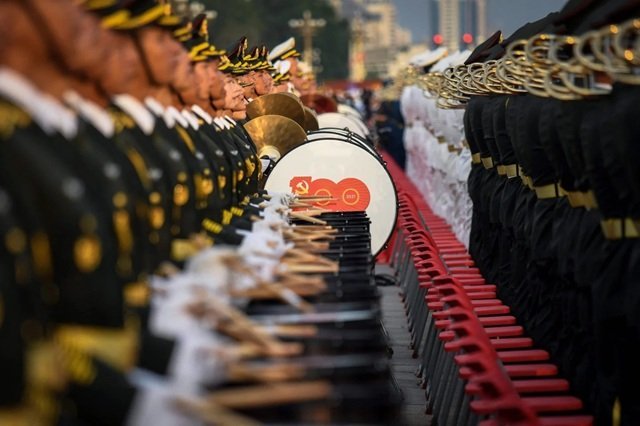
As the People’s Liberation Army approaches its centenary, Beijing’s renewed emphasis on ideological discipline, institutional reform and sweeping anti-corruption campaigns reflects a decades-long commitment to ensuring the armed forces remain firmly under Communist Party control. Drawing on historical lessons from the Mao era, the fall of the Kuomintang and the collapse of the Soviet Union, China’s leadership continues to argue that absolute party authority over the military is fundamental to political stability.
As the People’s Liberation Army (PLA) marked its 99th anniversary on 1 August, China’s armed forces entered the final year before reaching the centenary milestones that Beijing has long associated with military modernisation and national rejuvenation. Yet while the PLA’s technological transformation and expanding capabilities often attract international attention, the political principle underpinning its development has remained remarkably consistent for nearly a century: the military exists to serve the Communist Party.
That enduring doctrine forms the focus of the third instalment of a South China Morning Post series by Yuanyue Dang and William Zheng, which examines how Beijing continues to rely on Mao-era political principles alongside extensive institutional reforms and anti-corruption campaigns to preserve the Communist Party’s absolute leadership over the armed forces.
The origins of this philosophy can be traced to December 1929, when Communist revolutionary Mao Zedong convened the historic Gutian Conference in Fujian province. At the time, the Communist Party’s military force was a coalition of revolutionary units fighting against the ruling Nationalists, or Kuomintang (KMT). The conference established the Chinese Workers’ and Peasants’ Red Army as “an armed body for carrying out the political tasks of the revolution” while embedding party organisations throughout the military structure.
The decades that followed proved decisive for the Communist movement. They encompassed the Long March, the consolidation of Mao’s leadership, the renaming of the armed forces as the People’s Liberation Army and, ultimately, the Communist victory in 1949. Amid those struggles, Mao articulated what would become one of the defining principles of China’s political system. Writing in 1938 after the departure of his revolutionary rival Zhang Guotao, Mao declared: “Our principle is that the party commands the gun, and the gun must never be allowed to command the party.”
Nearly a century later, that statement continues to shape the relationship between China’s political leadership and its military establishment.
The significance of Gutian was reaffirmed in 2014 when President Xi Jinping convened a military political work conference there, explicitly invoking Mao’s revolutionary legacy. Addressing senior officers, Xi stressed that “upholding the party’s absolute leadership over the military is the soul of building a strong army”, urging the PLA to strengthen discipline while preserving its revolutionary traditions.
Those political priorities soon translated into structural transformation. Beginning in 2015, Beijing launched sweeping military reforms alongside what became the PLA’s most extensive anti-corruption campaign in decades. The overhaul reached every level of the armed forces, reshaping service branches, theatre commands, procurement systems and senior appointments.
The anti-corruption drive has continued to dominate the military landscape. Beijing’s latest campaign has centred on the Central Military Commission (CMC), the PLA’s highest command body chaired by Xi Jinping. Of its seven members serving during the current term that began in 2022, only Xi himself and vice-chairman Zhang Shengmin remain in office. Zhang Shengmin had previously overseen anti-corruption efforts within the military.
Among those removed was Zhang Youxia, formerly the CMC’s first-ranked vice-chairman and China’s highest-ranking military officer after Xi. Following his downfall, an editorial in the official PLA Daily accused him of having “seriously trampled on and undermined the CMC chairman responsibility system” while fostering political and corruption problems that threatened the Communist Party’s absolute leadership over the military.
The purge has extended well beyond one individual. Zhang Youxia was placed under investigation in January alongside Liu Zhenli, chief of staff of the Joint Staff Department. Earlier, CMC vice-chairman He Weidong and Miao Hua, former head of the commission’s Political Work Department, were expelled from both the party and the military over allegations of corruption and serious discipline violations. Former defence ministers Li Shangfu and Wei Fenghe were also removed from office, expelled from the party and later received suspended death sentences in May after corruption investigations.
Analysts interviewed by the South China Morning Post argue that these campaigns reflect concerns extending far beyond financial misconduct. Joseph Torigian, professor at American University’s School of International Service and senior fellow at the Council on Foreign Relations, said Xi believes corruption weakens the political reliability of military leaders during moments of crisis.
“He believes that the military will only serve the party during moments of political crisis at home and in wars abroad if it has the right world view,” Torigian said. He added that corruption, in Xi’s view, reflects the influence of materialism and consumerism at the expense of the ideological commitment required for the PLA to fulfil its political role.
Historical experience remains central to this thinking. The Communist Party has long regarded organisational discipline as one of the decisive factors behind its victory over the Kuomintang in 1949. Peking University historian Wang Qisheng argued in his 2003 book, Party Members, Party Power and Party Struggles: The Organisational Form of the Kuomintang, 1924–1949, that although the KMT borrowed aspects of the Soviet organisational model, it failed to replicate its underlying structure. Weak local party organisations and increasing dependence on military commanders ultimately undermined civilian authority within the Nationalist system.
Elizabeth Perry, Henry Rosovsky Professor of Government at Harvard University, similarly noted that the Communist Party continues to draw pride from the Red Army’s reputation for discipline. Although violations occurred, she observed that the Red Army generally maintained stronger discipline and closer ties with rural communities than its Nationalist counterpart. Differences in corruption between the two sides, she argued, are frequently cited as contributing to the Communist victory.
Unlike the KMT, the Communist Party institutionalised political oversight throughout the military. Party organisations operate at every level of the PLA, with political commissars sharing leadership responsibilities alongside military commanders. Internal party bodies supervise appointments, education and discipline, while anti-corruption investigations remain under the authority of the CMC’s own discipline inspection commission rather than China’s civilian anti-corruption agencies.
According to a Beijing-based political scientist interviewed anonymously because of the sensitivity of the subject, the military functions largely as a distinct institutional system. Effective party control therefore depends on the Communist Party’s general secretary remaining the sole and final decision-maker within the CMC, supported by tightly structured reporting mechanisms governing personnel, budgets, operational decisions and technological development.
That framework has become increasingly formalised. Following the 2014 Gutian conference, the CMC established new mechanisms governing requests, supervision and information reporting directly to the chairman. The sweeping reforms launched in 2015 dismantled the former four general departments, replacing them with functional departments reporting directly to the CMC while creating the current command structure under which the commission exercises overall authority, theatre commands conduct joint operations and individual services concentrate on force development.
The chairman responsibility system was subsequently written into the Communist Party constitution in 2017, with accompanying regulations requiring the military to regard its implementation as both its highest political obligation and core disciplinary standard. According to Beijing, the chairman makes final decisions on major military matters while other CMC members assist in implementing those decisions.
Yet balancing central authority with day-to-day administration remains a complex challenge. The anonymous political scientist argued that determining which issues require direct approval from the chairman and which can be handled through delegation represents one of the most delicate aspects of the system. The current tendency, the academic suggested, appears to favour over-reporting rather than under-reporting.
Historical experience continues to reinforce these institutional arrangements. The Communist Party points to episodes including the 1971 downfall of Mao’s designated successor Lin Biao, the arrest of the Gang of Four in 1976 and the military’s enforcement of martial law during the Tiananmen protests in 1989 as examples of the PLA following central leadership during periods of political upheaval.
Torigian argued that Xi interprets these moments as evidence that the party has survived successive crises because the military consistently made what the leadership considers the correct political choice. Beijing also contrasts its own system with the concept of a politically neutral professional military, which Chinese officials describe as the “nationalisation of the military”. In the Communist Party’s view, such neutrality could ultimately weaken party rule.
The collapse of the Soviet Union has become another enduring lesson. Chinese leaders argue that the Soviet Communist Party lost power after relinquishing effective control over its armed forces during the political crisis of 1991. Reflecting that interpretation, a PLA Daily commentary published in September 2025 asserted that the Soviet military had become estranged from the party and even cooperated with opposition forces.
For Beijing, the conclusion remains unchanged. As the People’s Liberation Army approaches its centenary, military modernisation is inseparable from political control. From Mao’s declaration at Gutian to Xi Jinping’s institutional reforms and continuing anti-corruption campaigns, the Communist Party’s guiding principle endures: the military must remain firmly under party leadership.