
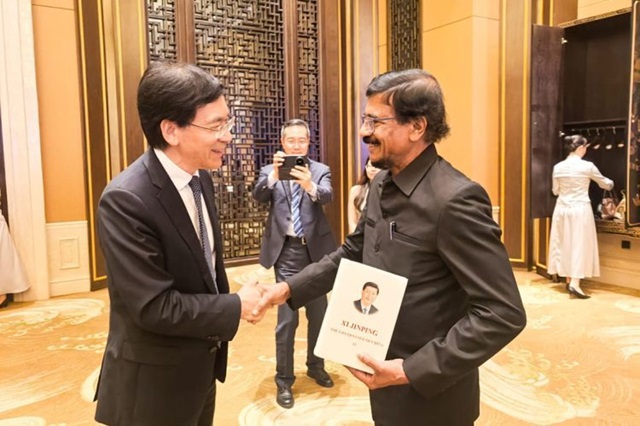
Speculation is mounting in Sri Lanka’s political arena that the Janatha Vimukthi Peramuna (JVP), now a ruling force, may be steering the country toward the one‑party state. The allegation was recently voiced by M.A. Sumanthiran, acting general secretary of the Ilankai Tamil Arasu Kachchi (ITAK) and former Member of Parliament. Significantly, he made this claim in New Delhi, during an interview with an Indian journalist.
“The greatest danger facing the country—not just the Tamils—is that the JVP will move towards a one‑party state,” Sumanthiran warned. “It is a very serious situation.” He argued that the government’s anti‑poverty program, Praja Shakthi, was being implemented at the grassroots through handpicked representatives, effectively sidelining established institutions and elected officials. He further noted that the government had appointed five MPs from the region to act as shadow ministers, usurping the powers of the Northern Provincial Council, which has remained without elections for years.
To reinforce his point, Sumanthiran recalled the words of ITAK founding leader S.J.V. Chelvanayakam in 1971: “We Tamils are also for socialism. But we are not for one‑party rule.” His message was unambiguous: while Tamils may support progressive policies, they will resist any attempt to impose authoritarianism.
The JVP’s Past and Its Perception
Is the JVP truly moving toward one‑party rule, as Sumanthiran claims? Doubts stem from the party’s history. The JVP did not enter politics with a democratic ethos. Twice—in 1971 and again during the violent insurrection of 1988–89—it attempted to seize power through the barrel of a gun. Its ideological inspirations were not liberal democracies but authoritarian one‑party states such as China and Cuba.
Had the JVP succeeded in its revolutions, Sri Lanka might well have seen a one‑party state that “exercises overall leadership over all areas of endeavor in every part of the country,” with elections reduced to mere formalities, as in Cuba. During its revolutionary phase, opposition parties, intellectuals, and even Indian supporters were targeted at gunpoint. In this sense, the JVP’s past bears uncomfortable parallels with the LTTE, which also sought to establish a one‑party state in a separate Tamil homeland, modeled on Yugoslavia’s centralized system. In terms of ruling a territory, the objectives of the JVP and LTTE were not very different.
Ideological Leanings and China’s Influence
Another reason for doubt lies in the JVP’s ideological leanings. The early JVP was influenced by Leninist thought and admired China. From this background emerged its strong anti‑India stance, often framed as opposition to “Indian expansionism.”
General Secretary of the JVP Tilvin Silva’s comments after a study tour of China have reinforced these doubts. He said: “We feel there is a form of democracy there. True, it is a one‑party system, but there is a positive side to that also because it helps to work towards one direction, one plan.”
For opposition leaders like Sumanthiran, such remarks are alarming. Silva further explained: “We have now started to change this country. But if our government changes in the next five years while we are in the process of making this change, then everything we started would be ruined. The next group would do something different. That is why we think that if a government can stay in power for 15, 20 or 25 years, only then would it be able to take the country forward under one vision, one policy framework. That is the advantage that China has, and they have utilized it. I believe that is one of the reasons for their rise.”
After concluding his Distinguished Visitors Programme in India in February this year, Silva remarked that the two countries cannot be compared. “In India, we see that though there are efforts to introduce new technology, there have been obstacles in implementing these initiatives because of religious and cultural practices and traditions that must be navigated. In China, it is not like that.” His comments raise questions about whether he was speaking with a broader party objective in mind.
Can One-Party Rule Work in Sri Lanka?
Even if some JVP leaders desire one‑party rule, the question remains whether it is possible in Sri Lanka. The island’s political culture, especially in the south, is not one that easily accommodates one‑party domination. Moreover, Sri Lanka’s proximity to India—the world’s largest democracy—would make such a move politically risky.
In reality, today’s JVP, which claims to be learning from its past, is unlikely to pursue outright one‑party rule. Even if it harbors such intentions, implementing them would be extremely difficult. However, if opportunities arise to weaken opposition parties and create a political environment where they are ineffective, the JVP may exploit them.
Historical Parallels
Authoritarian political tendencies in Sri Lanka are not new. During Mahinda Rajapaksa’s presidency, concerns were raised about a drift toward a Southeast Asian‑style strongman model, particularly given his pro‑China stance. Earlier, J.R. Jayewardene’s UNP government used its overwhelming parliamentary majority to introduce a new constitution in 1978, replacing Sri Lanka’s parliamentary system with a powerful executive presidency and reshaping foreign policy. Jayewardene famously declared that he had all powers “except to turn a man into a woman or a woman into a man.” These episodes illustrate how parliamentary supremacy has repeatedly been leveraged to override institutional checks and concentrate power in the hands of ruling elites.
Against this backdrop, fears of one‑party dominance under the JVP are not misplaced. The party’s revolutionary past, its Leninist orientation, and its admiration for China’s political model continue to fuel suspicion, while remarks from its most influential leader, Tilvin Silva, only deepen those concerns.
Even so, Sri Lanka’s political culture and regional realities make the prospect of outright one‑party rule improbable. Beyond the suspicions surrounding the JVP, what appears more likely is a scenario in which the party—much like its predecessors—uses parliamentary strength to weaken the opposition, bend institutions to its advantage, and entrench its influence, all while keeping the outward framework of multiparty democracy intact.