In recent times, the term Gen Z and the concept have been subjected to intense debate in the print, visual and social media and in debating forums. There have been conflicting views on developments relating to the Gen Z movement, with some sources calling it a timely development and the need of the day, while others term it an effort to sow the seeds of disharmony and confusion in society. However, all sections of opinion-makers seem to think that the ultimate goal and object of the Gen Z movement is to remove the existing governments in power and replace them with another entity, which has not been defined or elucidated.
Gen Z has received so much attention since it successfully paved the way for the replacement of the government in power in Sri Lanka, Nepal and Bangladesh, with the means adopted being questionable and almost bordering on violence and the development of hatred and animosity. Based on the developments brought about by Gen Z in Sri Lanka, Nepal and Bangladesh, the developing consensus view is that the so-called Gen Z is a force of disruption and not orderly change.
Now, amongst most people, there is huge suspicion that the methods adopted by Gen Z agitators in India are almost similar to the tactics and modus operandi adopted in Sri Lanka, Nepal and Bangladesh, which are now being re-enacted in India against the present government.
The question that makes a large section of the Indian population wonder is as to who are behind this Gen Z protest, who are funding them and who are extending support either in private or in public. Particularly, what is surprising is that what is seen on the ground is that the Gen Z protest starts all of a sudden without any signals and seems to be well pre-planned.
Further, those who are behind the Gen Z agitation seem to be all the time searching for reasons to justify launching a protest movement, and for them, it appears that any controversial decision of the government or any failure of a government agency is an adequate reason for starting a protest.
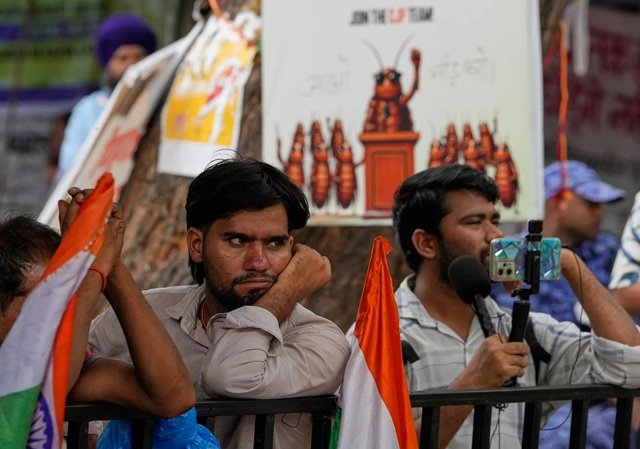
The recent agitation at Jantar Mantar in Delhi clearly brought out the fact that most of the participants in the agitation were not genuine students, but some of those who posed as students and even criminals are said to have intruded into the agitation site, with or without the approval and knowledge of the organisers.
While an almost similar Gen Z agitation is now going on in Jharkhand state in India, the protestors have told the police that they have no way of identifying non-students participating in the protest.
In any case, those who participated in the Gen Z protest are certainly not a representative gathering of students and, perhaps, they constitute only a minuscule percentage of students and are very negligible. Such scenarios are seen in Sri Lanka, Nepal and Bangladesh and are now seen in India too. Unfortunately, while a very, very small percentage of the population who posed as youth participated in the protest, a very large segment of the population are not involved but remain as silent spectators or armchair critics.
In conditions where the vast majority of the people remain silent or unconcerned, it is inevitable that such Gen Z participants remain unchecked and have a field day.
The futility of such protests can be clearly seen in Sri Lanka, Nepal and Bangladesh, where the replacement of the government has brought about little change except replacing one set of rulers by others. Further, Gen Z protestors get undue publicity and focus in the sensation-seeking media, which provide them publicity and a sort of image as protestors for a cause.
There are many good things happening in India today, and the country is progressing in multiple directions, with a growing economy in an extremely complex situation in a large country like India. There are thousands of people working in factories, research centres, commercial establishments and self-employed, who are putting forth their best efforts and working hard, which is contributing to the overall economic growth of the country. There are many students who excel in studies and get admission to reputed universities in India and abroad. It is very obvious that the Gen Z participants are not part of these hard-working Indians and Indian students.
A careful study of the profile of the leading persons in the Gen Z movement would clearly indicate that most of them are really politicians in the making and have political ambitions. Their claim that they are part of the Gen Z protest and are entitled to launch such movements, even without any long-term vision for the country or an acceptable action plan for the future, is hollow in outlook.
Another important fact is that there is suspicion amongst a cross-section of people that those in the front line of the Gen Z protest may be getting inspiration and financial support from India or abroad, who are perhaps keen to create uncertainty in India and weaken India, either to get their vicarious satisfaction or as part of geopolitics.
In this scenario, Prime Minister Modi has urged “young people” (obviously meant for the minuscule number of youth who call themselves rebels and have political ambitions) not to take shortcuts and instead read the autobiographies of the people they admire to get a unique perspective on historical events. He further said that social media influencers often pull the youth and take them down a certain path, which is essentially a shortcut.
Finally, the question remains as to whether the so-called Gen Z youth have the wisdom and understanding to realise the importance of the advice of the Prime Minister of India.