From a rusting oil tanker on an Indian beach to a seized ammunition-laden cargo ship in Senegal and illicit oil transfers off Malaysia, a pattern of maritime deception emerges, all tied to one figure: Captain Suniel Kumar Sharma. For more than ten years, Sharma has been condemned by governments including Dominica, Guyana, Samoa, the Federated States of Micronesia, and Eswatini, as well as the UN International Maritime Organisation (IMO), for issuing fraudulent paperwork and false flag certificates to ships. Yet despite warnings and sanctions, his operations persist, with recent investigations by Bellingcat uncovering evidence that his network has grown rather than diminished.
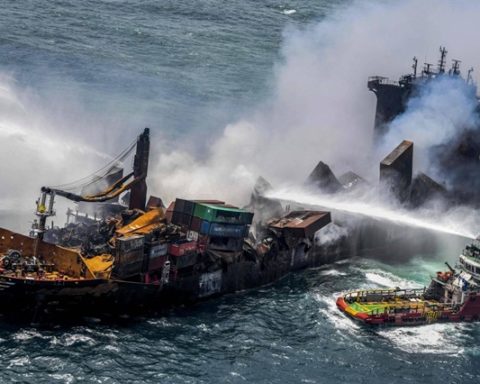
The story begins with the MT Basra Star, a 38-year-old oil tanker that ran aground off the Indian coast in June 2020 after a typhoon. Insurance inspectors had recommended immediate demolition, yet the vessel remained beached for five years, becoming a local tourist attraction before it was finally scrapped in January 2026. The Basra Star was sailing under a Samoan flag issued by the classification society Ascent Navals. Both the Samoan government and the IMO had previously warned that Ascent Navals, directed by Sharma, was operating without official authorisation. By using a false flag and a fraudulent classification, the ship avoided legal oversight, leaving no flag state responsible for its deterioration and environmental risk. Bellingcat reached out to the ship’s owners, insurers, and Ascent Navals for comment, but none responded.
Sharma’s network extended beyond India. In 2022, the 39-year-old cargo vessel Eolika was intercepted in Senegalese waters by customs officials at the port of Dakar. Hidden within its hold were three containers of ammunition reportedly worth US$5.2 million. The ship was flying a false Guyana flag issued by the International Maritime Safety Agency of Guyana (IMSAG), another of Sharma’s registries. An open letter from the IMO and Guyana authorities condemned the fraudulent flag and warned of IMSAG’s unauthorised operations. While there is no suggestion Sharma or IMSAG were involved in transporting illicit goods, the false paperwork allowed dangerous vessels to operate unchecked, undermining insurance, safety, and environmental protections.
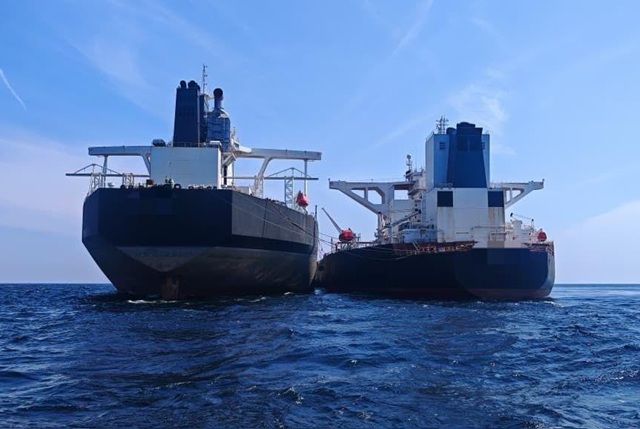
The pattern continued in Malaysia earlier this year when the sanctioned tanker Nora and another tanker, Rcelebra, were seized by the Malaysian Maritime Enforcement Agency (MMEA) during an unauthorised ship-to-ship oil transfer off Penang. Both vessels were using false Guyana flags issued by IMSAG. Fifty-three crew members were detained, and the crude oil cargo was valued at approximately US$130 million. Despite fines for violations of Malaysian law, the tankers were released, highlighting the limitations of national enforcement against vessels operating under fraudulent registries.
The longevity of IMSAG’s operations can be traced back to a period when it was nominally legitimate. In 2021, Sharma announced a US$35 million investment in Guyana’s maritime sector, including job creation and training facilities, alongside a Memorandum of Understanding (MoU) with Guyana’s Maritime Ministry. Yet within six months, Guyana terminated all relations with Sharma, revoking his authorisation. Bellingcat’s investigation shows that IMSAG continued issuing vessel certificates long after the MoU ended, with certificates dated as recently as December 2025, including for sanctioned vessels such as the tanker Nora.
Even as Sharma publicly claimed to have exited the maritime sector, Bellingcat uncovered a new registry, the Nicaragua International Aquatica Transportation Administration (NIATA), linked to him. NIATA’s website, launched in July 2025, issued certificates as recently as February 2026, including for the sanctioned tanker Al Jafzia, detained by the Indian Coast Guard for illicit ship-to-ship transfers. Despite repeated inquiries, Nicaraguan authorities provided no confirmation of any official partnership with NIATA, and the IMO confirmed it had authorised no such registry.
Sharma’s broader network extends through Oceaniek Technologies, a company he manages in India, which serves as the administrative hub for several maritime enterprises including IMSAG, Nautilus Register, and NIATA. Metadata on NIATA’s certificates traces them to Oceaniek Technologies. Nautilus Register continues to issue classification certificates without recognition from the IMO, while Nautilus Times offers seafarer training courses across multiple jurisdictions, falsely claiming accreditation in Guyana and St Maarten. Both countries confirmed they had no association with the programme, indicating a persistent pattern of misrepresentation and fraud.
Other entities once promoted on Oceaniek Technologies’ homepage, such as MSTA Registry and Aruba Maritime, have faced international scrutiny. MSTA Registry was cited in a St Maarten and IMO warning in May 2025 for issuing false flags, and Aruba Maritime was sanctioned by the European Union in October 2025 for similar fraud. These developments illustrate the expansive and interconnected nature of Sharma’s operations, which provide false credentials to aging, sanctioned, or high-risk vessels across the globe.
Maritime experts warn that as international sanctions expand, fraudulent registries like IMSAG and NIATA are increasingly exploited by vessels seeking to evade oversight, putting crew safety, the environment, and global trade at risk. Bellingcat’s meticulous investigation demonstrates that despite prior sanctions, warnings, and media exposure, Sharma’s operations not only continue but are growing internationally. The shadow network he has built, anchored in Oceaniek Technologies and proliferating through multiple fraudulent registries, underscores the systemic vulnerabilities in maritime governance and raises urgent questions about the enforcement of international maritime law.
From shipwrecks on Indian shores to seized arms in Senegal and illicit oil transfers in Malaysia, the consequences of a single man’s fraudulent paperwork ripple across oceans, highlighting the global stakes of false flags and unregulated registries. For regulators, law enforcement, and the shipping industry, Sharma’s ongoing operations are a stark reminder that fraud at sea is not confined to the past – it is evolving, international, and far from contained.