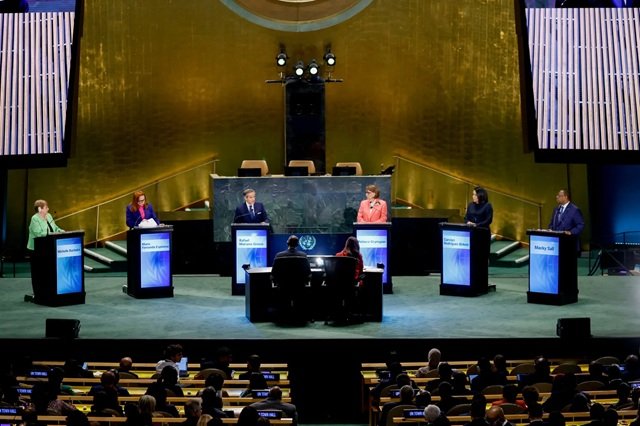
The race to lead the United Nations has moved into a critical stage after months of preliminary manoeuvring gave way to the first public debate between the six official candidates seeking to replace António Guterres when his term ends in 2027. Hosted by the UN General Assembly, the event brought together four women and two men in an effort to generate wider interest in a selection process that has so far struggled to capture public attention. As reported by El País, the debate reflected not only the absence of a clear favourite but also the broader uncertainty surrounding an organisation increasingly viewed as being on the margins of many of the world’s most consequential crises.
The timing is significant. Within days of the debate, the 15 members of the United Nations Security Council are scheduled to meet behind closed doors to begin assessing the candidates, marking the point at which the selection process enters its most consequential phase. Yet the public exchange itself offered few direct confrontations. The highly structured format required candidates to answer prepared questions individually, with little opportunity to challenge one another’s ideas or articulate competing visions for the future of the organisation.
That restrained format mirrored the careful diplomacy expected within the United Nations itself, but it also underscored the difficulties facing an institution grappling with financial constraints while struggling to maintain a central role in negotiations over major international conflicts. Throughout the debate, candidates repeatedly returned to the question of how to restore the organisation’s relevance at a time when many governments increasingly pursue diplomatic initiatives outside UN structures.
Perhaps the clearest expression of that challenge came from Costa Rica’s Rebeca Grynspan, who currently heads the United Nations Conference on Trade and Development (UNCTAD). Asked what achievement she hoped to present after five years if elected Secretary-General, she offered a concise measure of success. “Me gustaría que nadie más me preguntara dónde está la ONU. Ese será mi indicador,” she said, expressing the hope that no one would any longer ask where the United Nations was during global crises.
Although many observers have argued that the next Secretary-General should come from Latin America and the Caribbean, where five of the six declared candidates originate, the outcome remains far from certain. Nor is there any guarantee that the organisation will elect its first female Secretary-General after more than 80 years of history. El País noted that despite widespread assumptions favouring both regional rotation and gender representation, the process remains unpredictable, and the possibility of a late-emerging candidate cannot be ruled out.
That uncertainty was reinforced by reports published by the New York Post suggesting that US President Donald Trump would like FIFA President Gianni Infantino to lead the United Nations. Sources cited by El País were uncertain whether the report should be treated as a serious possibility or merely speculation, adding another unexpected dimension to an already fluid contest.
For Ecuador’s María Fernanda Espinosa, a former foreign minister and former President of the General Assembly, the debate was an opportunity to address what she described as a profound institutional challenge. “Esta institución atraviesa una crisis,” she said, arguing that rebuilding confidence within the organisation itself must become a priority. She called for restoring trust and communication with UN staff while strengthening the organisation’s capacity to facilitate dialogue, prevent conflicts and protect vulnerable populations.
Chile’s former president Michelle Bachelet also focused on the qualities she believes the next Secretary-General must possess. Facing questions about how she would respond to conflicts such as the war in Gaza, Bachelet argued that the office depends above all on moral authority. She said the Secretary-General must be prepared to speak out when international law and humanitarian law are violated while simultaneously maintaining channels of dialogue capable of bringing opposing sides together.
Drawing on her experience leading UN Women, Bachelet recalled resisting financial pressure from a donor who threatened to withdraw funding if she pursued a particular course of action. “Y lo hice, porque era lo que había que hacer,” she said. Neutrality, impartiality and independence, she argued, form part of her professional identity and remain essential if all 193 member states are to believe that the Secretary-General represents both the most powerful and the least powerful countries equally.
Carolyn Rodrigues-Birkett, Guyana’s former foreign minister, emphasised that although the Secretary-General lacks executive authority, the office retains significant diplomatic influence. She argued that neutrality, combined with the United Nations’ global presence, enables the Secretary-General to gather information, formulate proposals and place recommendations before the Security Council. Even if immediate action proves impossible, she suggested that persistent diplomacy can eventually create opportunities for agreement.
The debate also confronted questions arising from major international conflicts. Rafael Grossi, Director General of the International Atomic Energy Agency, was asked how he would respond if a permanent member of the Security Council launched a war of aggression against another UN member state, an apparent reference to the war in Ukraine. Grossi argued that effective diplomacy begins with listening and understanding the roots of conflict before seeking realistic solutions that recognise both the motivations of the aggressor and the circumstances facing the victim.
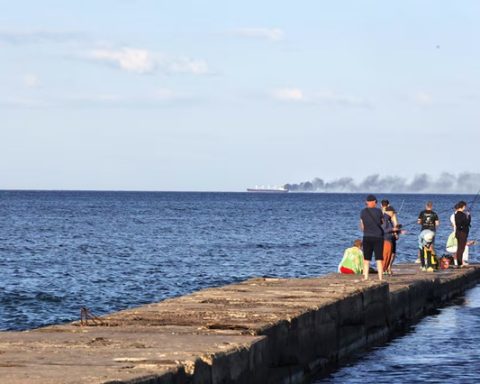
The conflict involving Iran and the disruption of shipping through the Strait of Hormuz also featured prominently. Grynspan argued that the United Nations should have engaged much earlier with all parties involved in an effort to alleviate the humanitarian and economic consequences. Referring to her previous contribution to the Black Sea grain agreement between Ukraine and Russia during 2022 and 2023, she suggested that the Secretary-General’s most important role begins precisely when the Security Council becomes deadlocked. In those moments, she argued, the office exists to create openings for dialogue that formal diplomatic channels cannot achieve.
Former Senegalese president Macky Sall expanded the discussion beyond conflict management to global economic governance. He argued that achieving lasting international stability requires reform of the global financial architecture, bringing together member states, the Bretton Woods institutions, international financial organisations, the private sector, civil society and philanthropic organisations. Such cooperation, he argued, would improve access to the conditions necessary for shared prosperity while contributing to a safer and more stable international order.
Before appearing in the public debate, all six candidates had already undergone extensive three-hour question-and-answer sessions with representatives of the United Nations’ 193 member states. Yet the decisive phase begins on 30 July, when the Security Council’s 15 members, including its five permanent members, start the voting process that will determine who advances in one of the world’s most consequential diplomatic appointments.
As El País observed, the contest has become about more than choosing António Guterres’ successor. It has evolved into a broader debate over whether the United Nations can restore its authority, rebuild confidence among member states and once again become an indispensable forum for preventing conflict, fostering dialogue and addressing the increasingly complex challenges confronting the international community.