by Durga Velayudham
For much of the Cold War, the Soviet Union’s military posture in Europe rested on a stark premise: if war came, Soviet forces would advance rapidly into Western Europe. Its armed forces, training, doctrine and military structure were shaped by the expectation of a conflict modelled on the experience of World War II—only faster, broader and more destructive.
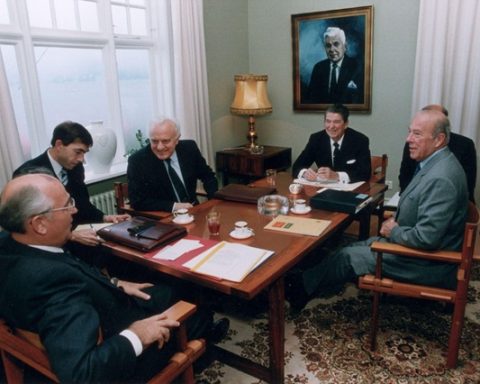
Yet near the end of the Cold War, General Secretary Mikhail Gorbachev sought to overturn that model.
Newly declassified U.S. documents and contemporaneous notes from Gorbachev’s closest advisers, published for the first time by the National Security Archive, provide an unusually detailed account of that transformation. The records show a Soviet leader confronting the contradiction between Moscow’s declarations of peaceful intentions and the military machine it had built, while facing resistance from military, industrial and intelligence institutions that had long occupied a powerful position within the Soviet state.
The change, according to the records, was not simply a reduction in military spending or a streamlining of Soviet forces. It was an attempt to alter the fundamental mission of the Soviet Armed Forces, moving from an offensive doctrine towards what Marshal Viktor Kulikov, commander of Warsaw Pact forces, described as “a strong and active defense”.
That shift was radical precisely because offensive superiority had long been central to Soviet military thinking. During the Cold War, Soviet planners anticipated that a European war would be an extrapolation of World War II. Faster advances, greater devastation and improved communications would make the conflict even more destructive. The Soviet military therefore prepared for rapid movement into Western Europe, pushing the frontlines away from the USSR’s borders.
The objective was not simply stability. According to Generals Alexander Savel’yev and Nikolai Detinov, two of the Soviet Union’s chief arms control negotiators, “winning” a war, including a nuclear one, was the objective, even as the possibility of achieving such a victory became increasingly difficult to reconcile with reality.
Gorbachev confronted that inheritance directly. Earlier Soviet leaders, including Nikita Khrushchev, had introduced measures to reduce the size of the land forces. But the records portray Gorbachev’s reforms as fundamentally different: he sought to restructure the Soviet Armed Forces around a genuinely defensive national theory of war.
The contradiction was obvious even to Gorbachev himself. During a Politburo discussion recorded by his adviser Anatoly Chernyaev, he pointed to the Soviet military presence in East Germany.
“In the GDR we have [stationed] a powerful group of armored forces, plus pontoon forces,” Gorbachev said. “When all this hangs over them, how can they believe that our doctrine is defensive?!”
The question captured the central problem facing Soviet diplomacy. Moscow could proclaim peaceful intentions, but its military posture communicated something else. The Soviet leadership could not easily persuade Western governments that its doctrine had changed while large armoured formations and other offensive capabilities remained positioned in Eastern Europe.
The problem was compounded by the legacy of Soviet strategic deception. Western governments and military establishments had spent decades treating Soviet declarations with suspicion. Even as Gorbachev pursued glasnost and perestroika, officials in Washington questioned whether military reforms represented a genuine transformation or simply a more efficient way of maintaining Soviet military power.
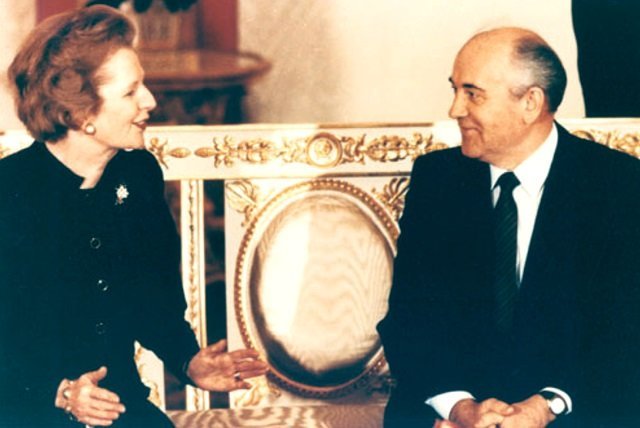
That distrust was visible in Gorbachev’s meeting with British Prime Minister Margaret Thatcher in April 1987. According to Chernyaev’s notes, Thatcher told Gorbachev bluntly: “We do not believe you. We are afraid of you.”
Gorbachev regarded Thatcher as “hardened, convinced, and cluttered with stereotypes”, but the meeting also demonstrated to him that European fear of the Soviet Union was widespread. At a subsequent Politburo discussion, he acknowledged that “This perception is widespread among the public there. It persists in the minds of many people.”
The reforms also created a struggle inside the Soviet system. A 1988 U.S. State Department Bureau of Intelligence and Research report described Gorbachev’s desire for reform as genuine and the military’s resistance as equally real. Glasnost exposed long-standing practices within the armed forces, including extreme hazing, while giving greater prominence to Afghan war veterans. Gorbachev also sought to reduce bureaucratic privileges enjoyed by the military.
The confrontation extended to the Warsaw Pact. Kulikov continued advocating measures associated with the old militarised approach, including expanding chemical combat troops and air assault forces, increasing fuel and ammunition stockpiles and improving military airfields.
The response from Gorbachev’s political allies was blunt. They questioned whether it made sense for Warsaw Pact states to continue increasing military expenditure at the expense of their economies.
The Mathias Rust incident further exposed tensions between Gorbachev and the military establishment. A light civilian aircraft penetrated heavily defended Soviet airspace and landed next to Red Square. The incident gave Gorbachev an opportunity to remove several senior officers and replace them with individuals more aligned with his approach.
Chernyaev captured the political message in his diary: “Let everyone know,” he wrote, “where our power is… in the political leadership, in the Politburo.” Those who feared that the military might eventually displace Gorbachev, he added, “will have to quiet down”.
Washington nevertheless remained unconvinced. A November 1988 CIA assessment, issued shortly before Gorbachev announced massive unilateral force reductions, interpreted Soviet initiatives largely as a diplomatic effort to reduce Western perceptions of the Soviet threat. It concluded that the changes were “intended primarily to make [Soviet] units more effective for prolonged conventional combat operations against NATO.”
The assessment proved too cautious. Gorbachev soon announced reductions far more sweeping than the intelligence community had anticipated.
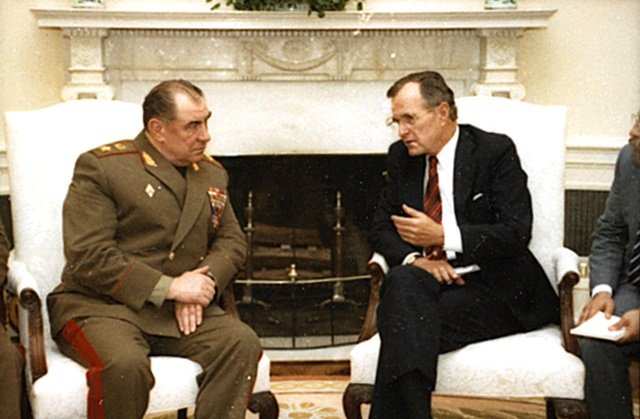
By October 1989, Soviet Defence Minister Dmitri Yazov was in the United States explaining the transformation directly to American military officials. At the National Defense University, he described the changes as a fundamental transition from attack to defence. He argued that Soviet withdrawals from Eastern Europe and changes to the structure of Soviet forces demonstrated that the reforms were genuine.
“The proof of the pudding is in the eating,” Yazov said, invoking a British phrase he had recently learned.
The encounters were extraordinary by the standards of the Cold War. Yazov and U.S. Secretary of Defense Dick Cheney held an unprecedented discussion in which the two sides “compare notes” on military strategy, budgets and defence industries. Soviet and American commanders who had spent their professional careers studying one another as potential enemies now sat together at the negotiating table.
Colin Powell, newly appointed Chairman of the Joint Chiefs of Staff, told General Achalov that they had been “neighbors some time ago” in Germany. Their forces had once been separated by just 115km. Powell had a picture of Achalov on his wall; Yazov had a picture of Powell, that “good-looking chap,” on his.
The transformation was still contested, and not all American assessments immediately recognised its full significance. A U.S. congressional delegation visiting the Soviet Union in 1989 acknowledged that Gorbachev’s actions would reduce the offensive capability of Soviet forces in Eastern Europe by about 30 percent. Yet some American experts remained sceptical about the extent to which the reforms reduced the Soviet ability to wage offensive war.
The disagreement partly reflected differences in how military power was measured. U.S. assessments often assigned numerical military value to individual pieces of equipment. But the removal of tanks, air assault forces and assault bridging elements had a significance for Soviet military planning that such calculations did not always capture.
The newly released records therefore document more than a series of arms-control initiatives. They reveal a struggle over the purpose of Soviet military power itself. Gorbachev was attempting to reconcile the Soviet Union’s political objective of preventing war with armed forces whose structure and doctrine had been built around preparing to fight one.
His challenge was not only to persuade Washington and its allies. He also had to persuade his own military establishment—and, ultimately, confront decades of assumptions about how security was achieved.
By 1989, Soviet officials were no longer merely declaring that their intentions were peaceful. They were attempting to demonstrate it through troop withdrawals, force reductions and structural changes to the armed forces.
The records show why that distinction mattered. After decades in which Soviet military strength had been measured largely through the capacity to attack, Gorbachev was attempting something far more consequential: to make the military posture of the Soviet Union correspond with its stated political objective of preventing war.
The transformation did not erase the distrust created by the Cold War. But the documents reveal the scale of the attempt—and why convincing the outside world that the change was genuine proved almost as difficult as imposing it within the Soviet system.