


Editorial
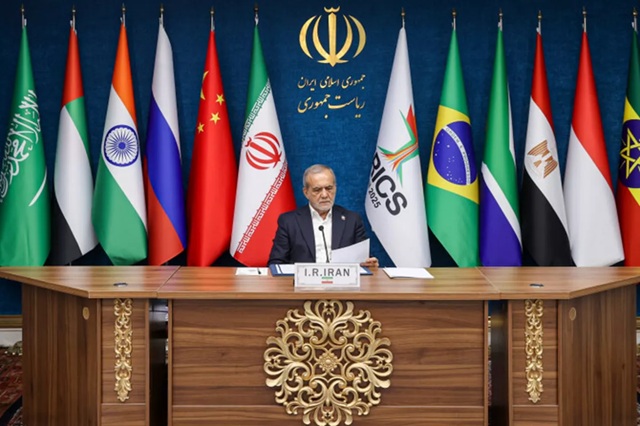
Where were the BRICS countries when one of their permanent members was struck and its head of state was decapitated? Not issuing warnings. Not convening emergency sessions. Not even speaking in a single coherent voice. They have perfected the art of doing nothing while pretending that silence is sophistication.
This year, the presidency of the bloc rests with India, a nation that frequently speaks of civilisational confidence and the rights of the Global South. Yet, only hours before the assault on Iran, its leadership was in Israel, reportedly concluding multi-billion-dollar defence deals ranging from sophisticated surveillance systems to missile defences. Every sovereign state is entitled to pursue its interests. That is not the issue. The issue is the dissonance between grand declarations of collective purpose and the complete absence of collective action when a member state faces outright military aggression.
Iran’s senior leadership was eliminated in a coordinated strike. Retaliation followed with predictable ferocity. Streets across parts of Asia and the Middle East erupted with protest and outrage. This was a moment that demanded clarity, urgency, and solidarity—an acid test of whether BRICS was an organisation with teeth or merely ceremonial. It failed. Hesitation replaced action. Bloodless phrases and endless procedural delays replaced courage.
This is not an isolated lapse. It is a pattern. When Syria was reduced to rubble, BRICS interpreted the devastation as counter-terrorism and looked away. When Venezuela faced sustained external pressure, the bloc again offered careful neutrality that protected nobody and satisfied no one. When Cuba struggled under sanctions, relief packages were absent, replaced by the usual bland statements. Each crisis was someone else’s problem, safely compartmentalised to avoid discomfort. Now the same pattern repeats, this time involving a permanent member.
BRICS likes to speak of multipolarity as though repeating the word will make it real. Multipolarity is not a slogan. It demands coordination, risk, and, above all, the courage to stand up to powerful actors. What exists instead is a gathering of states deeply reluctant to inconvenience themselves for one another. Photographs, summits, and development rhetoric replace any meaningful obligation.
“Strategic autonomy” has become the favourite excuse. The phrase sounds dignified, but in practice it means avoiding difficult positions altogether. Autonomy has been confused with detachment. Independence has been reduced to watching events unfold while issuing statements designed to offend no one. This is not strategy. This is evasion.
The expansion of BRICS was touted as the dawn of a more assertive Global South. More members, more weight, more influence. Instead, enlargement has produced a looser, anxious formation in which internal contradictions outweigh any shared purpose. Economic cooperation continues because it is safe; political coherence collapses because it demands courage.
India’s chairmanship should have been an opportunity to demonstrate that the bloc could be more than an annual talking shop. Leadership requires clarity. It requires the willingness to declare an action unacceptable, even when such candour complicates bilateral relationships. Without that, the presidency becomes administrative rather than political, a matter of scheduling meetings rather than shaping outcomes.
What does this silence communicate? That BRICS membership offers symbolism, not support. That the bloc is comfortable invoking sovereignty in speeches yet incapable of defending it in practice. That each member ultimately stands alone, free to trade with others but unable to rely on them.
Some defenders insist BRICS was never intended to be a security alliance. That defence is technically correct and morally hollow. Once an organisation claims to represent an alternative centre of global influence, it cannot retreat behind technicalities whenever events turn severe. Influence is measured by response, not intention.
There is also a long-term cost to this passivity. By declining to articulate a shared position in crises, BRICS weakens its negotiating power in every other arena. Why should the world treat it as consequential if it cannot act collectively at decisive moments? Economic statistics alone do not create geopolitical stature. Conduct does.
The uncomfortable truth is that BRICS today functions less as a coalition and more as a convenience. Members cooperate where profitable and scatter when principle is required. That may preserve the structure, but it empties it of meaning. An organisation that cannot defend its own relevance will eventually be ignored.
The present crisis is not only about Iran, nor about the West, nor about any single strike or retaliation. It is about whether BRICS can ever be more than an acronym with aspirations. If it continues to respond to moments of consequence with cautious murmurs, it will confirm the harshest judgement forming in diplomatic circles: this much-advertised alternative is not a pole of power, but a hesitant assembly afraid of casting a shadow.
If BRICS remains in this deep slumber, it should never awaken. It should continue to ignore the suffering of its members, sleep through the collapse of states, and offer nothing but empty phrases while the world burns around it. It has become a grotesque theatre, a laughing stock of international relations, performing pageants of solidarity with the precision of a factory—yet producing nothing but mockery and spectacle. . Let it sleep. Let it perform. Let the world see it for what it is: an institution that applauds itself for activity while remaining utterly incapable of action when it matters most.










