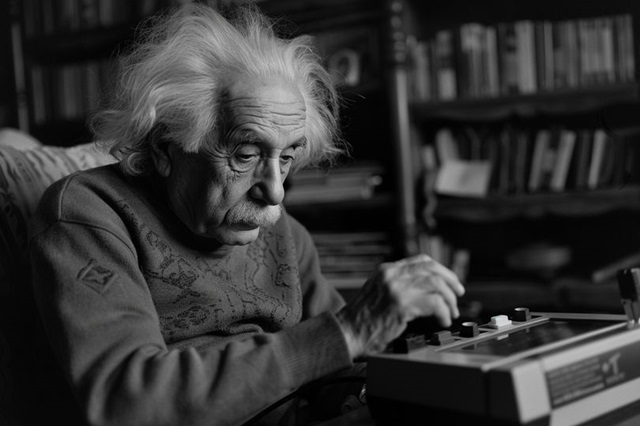
In an extraordinary and haunting account, author Thomas Harding delves into a chilling chapter of history: Adolf Hitler’s vendetta against Albert Einstein. This was no mere political disagreement or ideological clash; it was a targeted, personal campaign that escalated into violence, terror, and tragedy—reaching even into the sanctity of Einstein’s own family.
By 1933, Albert Einstein had already ascended to global fame. A Nobel laureate and the architect of the theory of relativity, his name had become synonymous with genius. But as Hitler rose to power in Germany, Einstein’s prominence—and more importantly, his Jewish heritage and outspoken criticism of the Nazi regime—placed him directly in the Fuhrer’s crosshairs. That same year, Nazi propagandists published Juden sehen Dich an (“Jews Are Watching You”), a booklet sanctioned by Josef Goebbels. In it were biographies of prominent German Jews, including Einstein. Under each name: the chilling word Ungehängt, or “Not yet hanged.”
It was no idle threat. The philosopher Theodor Lessing, another figure featured in the booklet, was assassinated just months later in Czechoslovakia—one of the first Nazi murders committed beyond German borders. Einstein, learning of his own place on a Nazi hit list, fled Germany. British and American newspapers reported that a bounty of £1,000 had been placed on his head—more than £400,000 in today’s money. The scientist briefly took refuge in East Anglia, England, before settling permanently in Princeton, New Jersey, with his wife Elsa. Though Einstein was physically beyond Hitler’s reach, the war against him was far from over.
This vendetta was not merely symbolic. The Nazis sought tangible revenge against Einstein for his open defiance, his contributions to the U.S. war effort, and his role as a global symbol of scientific intellect and Jewish perseverance. As Harding notes, this was a brutal expression of Sippenhaft, the old German principle of kin liability—punishing relatives for the “crimes” of family members. The repercussions would soon be felt across Europe.
Einstein’s direct family had mostly escaped Nazi territory. His sons, sister, and first wife were safely in the U.S. and Switzerland. But one beloved relative remained in danger: Robert Einstein, his first cousin. The two had grown up together like brothers in Munich, their fathers once business partners. Robert had remained in Italy, living peacefully with his wife and daughters on a Tuscan estate.
But in August 1944, Nazi officers arrived at Robert Einstein’s villa outside Florence. He was not home, and so they exacted their revenge in his absence. His wife, Nina, and their two daughters, Luce and Cici, were executed by German soldiers. Robert returned to find his family murdered. It was a massacre borne not from military necessity but from personal vengeance, a grotesque message from Hitler’s regime that no enemy—no matter how distant—would be left unpunished.
Albert Einstein received the news a few weeks later. There is no surviving record of his reaction, but his sister Maja, who lived with him in Princeton, recalled feeling “broken” and plagued by nightmares after the letter arrived. The enormity of the loss—the transformation of political animosity into personal annihilation—was staggering.
This story, recounted in Harding’s recent book The Einstein Vendetta, is more than a grim historical episode. It is a warning. It underscores how authoritarianism thrives not just on control of institutions, but on the erosion of moral boundaries. Harding draws disturbing parallels to today’s political landscape—where scientific experts are targeted, dissent is punished, and regimes around the world silence opposition with increasing boldness. From the poisoning of Russian dissidents to the murder of journalists, from attacks on academic freedom to the rise of conspiratorial politics in the U.S., the pattern is unmistakable.
In these modern cases, the vendettas may not always wear uniforms or carry rifles, but the intent is similar: to eliminate threats through intimidation, violence, or erasure. Harding reminds us that this darkness is not just history—it is a present danger. And the fate of the Einstein family stands as an eternal testament to the consequences of unchecked power and ideological vengeance.
The Independent UK piece is a poignant exploration of how quickly rational debate can give way to brutal retribution—and how even the most brilliant minds are not immune to the reach of tyranny. Einstein’s name, so often associated with equations and theories, carries another legacy: a searing lesson about the human cost of authoritarian hate.