by a Special Political Commentator in Colombo
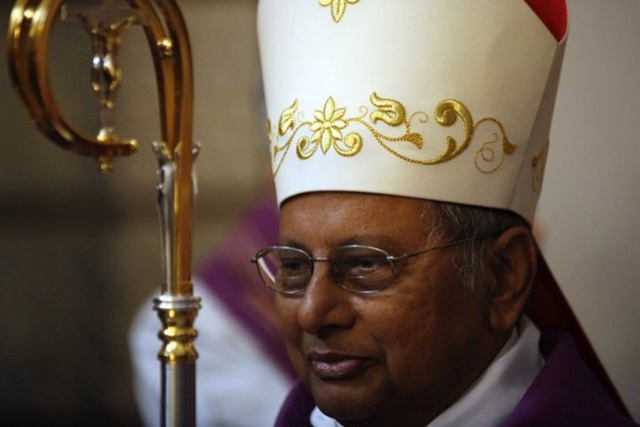
Ah, if George Orwell were to rise from the dead and see what’s happening in Sri Lanka today, he’d surely scratch his head in disbelief. A man of the cloth is a political puppeteer, tugging at the strings of national sentiment. A man of the cloth is a political puppeteer, pulling the strings of national sentiment. I speak, of course, of Cardinal Malcolm Ranjith—our very own Pontiff of Paradoxes, the man who will preach unity from the pulpit while building castles of disunity on the political battlefield. A man so obsessed with finding “the mastermind” behind the Easter Sunday attacks that it’s beginning to feel like he’s the one masterminding the whole circus.

Let’s begin with the “mysterious mastermind” of the Easter Sunday bombings. While the FBI meticulously investigated over 700 devices and concluded that it was IS-inspired extremists behind the attacks, Ranjith remains fixated on his own theory. It’s as if he’s auditioning for a role in a biblical thriller—complete with a shadowy villain whose face we never quite see. But here’s the thing: unlike the burning bush that spoke to Moses, Ranjith’s “mastermind” is more like a burning desire to keep the national tragedy in his personal political spotlight. Perhaps he thinks if he says “mastermind” enough times, the ghost of someone to blame will finally appear. A bit like the way Jesus kept asking, “Who do men say I am?” only to get answers that weren’t exactly… accurate.
But Ranjith, in his holy quest, isn’t content with mere spiritual warfare. Oh no. He’s decided to delve into politics, where the real money and power are. His sermons about sovereignty were once as fiery as a bush on Mount Sinai. He warned us that a land bridge between Sri Lanka and Tamil Nadu would turn Sri Lanka into a part of India. “Do not be deceived, my children,” he proclaimed, sounding like the modern-day prophet who saw invaders in every wave of the Palk Strait. In his mind, the only thing scarier than IS terrorists was the possibility of Sri Lanka being too connected to India. His warning echoed through the land like the parable of the Good Samaritan, only with a sinister twist. The Samaritan here, it seems, was India—and Ranjith wasn’t buying it.
However, just when you think Ranjith might be the biblical hero Sri Lanka needs, he flips the script. The new government, which he helped usher into power, begins signing MoUs with India. MoUs that are more extensive than anything the previous government could have dreamed of. But Ranjith’s lips are sealed tighter than the tomb of Lazarus. No fiery sermons, no divine warnings. Just crickets. And the nation? Well, it’s still waiting for his next “revelation.”
It’s almost as if Ranjith’s concept of sovereignty is as fluid as the parting of the Red Sea. One minute, Sri Lanka is in mortal danger of losing its independence to a land bridge, and the next, it’s all about signing defence agreements, energy deals, and medical collaborations with India. Perhaps it’s Ranjith’s way of invoking the old biblical principle: “Thou shalt have double standards.” After all, who needs consistency when you’ve got political convenience?
His sudden silence on the matter of India, after so much fire and brimstone, is nothing short of divine comedy. One might wonder if Ranjith was simply waiting for his own version of the “burning bush” to appear—something that would tell him it was okay to be a hypocrite. And lo, it seems, he found it in the form of a government he now supports. How else to explain the sudden transformation from “the bridge is an invasion!” to “well, actually, let’s sign some deals”?
Perhaps there’s a deeper biblical lesson here: “Do not lay up for yourselves treasures upon the earth,” said Jesus, warning against the perils of earthly gain. Ranjith, on the other hand, has clearly laid up some political treasures—and now he’s reaping them. The cardinal, who once decried foreign interference, now happily entertains it, as long as the coins of power keep coming. It’s like Jesus flipping the tables in the temple—except, in Ranjith’s case, the money changers have become his best friends.
But it’s not just the politics that make this situation a farce. Ranjith’s silence on the church’s funds from the aftermath of the Easter Sunday tragedy is the stuff of biblical parables. In one of Jesus’s most famous stories, the widow gives all she has, a tiny coin, while the rich give from their abundance. But here we have a Cardinal, blessed with what can only be described as a treasure chest of donations, yet we’ve heard precious little about what happened to the funds. The right hand does what it pleases, while the left hand—well, it knows nothing. Perhaps this is Ranjith’s take on “Let not thy left hand know what thy right hand doeth”—especially when it comes to pocketing large sums and avoiding accountability.
So, here we are: the great double-cross of the century. Cardinal Malcolm Ranjith, once the fiery advocate for Sri Lanka’s sovereignty, now plays the role of a political chameleon. His convictions change like the winds of the Palk Strait. One day, it’s all about protecting Sri Lanka from foreign influence, and the next, he’s silent while the country signs deals that deepen foreign entanglement. It’s almost as if he’s waiting for a divine sign to tell him which side of history he’s on. If only he had a clearer view of the political landscape—or, better yet, if only he could pull a few more parables out of his hat.
In the end, perhaps the most biblical lesson Ranjith teaches us is that power, like a fickle breeze, blows in whichever direction suits the wielder. Whether it’s sovereignty, church funds, or political alliances, the only consistency is Ranjith’s uncanny ability to navigate the shifting tides of Sri Lankan politics. Who needs a burning bush when you’ve got a Cardinal who can perform the miracle of doublespeak? Maybe next, we’ll see him part the Palk Strait itself—if it serves his interests.