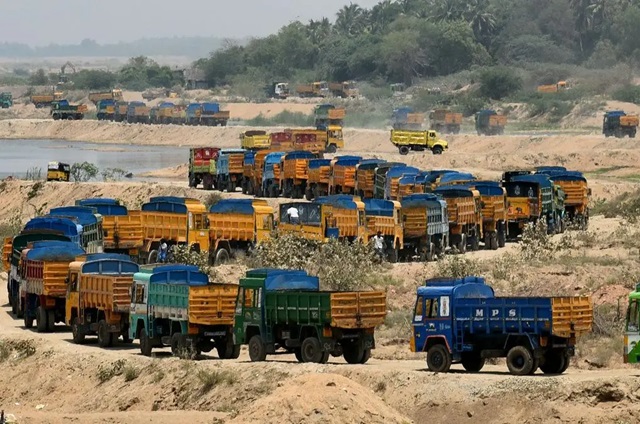
Tamil Nadu is facing an environmental and socio-economic crisis driven by the unchecked growth of illegal stone quarries, according to a detailed investigation published by Front Line India. These quarries—numbering around 5,000 both legal and illegal—have proliferated since 2018, when restrictions on river sand mining led to a surge in demand for quarry-derived M-sand and P-sand for construction.
While these materials have become a cornerstone of the building industry, the cost has been staggering. As Front Line India reports, the expansion of quarrying has poisoned water sources, damaged farmlands, destabilized wildlife habitats, and endangered human lives.
Environmental Devastation
Explosive blasts used in quarry operations routinely violate the Explosives Acts, generating toxic sulphur fumes and strong tremors felt up to two kilometres away. Residents living nearby report daily exposure to dust clouds and constant noise. According to environmental regulations, quarries are required to create green belts, spray water to control dust, and limit operating hours—all rules that are regularly ignored.
In agricultural communities, the consequences are severe. Dust covers crops and clogs wells, leading to poor pollination, failed harvests, and dying livestock. In regions like Radhapuram Taluk and Edappalayam village, blasts have caused deadly accidents—collapsing homes and killing residents.
Public Health and Wildlife at Risk
Inhalation of quarry dust has been linked to respiratory issues such as asthma, sinusitis, and lung infections. Toxic runoff from quarries contaminates local water sources, further exacerbating health risks. This polluted water often finds its way into M-sand production, compromising the integrity of construction materials.
Wildlife, too, is suffering. Loud explosions and habitat destruction have driven birds and small animals out of the region. Reptile populations are under threat, and ecological balance in the Western Ghats is being disturbed. The Indian Space Research Organisation (ISRO) has identified 147 landslide-prone zones across India, six of which are in Tamil Nadu—highlighting the environmental dangers of deep, unregulated quarrying.
Abandoned Quarries Turned Dumping Grounds
Governmental contradictions add to the confusion. While mining regulations recommend repurposing disused quarries as reservoirs, a State Government Order (GO 23/2022) allows them to be used for solid waste landfills. The result, as seen in places like Kaalampalayam in Tiruppur, is indiscriminate dumping of municipal and medical waste—often from other states or even countries—with no oversight. The nearby groundwater is now heavily contaminated.
Abandoned quarries also pose physical hazards. With no fencing or safeguards, over 400 people and hundreds of animals have died from accidental falls in the past four years.
Social Fragmentation and Calls for Reform
Beyond the environmental and health impacts, illegal quarrying has torn at the social fabric of many villages. Quarry operators often exploit caste divisions and sponsor local festivals to maintain influence and suppress opposition. In areas like Denkanikottai in Krishnagiri district, women and children have staged protests against the dust and disruption caused by quarry-related transport vehicles.
In the face of this destruction, experts argue that the Tamil Nadu government must look beyond M-sand. Importing river sand—currently available from several international markets—could provide a more sustainable solution. As Front Line India emphasizes, the costs of inaction are far greater than the price of environmentally responsible alternatives.