The International Monetary Fund (IMF) has raised its forecast for global economic growth in 2026 to 3.1%, an increase of 0.1 percentage point from its July projection, as investment linked to artificial intelligence helps offset the economic damage caused by the conflict in the Middle East.
In its latest World Economic Outlook, titled “Resilience Under Strain, Urgent Choices”, published on Tuesday, the IMF projected global growth slowing from 3.5% in 2025 to 3.1% this year before recovering to 3.4% in 2027. The 2027 forecast remains unchanged from July and is 0.2 percentage points higher than the projection made in April.
The improved headline forecast masks increasingly uneven growth across countries. The IMF said just 32 economies now account for 95% of global economic growth, compared with 54 in April, while forecasts for about 47% of economies have been downgraded.
The Fund described an economy in which growth is being redistributed according to countries’ exposure to the war-related energy shock and their links to demand for artificial intelligence technologies. Economies with limited energy vulnerabilities and strong connections to the AI hardware supply chain are performing best, while countries dependent on imported energy and less integrated into the technology boom face higher import costs, weaker currencies and declining real incomes.
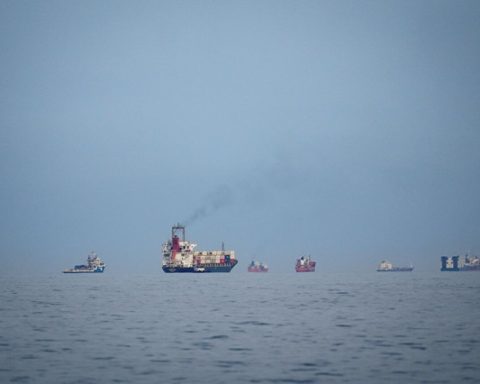
The outlook depends heavily on the duration of disruptions to energy supplies. The IMF’s baseline scenario assumes the Strait of Hormuz will reopen in March 2027, with conditions broadly returning to pre-war levels by October that year. Before the conflict, the strait carried about a quarter of the world’s seaborne oil trade.
The Fund estimated that a closure of the waterway would have reduced global growth by 0.9 percentage points this year if there had been no compensating supply responses. Rerouting Gulf oil shipments, increasing production elsewhere, drawing on inventories and reducing the global economy’s dependence on oil helped limit the estimated net impact to 0.3 percentage points.
Nevertheless, the disruption has sharply weakened the outlook for several major energy-producing economies. Saudi Arabia’s 2026 forecast was cut by five percentage points from July, with the IMF now projecting a contraction of 3.3%. Bahrain, Iraq, Kuwait and Qatar, whose energy production and transport have been heavily affected, are expected to record double-digit economic contractions this year.
The IMF also warned that declining oil inventories could reach critically low levels, increasing the risk of sudden price increases. Its projections assume that oil prices will average US$95.74 a barrel in 2026, about 41% higher than in 2025, before easing to US$87.39 in 2027.
Higher energy costs are expected to push inflation upwards. Global headline inflation is forecast to rise from 4.1% in 2025 to 4.7% in 2026 before falling back to 4.1% in 2027. Compared with its April projections, the IMF raised its inflation forecasts by 0.3 percentage points for 2026 and 0.4 percentage points for 2027.
Core inflation is expected to remain above the 2% level until the end of 2027 in Japan and Britain, and until mid-2028 in the euro area and the United States.
Among major economies, US growth is projected at 2.3% in both 2026 and 2027, supported by consumer spending, fiscal policy and technology investment. The euro area is expected to grow by 1.1% this year and 1.2% next year, constrained by high energy prices and weak consumer confidence.
India is forecast to expand by 7% in both years, while Japan’s economy is projected to grow by 0.7% in 2026. Britain’s growth forecast for this year stands at 1.3%.